The sample copy of this report is available for access.
The LAMEA Edge-to-Cloud Continuum Infrastructure Market is expected to reach USD 13.3 billion by 2029, growing at a CAGR of 16.4% during (2026 - 2033).
The LAMEA Edge-to-Cloud Continuum Infrastructure Market originated from the need to bridge centralized cloud data centers with localized edge environments across Latin America, the Middle East, and Africa. Enterprises initially depended on distant cloud infrastructure, which created latency, bandwidth, and data-sovereignty challenges. Over time, advances in IoT, 5G, real-time analytics, containerization, microservices, and AI-driven orchestration enabled hybrid deployments that connect on-premises edge resources with regional cloud platforms.
Current market development is shaped by 5G connectivity, localized data processing, regulatory compliance, and AI at the edge. Edge sites are increasingly handling time-sensitive workloads, while cloud platforms provide broader scalability, analytics, and management. Growing use of micro data centers, localized cloud zones, specialized hardware accelerators, edge-native AI platforms, and modular infrastructure is making flexibility, regulatory alignment, and intelligent processing key differentiators across LAMEA.
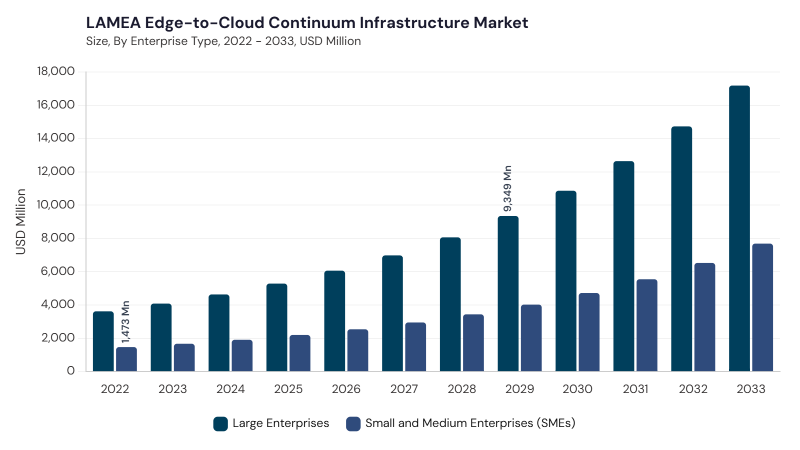
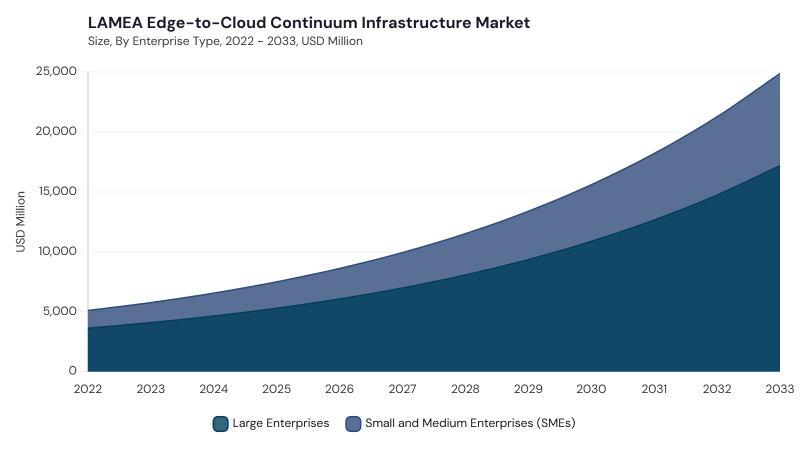
Based on Enterprise Type, the market is segmented into Large Enterprises and Small and Medium Enterprises (SMEs). The Large Enterprises market dominated the LAMEA Edge-to-Cloud Continuum Infrastructure Market by Enterprise Type in 2025, and would continue to be a dominant market till 2033; thereby, achieving a market value of USD 9.3 billion by 2029, growing at a CAGR of 16 % during the forecast period. Additionally, The Small and Medium Enterprises (SMEs) market is expected to witness highest CAGR of 17.1% during (2026 - 2033).
Large Enterprises are connecting local processing resources with centralized cloud platforms to support banking, telecommunications, energy, industrial operations, latency-sensitive applications, real-time analytics, data sovereignty, and operational continuity. Small and Medium Enterprises (SMEs) maintain a promising presence due to cloud-based infrastructure consumption, managed technology services, modular edge solutions, and lower upfront investment requirements. SMEs are adopting edge-to-cloud connectivity to optimize supply chain management, improve customer experience, support local data processing, and introduce advanced computing capabilities gradually as digital requirements evolve.
Based on Offering, the market is segmented into Hardware, Software, and Services. The Hardware market dominated the LAMEA Edge-to-Cloud Continuum Infrastructure Market by Offering in 2025, and would continue to be a dominant market till 2033; thereby, achieving a market value of USD 6.4 billion by 2029, growing at a CAGR of 15.9 % during the forecast period. The Software market is expected to witness a CAGR of 16.7% during (2026 - 2033).
Hardware provides the physical foundation through edge servers, gateways, networking equipment, storage devices, ruggedized systems, compact computing equipment, and energy-efficient infrastructure suited to diverse operating environments. Software is gaining strong relevance through centralized monitoring, workload portability, cybersecurity, virtualization, cloud-native technologies, AI frameworks, orchestration tools, and network management solutions. Services maintain a promising role through consulting, system integration, managed services, implementation support, infrastructure optimization, technical support, compliance guidance, and outsourced management for organizations modernizing legacy systems and integrating cloud-edge environments.
Based on Infrastructure, the market is segmented into Telecom Network Infrastructure, Business Site Infrastructure, Regional Edge Data Centers, Public Cloud Infrastructure, and Other Infrastructure. Telecom Network Infrastructure supports cellular towers, base stations, network edge routers, 5G-enabled technologies, network function virtualization, software-defined networking, and low-latency communications. Business Site Infrastructure enables on-premises computing across oil and gas facilities, mines, retail locations, financial branches, industrial plants, factories, healthcare facilities, and corporate campuses.
Regional Edge Data Centers provide intermediate compute and storage capacity near population and commercial hubs, while Public Cloud Infrastructure supports scalable applications, analytics, storage, disaster recovery, AI, and machine learning services. Other Infrastructure includes GPU-accelerated nodes, edge orchestration platforms, private cloud setups, satellite links, private wireless networks, energy infrastructure, and specialized deployments for remote, industrial, and sector-specific operating conditions.
Based on End-user, the market is segmented into IT and Telecommunication, Manufacturing, BFSI, Retail and E-commerce, Healthcare and Life Sciences, Government and Defense, Transportation and Logistics, and Other End-user. IT and Telecommunication uses continuum infrastructure for network function virtualization, edge data centers, cloud-native platforms, 5G, IoT connectivity, smart cities, and mobile broadband expansion. Manufacturing applies it for industrial automation, equipment monitoring, smart factories, predictive maintenance, supply chain management, digital twins, and Industry 4.0 initiatives. BFSI uses it for transaction processing, fraud detection, customer experience, branch modernization, electronic payments, data sovereignty, and regulatory reporting.
Retail and E-commerce relies on edge-to-cloud systems for online commerce, digitally enabled stores, inventory visibility, point-of-sale processing, personalized promotions, and demand forecasting. Healthcare and Life Sciences adopts it for patient monitoring, medical imaging analysis, telemedicine, connected diagnostic systems, and electronic information management. Government and Defense uses it for digital public services, smart infrastructure, surveillance, intelligence analysis, emergency response, and secure mission-critical processing. Transportation and Logistics applies it for port modernization, freight tracking, connected transportation assets, warehouse digitalization, route optimization, and supply-chain visibility, while Other End-user includes energy, utilities, education, media, agriculture, and other sectors using distributed computing for specialized digital needs.
Free Valuable Insights: Edge-to-Cloud Continuum Infrastructure Market Size Worth USD 296.5 Billion billion by 2033
Based on Country, the market is segmented into Brazil, Argentina, UAE, Saudi Arabia, South Africa, Nigeria, and Rest of LAMEA. The Brazil market dominated the LAMEA Edge-to-Cloud Continuum Infrastructure Market by Country in 2025, and would continue to be a dominant market till 2033; thereby, achieving a market value of USD 3.6 billion by 2029, growing at a CAGR of 15.1 % during the forecast period. The Argentina market is expected to witness a CAGR of 17.1% during (2026 - 2033). Additionally, The UAE market is expected to witness a CAGR of 15.3% during (2026 - 2033).
Brazil is supported by 5G and 6G readiness, localized data processing, AI at the edge, data governance, and regional edge hubs, while Argentina is shaped by AI at the edge, cybersecurity, localized infrastructure, and hybrid cloud solutions. The UAE reflects AI integration, multi-cloud strategies, 5G and 6G readiness, regional edge data centers, and compliance-focused infrastructure, whereas Saudi Arabia is driven by AI-led transformation, data center investments, network slicing, IoT, smart cities, and data sovereignty. South Africa is advancing through local cloud and edge investments, AI-driven analytics, distributed security, and localized data centers; Nigeria is supported by cybersecurity, hybrid cloud adoption, improved connectivity, 5G readiness, and localized edge deployments; and Rest of LAMEA is shaped by edge AI, data sovereignty, MEC with 5G rollout, hybrid orchestration, and localized infrastructure expansion.

By Enterprise Type
By Offering
By Infrastructure
By End-user
By Country
Set to reach $13.3 Billion by 2029, growing at 16.4% CAGR during 2026-2033.
Brazil dominates, achieving $3.6 billion by 2029, growing at 15.1% CAGR during 2026-2033.
Rising enterprise cloud adoption and AI-driven workloads are the main catalysts.
Large Enterprises to reach $9.3 billion by 2029, growing at 16% CAGR during 2026-2033.
The UAE market is expected to witness a 15.3% CAGR during 2026-2033.
Hardware to reach $6.4 billion by 2029, growing at 15.9% CAGR during 2026-2033.
Our team of dedicated experts can provide you with attractive expansion opportunities for your business.




 Unique Offerings
