The sample copy of this report is available for access.
The Europe Edge-to-Cloud Continuum Infrastructure Market is expected to reach USD 56.5 billion by 2031, growing at a CAGR of 13.9% during (2026 - 2033).
The Europe Edge-to-Cloud Continuum Infrastructure Market originated from the convergence of distributed computing and the growing need for real-time processing closer to data sources. Edge computing initially developed through isolated deployments for latency reduction, while cloud services provided centralized scalability, analytics, and storage. Over time, 5G networks, IoT proliferation, interoperability initiatives, and strategic European technology-sovereignty efforts enabled the transition toward an integrated continuum architecture connecting intelligent edge nodes with mature cloud infrastructure.
Current market development is shaped by digital sovereignty, federated edge models, AI-enabled orchestration, and secure distributed processing. European organizations are prioritizing infrastructure that supports data locality, privacy compliance, distributed intelligence, and workload flexibility across edge and cloud environments. The emergence of Edge as a Service, mesh-based edge systems, AI automation, secure enclaves, network slicing, and interoperable platforms is shifting the market toward sovereign, intelligent, and compliance-ready infrastructure ecosystems.
Based on Enterprise Type, the market is segmented into Large Enterprises and Small and Medium Enterprises (SMEs). The Large Enterprises market dominated the Europe Edge-to-Cloud Continuum Infrastructure Market by Enterprise Type in 2025, and would continue to be a dominant market till 2033; thereby, achieving a market value of USD 38.9 billion by 2031, growing at a CAGR of 13.6 % during the forecast period. Additionally, The Small and Medium Enterprises (SMEs) market is expected to witness highest CAGR of 14.6% during (2026 - 2033).
Large Enterprises are connecting enterprise data centers, branch locations, edge resources, and cloud environments to support AI applications, operational resilience, controlled data movement, hybrid workloads, and regulatory compliance across distributed digital ecosystems. Small and Medium Enterprises (SMEs) maintain a promising presence as subscription-based infrastructure, managed computing platforms, pay-as-you-go models, and simplified edge deployment models reduce upfront investment and technical barriers. SMEs are adopting edge-to-cloud infrastructure for retail, healthcare clinics, specialized manufacturing, local services, IoT monitoring, customer experience improvement, and data-driven decision-making.
Based on Offering, the market is segmented into Hardware, Software, and Services. The Hardware market dominated the Europe Edge-to-Cloud Continuum Infrastructure Market by Offering in 2025, and would continue to be a dominant market till 2033; thereby, achieving a market value of USD 26.7 billion by 2031, growing at a CAGR of 13.5 % during the forecast period. The Software market is expected to witness a CAGR of 14.3% during (2026 - 2033).
Hardware forms the physical foundation of edge-to-cloud infrastructure through edge servers, networking equipment, IoT devices, sensors, data center components, and ruggedized equipment used in industrial, smart city, automotive, energy, and latency-sensitive environments. Software is gaining strong relevance through operating systems, middleware, orchestration tools, analytics platforms, containerization, Kubernetes-based management, cloud-native frameworks, security policy enforcement, and federated data governance. Services maintain a promising role through consulting, integration, managed services, infrastructure lifecycle management, migration expertise, operational support, security guidance, compliance alignment, and AI-enabled automation.
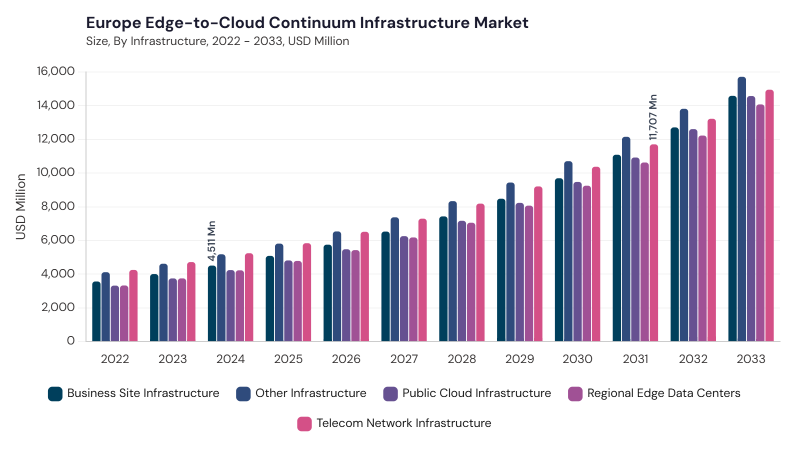
Based on Infrastructure, the market is segmented into Telecom Network Infrastructure, Business Site Infrastructure, Regional Edge Data Centers, Public Cloud Infrastructure, and Other Infrastructure. Telecom Network Infrastructure supports 5G, fiber optic backhaul, base stations, network function virtualization, Multi-access Edge Computing, private connectivity, latency-sensitive services, and cloud-edge synchronization. Business Site Infrastructure enables on-premises computing at factories, retail outlets, healthcare facilities, offices, energy sites, and corporate campuses where immediate decision-making, data control, and operational reliability are required.
Regional Edge Data Centers provide intermediary compute capacity near metropolitan and industrial clusters, while Public Cloud Infrastructure supports centralized application management, analytics, scalable computing, and storage. Other Infrastructure includes specialized private environments, orchestration platforms, security frameworks, software-defined networking, AI model management tools, distributed storage, and sector-oriented configurations.
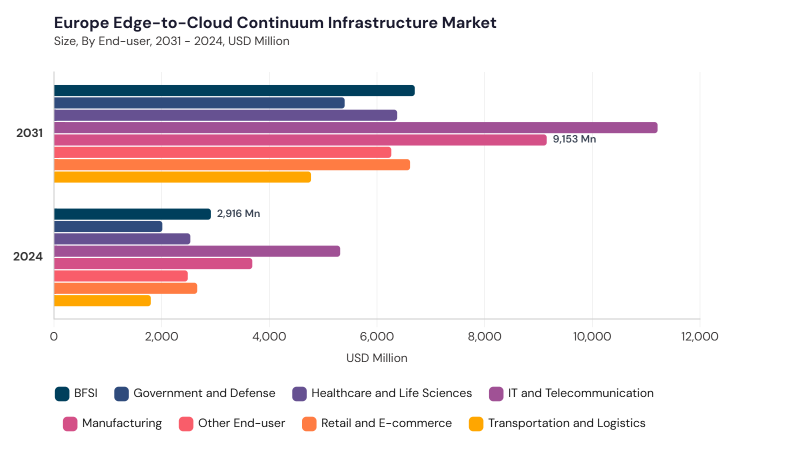
Based on End-user, the market is segmented into IT and Telecommunication, Manufacturing, BFSI, Retail and E-commerce, Healthcare and Life Sciences, Government and Defense, Transportation and Logistics, and Other End-user. IT and Telecommunication uses edge-to-cloud infrastructure for 5G deployment, content delivery networks, real-time analytics, network virtualization, distributed connectivity, and cloud service delivery. Manufacturing applies it for Industry 4.0, connected production, digital twins, automated quality inspection, intelligent machinery, robotics, and real-time plant operations. BFSI relies on distributed infrastructure for real-time fraud detection, secure transactions, customer interaction, compliance, and low-latency financial services.
Retail and E-commerce uses it for omnichannel operations, smart shelves, digital signage, demand forecasting, contactless payments, and personalized customer engagement. Healthcare and Life Sciences adopts it for telemedicine, digital diagnostics, medical imaging, electronic health records, clinical systems, and research computing. Government and Defense uses it for secure public services, smart cities, surveillance analytics, command systems, disaster response, and mission-oriented applications. Transportation and Logistics applies it in smart mobility, fleet visibility, ports, warehouses, connected vehicles, digital twins, and cargo monitoring, while Other End-user includes education, energy, agriculture, media, and other sectors adopting edge-to-cloud architectures for specialized digital transformation.
Free Valuable Insights: The Worldwide Edge-to-Cloud Continuum Infrastructure Market is projected to reach USD 296.5 Billion billion by 2033, at a CAGR of 14.3%
Based on Country, the market is segmented into Germany, UK, France, Russia, Spain, Italy, and Rest of Europe. The Germany market dominated the Europe Edge-to-Cloud Continuum Infrastructure Market by Country in 2025, and would continue to be a dominant market till 2033; thereby, achieving a market value of USD 11.5 billion by 2031, growing at a CAGR of 12.4 % during the forecast period. The UK market is expected to witness a CAGR of 12.9% during (2026 - 2033). Additionally, The France market is expected to witness a CAGR of 14.7% during (2026 - 2033).
Germany is supported by cloud sovereignty, smart manufacturing, AI, IoT, and localized cloud-edge infrastructure, while the UK is shaped by hybrid and multi-cloud strategies, AI at the edge, 5G, and sovereign data handling. France reflects edge AI adoption, digital sovereignty, orchestration platforms, and compliance-driven infrastructure, whereas Russia emphasizes localized infrastructure, data sovereignty, hybrid architectures, and AI workloads. Spain is advancing through edge-cloud orchestration, data privacy, AI workloads, and 5G-enabled infrastructure; Italy is driven by AI-enabled edge processing, GDPR-aligned data governance, hybrid multi-cloud ecosystems, and low-latency applications; and Rest of Europe is supported by integrated cloud-edge stacks, regional edge data centers, edge AI, sovereignty-focused infrastructure, and interoperable platforms.

By Enterprise Type
By Offering
By Infrastructure
By End-user
By Country
Set to reach $56.5 Billion by 2031, growing at 13.9% CAGR during 2026-2033.
Germany leads with $11.5 billion by 2031, growing at a CAGR of 12.4% during 2026-2033.
Rising enterprise cloud adoption and AI-driven workloads are the main catalysts.
Large Enterprises segment hits $38.9 billion by 2031, growing at a CAGR of 13.6% during 2026-2033.
The France market is expected to witness a CAGR of 14.7% during 2026-2033.
Hardware segment reaches $26.7 billion by 2031, growing at a CAGR of 13.5% during 2026-2033.
Our team of dedicated experts can provide you with attractive expansion opportunities for your business.




 Unique Offerings
