The sample copy of this report is available for access.
“Global Edge-to-Cloud Continuum Infrastructure Market to reach a market value of USD 296518.91 Million by 2033 growing at a CAGR of %”
The Global Edge-to-Cloud Continuum Infrastructure Market is expected to reach USD 296.5 billion by 2033, growing at a CAGR of 14.3% during (2026 – 2033).
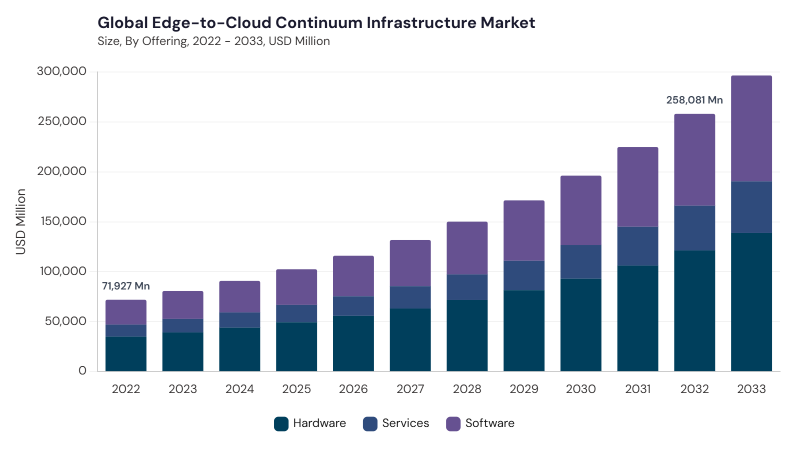
Growing integration of edge devices, distributed infrastructure, private clouds, and public cloud environments is driving the Edge-to-Cloud Continuum Infrastructure Market. Enterprises are adopting unified computing architectures to support low-latency processing, real-time analytics, workload orchestration, data sovereignty, and operational resilience across manufacturing, telecom, healthcare, retail, transportation, energy, and smart city use cases. Growth is further strengthened by IoT expansion, 5G connectivity, AI workloads, hybrid cloud adoption, and rising data generation outside centralized data centers.
Rising demand for real-time processing, data-driven operations, and distributed intelligence is strengthening edge-to-cloud continuum infrastructure adoption across enterprise and industrial environments. Organizations are increasingly processing data near the source to reduce latency, improve responsiveness, control bandwidth costs, and meet data-sovereignty requirements. Hybrid and multi-cloud strategies are also expanding the need for platforms that can coordinate applications across private data centers, public clouds, branch locations, and edge infrastructure. AI inference, connected devices, industrial automation, smart facilities, and regulated workloads are widening the role of unified management, security, observability, and workload orchestration across the continuum.
Competition is shaped by vendors’ ability to deliver secure, scalable, and interoperable platforms that connect edge devices, enterprise infrastructure, telecom networks, and cloud environments. Global technology providers emphasize hybrid cloud integration, distributed AI, containerized deployment, zero-trust security, centralized management, and consumption-based infrastructure models. Partnerships with telecom operators, hardware providers, semiconductor companies, software developers, and system integrators are important as no single vendor controls every layer of the continuum. Differentiation increasingly depends on orchestration depth, cloud-native consistency, edge AI readiness, deployment automation, and the ability to support regulated or disconnected environments.
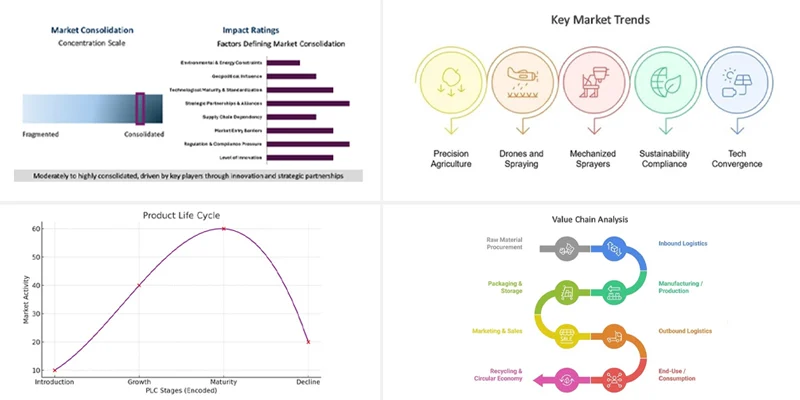

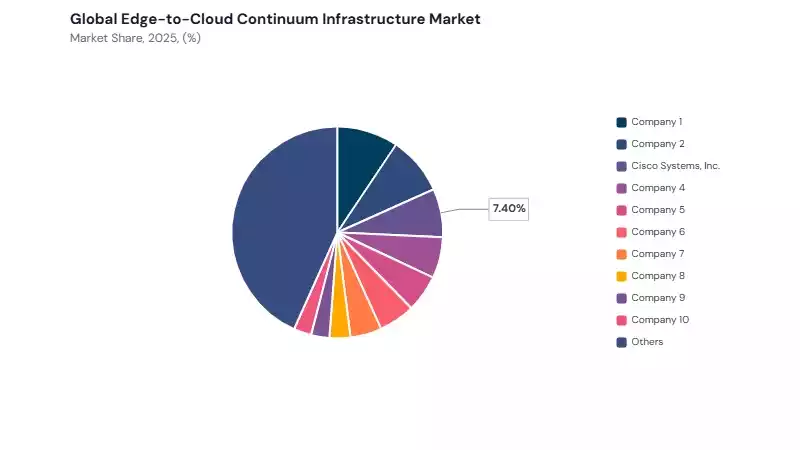
The market is moderately fragmented, with leading participation from Hewlett Packard Enterprise, Dell Technologies, Cisco Systems, Huawei Technologies, Microsoft, Amazon Web Services, Lenovo, Google, IBM, and Oracle. Competition is driven by the convergence of enterprise IT, distributed edge computing, public cloud, and hybrid infrastructure. Global cloud and infrastructure vendors benefit from platform scale, enterprise relationships, and integrated service portfolios, while specialized and regional players address localized compliance, deployment, and industry-specific requirements. Market share is influenced by cloud-to-edge integration, orchestration, security, workload portability, and the ability to support AI and real-time processing across distributed environments.
Based on enterprise type, the market is segmented into Large Enterprises and Small and Medium Enterprises (SMEs). The Large Enterprises market dominated the Global Edge-to-Cloud Continuum Infrastructure Market by Enterprise Type in 2025, and would continue to be a dominant market till 2033; thereby, achieving a market value of USD 203.0 billion by 2033, growing at a CAGR of 14 % during the forecast period. Additionally, The Small and Medium Enterprises (SMEs) market is expected to witness highest CAGR of 15% during (2026 - 2033).
Large enterprises remain the primary adopters because they operate complex IT estates across data centers, branch locations, edge sites, and cloud platforms. These organizations require scalable orchestration, strong security governance, and consistent management across distributed workloads. SMEs are gaining relevance as subscription-based infrastructure, managed services, and cloud-led deployment models lower adoption complexity. Smaller organizations increasingly use edge-to-cloud platforms to improve local processing, operational responsiveness, and application reliability without building large internal infrastructure teams.
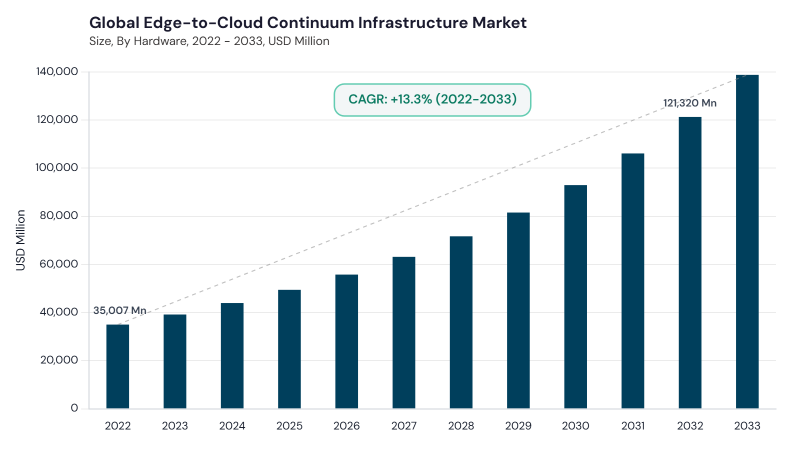
Based on offering, the market is segmented into Hardware, Software, and Services. The Hardware market dominated the Global Edge-to-Cloud Continuum Infrastructure Market by Offering in 2025, and would continue to be a dominant market till 2033; thereby, achieving a market value of USD 138.8 billion by 2033, growing at a CAGR of 13.9 % during the forecast period. The Software market is expected to witness a CAGR of 14.7% during (2026 - 2033).
Hardware includes edge servers, gateways, storage systems, networking devices, and computing infrastructure required to support localized data processing. Software enables orchestration, virtualization, workload placement, security, data management, and observability across the continuum. Services support consulting, deployment, integration, lifecycle management, maintenance, and managed operations as enterprises adopt more complex distributed architectures. Together, these offerings form the physical, operational, and support layers required to connect edge environments with cloud platforms.
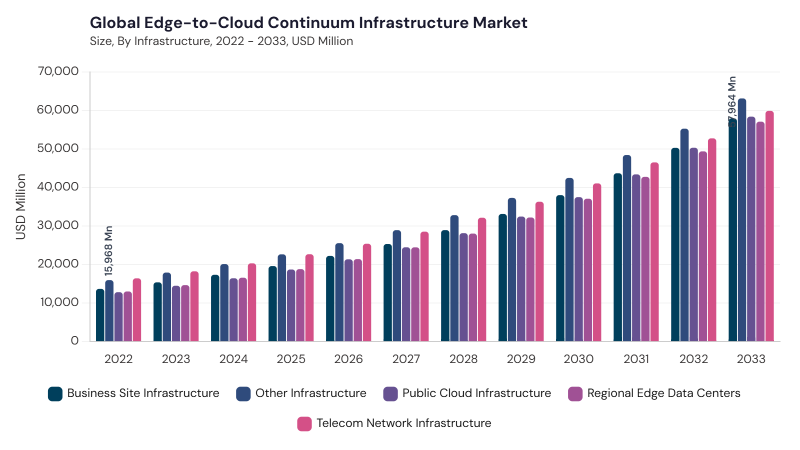
Based on infrastructure, the market is segmented into Telecom Network Infrastructure, Business Site Infrastructure, Regional Edge Data Centers, Public Cloud Infrastructure, and Other Infrastructure. The Telecom Network Infrastructure market dominated the Global Edge-to-Cloud Continuum Infrastructure Market by Infrastructure in 2025, and would continue to be a dominant market till 2033; thereby, achieving a market value of USD 59.9 billion by 2033, growing at a CAGR of 13 % during the forecast period. The Business Site Infrastructure market is expected to witness a CAGR of 14.7% during (2026 - 2033). Additionally, The Regional Edge Data Centers market is expected to witness highest CAGR of 15% during (2026 - 2033).
Telecom network infrastructure supports low-latency connectivity, 5G-enabled workloads, and network-edge computing. Business site infrastructure enables local processing at factories, offices, retail stores, hospitals, and branch locations. Regional edge data centers provide localized capacity between end devices and centralized clouds, while public cloud infrastructure supports scalable storage, analytics, application hosting, and centralized management. Other infrastructure covers specialized distributed environments built for industry-specific and operational use cases.
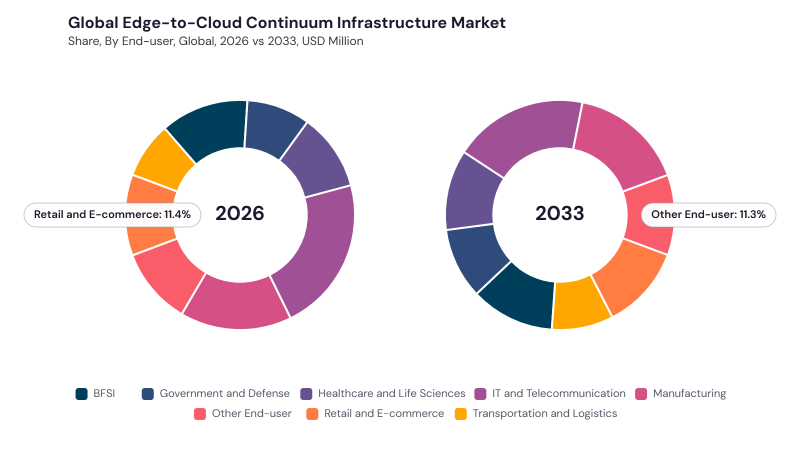
Based on end-user, the market is segmented into IT and Telecommunication, Manufacturing, BFSI, Retail and E-commerce, Healthcare and Life Sciences, Government and Defense, Transportation and Logistics, and Other End-user. The IT and Telecommunication market dominated the Global Edge-to-Cloud Continuum Infrastructure Market by End-user in 2025, and would continue to be a dominant market till 2033; thereby, achieving a market value of USD 56.0 billion by 2033, growing at a CAGR of 12 % during the forecast period. The Manufacturing market is expected to witness a CAGR of 14.8% during (2026 - 2033). Additionally, The BFSI market is expected to witness highest CAGR of 13.5% during (2026 - 2033).
IT and telecommunication users rely on distributed infrastructure for network automation, 5G, cloud-native services, and high-volume data processing. Manufacturing uses edge-to-cloud systems for industrial IoT, smart factories, machine monitoring, and real-time analytics. BFSI prioritizes secure and low-latency digital transactions, while retail uses distributed infrastructure for stores, personalization, and inventory visibility. Healthcare, government, transportation, and other sectors adopt these platforms for connected systems, regulated data, mission-critical operations, and real-time asset management.
Free Valuable Insights: Edge-to-Cloud Continuum Infrastructure Market Size to reach $296.5 Billion by 2033
Region-wise, the Edge-to-Cloud Continuum Infrastructure Market is analyzed across North America, Europe, Asia Pacific, and LAMEA. The North America market dominated the Global Edge-to-Cloud Continuum Infrastructure Market by Region in 2025, and would continue to be a dominant market till 2033; thereby, achieving a market value of USD 104.4 billion by 2033, growing at a CAGR of 13.8 % during the forecast period. The Europe market is expected to witness a CAGR of 13.9% during (2026 - 2033). Additionally, The Asia Pacific market is expected to witness a CAGR of 14.9% during (2026 - 2033).
North America leads due to mature cloud infrastructure, strong enterprise digitalization, advanced networking adoption, and edge data center development. Asia Pacific is witnessing strong demand from expanding 5G deployments, industrial automation, cloud adoption, digital infrastructure growth, and rising connected-device data. Europe is shaped by data-sovereignty requirements, hybrid cloud adoption, industrial digitalization, and investment in distributed computing. LAMEA is gradually expanding as telecom upgrades, cloud migration, data center investment, and enterprise modernization increase edge-to-cloud deployment opportunities.
| Report Attribute | Details |
|---|---|
| Market size value in 2026 | USD 116.0 billion |
| Market size forecast in 2033 | USD 296.5 billion |
| Base Year | 2025 |
| Historical Period | 2022 to 2024 |
| Forecast Period | 2026 to 2033 |
| Revenue Growth Rate | CAGR of 14.3% from 2026 to 2033 |
| Number of Pages | XX |
| Tables | XX |
| Report Coverage | Market Definition, Market Overview, COVID-19 Impact, Market Composition and Scenario, Key Factors Impacting Market, Market Share Analysis, Recent Developments, Segment Analysis, Regional Analysis, Company Profiles, SWOT Analysis, Key Customer Criteria, and Winning Imperatives |
| Segments Covered | Enterprise Type, Offering, Infrastructure, End-user, and Geography |
| Country Scope |
|
| Companies Included | Hewlett Packard Enterprise Company; Dell Technologies Inc.; Cisco Systems, Inc.; Huawei Technologies Co., Ltd.; Microsoft Corporation; Amazon Web Services, Inc.; Lenovo Group Limited; Google LLC; IBM Corporation; Oracle Corporation |
By Enterprise Type
By Offering
By Infrastructure
By End-user
By Geography
Expected to reach USD 296.5 billion by 2033, growing at 14.3% CAGR during 2026-2033.
Large Enterprises lead with a projected market value of USD 203.0 billion by 2033.
Hewlett Packard, Dell, Cisco, Huawei, Microsoft, AWS, Lenovo, Google, IBM, Oracle dominate this market.
North America leads with a market value of USD 104.4 billion by 2033.
Latency reduction and enhanced real-time processing capabilities are major growth drivers.
Telecom Network Infrastructure leads with a market value of USD 59.9 billion by 2033.
Our team of dedicated experts can provide you with attractive expansion opportunities for your business.






 Unique Offerings
