The sample copy of this report is available for access.
The Asia Pacific Edge-to-Cloud Continuum Infrastructure Market is expected to reach USD 60.9 billion by 2030, growing at a CAGR of 14.9% during (2026 - 2033).
The Asia Pacific Edge-to-Cloud Continuum Infrastructure Market originated from the integration of distributed computing resources designed to process data closer to its source. Initially, edge computing and centralized cloud services operated separately, with edge deployments addressing latency and bandwidth limitations while cloud platforms supported scalable storage and processing. Over time, advances in network connectivity, virtualization, containerization, 5G, IoT, and hybrid architectures enabled a unified continuum connecting edge devices, local micro data centers, and hyperscale cloud platforms.
Current market development is shaped by edge AI, 5G evolution, localized data processing, regulatory compliance, and growing demand for real-time insights. AI-enabled edge nodes are reducing dependence on cloud backhaul, while higher-bandwidth and lower-latency networks are supporting autonomous vehicles, augmented reality, distributed sensor networks, smart manufacturing, healthcare, agriculture, and industrial applications. Data sovereignty requirements are also encouraging localized edge facilities, regional edge data centers, and on-premises cloud extensions across Asia Pacific countries.
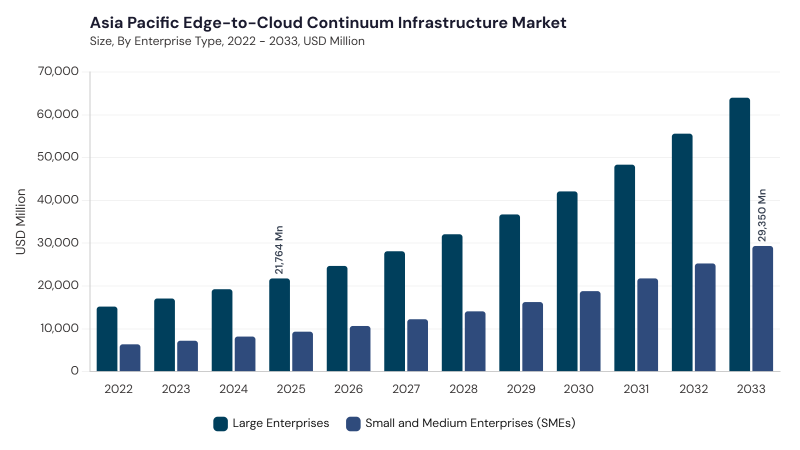
Based on Enterprise Type, the market is segmented into Large Enterprises and Small and Medium Enterprises (SMEs). The Large Enterprises market dominated the Asia Pacific Edge-to-Cloud Continuum Infrastructure Market by Enterprise Type in 2025, and would continue to be a dominant market till 2033; thereby, achieving a market value of USD 42.1 billion by 2030, growing at a CAGR of 14.6 % during the forecast period. Additionally, The Small and Medium Enterprises (SMEs) market is expected to witness highest CAGR of 15.6% during (2026 - 2033).
Large Enterprises are developing interconnected computing environments across corporate data centers, industrial sites, edge locations, private clouds, hybrid clouds, and hyperscale cloud platforms to improve processing agility, operational resilience, real-time analytics, and data management. Small and Medium Enterprises (SMEs) maintain a promising presence due to affordable cloud consumption models, managed edge platforms, preconfigured infrastructure, pay-as-you-go services, and broader digitalization. SMEs are using edge-to-cloud infrastructure for remote monitoring, customer service improvement, retail analytics, healthcare clinics, small-scale manufacturing, inventory synchronization, and incremental digital innovation.
Based on Offering, the market is segmented into Hardware, Software, and Services. The Hardware market dominated the Asia Pacific Edge-to-Cloud Continuum Infrastructure Market by Offering in 2025, and would continue to be a dominant market till 2033; thereby, achieving a market value of USD 28.8 billion by 2030, growing at a CAGR of 14.4 % during the forecast period. The Software market is expected to witness a CAGR of 15.2% during (2026 - 2033).
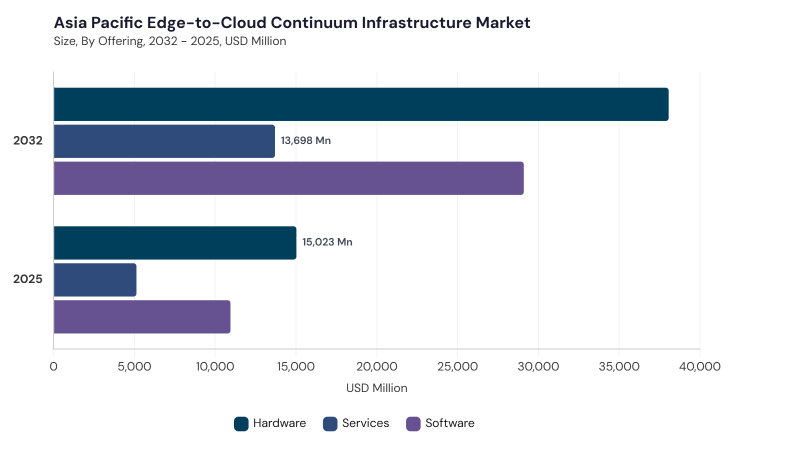
Hardware forms the physical foundation of the market through compact servers, intelligent gateways, storage appliances, networking equipment, AI accelerators, edge computing devices, IoT gateways, and edge data centers. Software is gaining strong relevance through cloud-native development, automated infrastructure management, workload scheduling, distributed security, orchestration tools, middleware platforms, AI and ML frameworks, and edge-to-cloud data synchronization. Services maintain a promising role through cloud migration, architecture modernization, technical integration, consulting, system integration, managed services, support, lifecycle management, and expertise for deployment across complex distributed environments.
Based on Infrastructure, the market is segmented into Telecom Network Infrastructure, Business Site Infrastructure, Regional Edge Data Centers, Public Cloud Infrastructure, and Other Infrastructure. Telecom Network Infrastructure supports cellular base stations, 5G infrastructure, network function virtualization, network slicing, high-bandwidth connectivity, and low-latency applications across IoT, autonomous vehicles, smart cities, and dense device environments. Business Site Infrastructure enables localized processing across factories, offices, retail stores, commercial buildings, mines, utilities, and enterprise campuses for automation, equipment monitoring, and real-time decisions.
Regional Edge Data Centers provide intermediate compute and storage capacity closer to end users, while Public Cloud Infrastructure supports centralized AI, analytics, storage, development resources, disaster recovery, and hybrid architecture. Other Infrastructure includes network edge devices, gateways, routers, virtualization platforms, security appliances, orchestration tools, micro data centers, AI accelerators, and hybrid cloud management platforms.
Based on End-user, the market is segmented into IT and Telecommunication, Manufacturing, BFSI, Retail and E-commerce, Healthcare and Life Sciences, Government and Defense, Transportation and Logistics, and Other End-user. IT and Telecommunication uses continuum infrastructure for 5G deployment, real-time processing, content delivery, IoT connectivity, cloud-native service orchestration, network slicing, and distributed infrastructure services. Manufacturing applies it for factory automation, robotics, industrial IoT, machine analytics, predictive maintenance, digital twins, and real-time quality control. BFSI uses it for mobile banking, digital payments, transaction analysis, fraud detection, risk analytics, and secure localized processing.
Retail and E-commerce relies on edge-to-cloud systems for smart retail, automated fulfillment, inventory monitoring, point-of-sale analytics, personalized marketing, and peak-demand scalability. Healthcare and Life Sciences adopts it for telehealth, connected diagnostic equipment, digital medical imaging, patient monitoring, electronic health records, and genomic data analytics. Government and Defense uses it for smart cities, secure communications, surveillance, disaster management, critical infrastructure protection, and public digital services. Transportation and Logistics applies it for connected fleets, intelligent ports, warehouse automation, real-time tracking, autonomous transport, and supply-chain monitoring, while Other End-user includes education, media and entertainment, energy, agriculture, and other sectors using distributed computing for specialized digital requirements.
Free Valuable Insights: Edge-to-Cloud Continuum Infrastructure Market is Predicted to reach USD 296.5 Billion billion by 2033, at a CAGR of 14.3%
Based on Country, the market is segmented into China, Japan, India, South Korea, Singapore, Malaysia, and Rest of Asia Pacific. The China market dominated the Asia Pacific Edge-to-Cloud Continuum Infrastructure Market by Country in 2025, and would continue to be a dominant market till 2033; thereby, achieving a market value of USD 17.2 billion by 2030, growing at a CAGR of 12.9 % during the forecast period. The Japan market is expected to witness a CAGR of 14.1% during (2026 - 2033). Additionally, The India market is expected to witness a CAGR of 15.6% during (2026 - 2033).
China is shaped by 5G expansion, AI-driven edge analytics, data localization, smart manufacturing, and domestic cloud-edge platforms, while Japan reflects edge AI, 5G connectivity, interoperable software frameworks, and secure hybrid infrastructure. India is driven by AI and machine learning at the edge, zero-trust security, 5G and 6G readiness, local data centers, and scalable orchestration platforms. South Korea is supported by AI analytics, hybrid multi-cloud adoption, standardized edge orchestration, and 5G-enabled infrastructure, whereas Singapore is influenced by secure operational technology environments, cost-optimized deployments, and advanced workload orchestration. Malaysia is progressing through AI automation, hybrid and multi-cloud models, sustainable infrastructure, localized data centers, and 5G investment, while Rest of Asia Pacific is shaped by decentralized infrastructure, sovereign cloud initiatives, AI automation, modular facilities, and localized edge deployments.

By Enterprise Type
By Offering
By Infrastructure
By End-user
By Country
Set to reach $60.9 Billion by 2030, growing at 14.9% CAGR during 2026-2033.
China leads with a market value of USD 17.2 billion by 2030, growing at a CAGR of 12.9% during 2026-2033.
Rising enterprise cloud adoption and AI-driven workloads are the main catalysts.
Large enterprises will reach USD 42.1 billion by 2030, growing at a CAGR of 14.6% during 2026-2033.
India is expected to witness a CAGR of 15.6% during 2026-2033.
The hardware segment will achieve a market value of USD 28.8 billion by 2030, growing at a CAGR of 14.4% during 2026-2033.
Our team of dedicated experts can provide you with attractive expansion opportunities for your business.




 Unique Offerings
