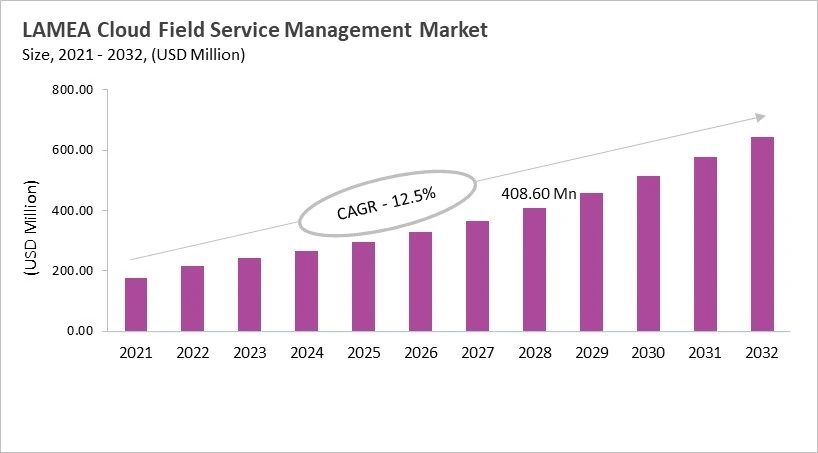
The Latin America, Middle East and Africa Cloud Field Service Management Market is expected to reach $408.60 million by 2028 and would witness market growth of 11.8% CAGR during the forecast period (2025-2032).
The Brazil market dominated the LAMEA Cloud Field Service Management Market by Country in 2024, and would continue to be a dominant market till 2032; thereby, achieving a market value of $117.6 million by 2032. The Argentina market is showcasing a CAGR of 12.3% during (2025 - 2032). Additionally, The UAE market would register a CAGR of 10.8% during (2025 - 2032). The Brazil and Saudi Arabia led the LAMEA Cloud Field Service Management Market by Country with a market share of 20.8% and 17.4% in 2024. The Nigeria market is expected to witness a CAGR of 12.7% during throughout the forecast period.
The LAMEA Cloud Field Service Management (CFSM) market has grown along with other digital transformation projects in Latin America, the Middle East, and Africa. Governments and regional groups have pushed for more people to use the cloud by using digital strategies that aim to modernize infrastructure, make connections better, and speed up the digitization of businesses. In the past, field service operations depended on handwritten notes, broken communication, and few scheduling tools. This made it hard to see what was going on and made it less efficient in markets that were spread out over a large area. The growth of broadband networks, enterprise cloud platforms, and smartphone use has made it possible for businesses to use centralized service management systems. Companies that provide technology around the world have made cloud-based platforms that combine scheduling, dispatching, mobile workforce management, and business systems like CRM and ERP. These changes have helped businesses work together better, see more of their services, and get more done in complicated service environments.
Some of the most important trends in the market are the use of artificial intelligence, mobile-first workforce enablement, and predictive maintenance powered by the Internet of Things (IoT). AI-powered scheduling and automation tools help make the best use of technicians, speed up response times, and cut down on administrative work. Technicians can use mobile service apps to access work orders, update job statuses, and take notes in real time, even when they are far away and have limited internet access. Also, connected infrastructure and industrial systems are making predictive maintenance models more popular. These models use real-time sensor data to predict when equipment will break down and start proactive service interventions. Global enterprise software companies that focus on platform integration, AI-driven analytics, secure cloud deployment, and ecosystem partnerships are leading the way in the market. They help businesses in LAMEA move from reactive service models to smart, connected, and predictive service operations.
Based on User Type, the market is segmented into Large Enterprises and Small & Medium-sized Enterprises. With a compound annual growth rate (CAGR) of 10.5% over the projection period, the Large Enterprises Market, dominate the UAE Cloud Field Service Management Market by User Type in 2024 and would be a prominent market until 2032. The Small & Medium-sized Enterprises market is expected to witness a CAGR of 11.1% during (2025 - 2032).
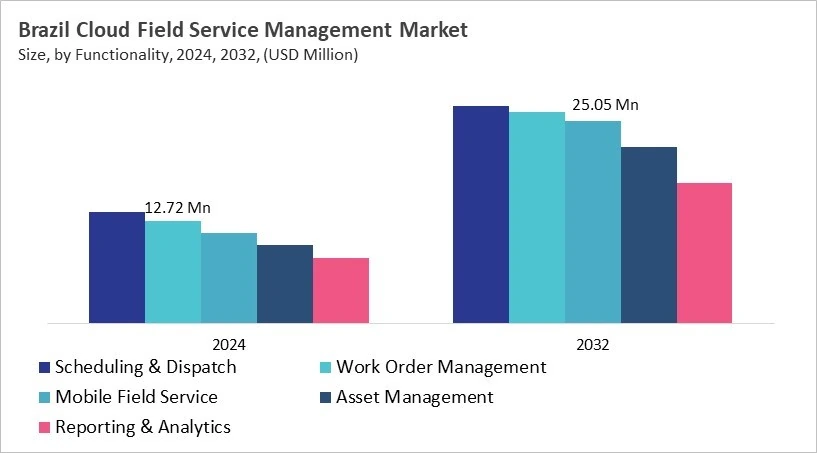
Based on Functionality, the market is segmented into Scheduling & Dispatch, Work Order Management, Mobile Field Service, Asset Management and Reporting & Analytics. Among various Brazil Cloud Field Service Management Market by Functionality; The Scheduling & Dispatch market achieved a market size of USD $13.8 Million in 2024 and is expected to grow at a CAGR of 8.9 % during the forecast period. The Mobile Field Service market is predicted to experience a CAGR of 10.7% throughout the forecast period from (2025 - 2032).
Free Valuable Insights: Cloud Field Service Management Market Size Worth USD 6.49 billion by 2032
Brazil is the leader in the Latin American Cloud Field Service Management market because it has a diverse economy, a lot of telecommunications infrastructure, and strong industrial and utility sectors. More and more businesses in the energy, telecom, agriculture, and infrastructure sectors are using cloud-based FSM platforms to manage service operations that are spread out over a wide area and improve coordination among technicians. Digital transformation projects are speeding up the use of cloud solutions for scheduling, workforce optimization, and service lifecycle management. Vendors like TOTVS and Oracle offer these solutions. Market trends focus on enabling mobile workers and connecting them to enterprise systems. Companies like Telefônica Brasil are helping with this by working on connectivity projects. There are both local and global competitors, like SAP and Salesforce. Overall, Brazil's cloud-based field service management ecosystem is expected to get even stronger as more people use the cloud and invest in digital infrastructure.

By User Type
By Service Type
By Deployment Model
By Functionality
By Industry Vertical
By Country
Market will reach $408.60 million by 2028, growing at 11.8% CAGR during 2025-2032.
Brazil dominates with $117.6 million by 2032 and holds 20.8% market share in 2024.
Growing enterprise digital transformation initiatives and mobile workforce management needs fuel regional expansion.
UAE market grows at 10.8% CAGR during 2025-2032, showing strong regional momentum.
Saudi Arabia holds second place with 17.4% market share in 2024.
Scheduling & Dispatch reached $13.8 million in 2024, expanding at 8.9% CAGR during 2025-2032.
Our team of dedicated experts can provide you with attractive expansion opportunities for your business.




 Unique Offerings