The Asia Pacific Cloud Field Service Management Market is expected to reach $1.21 billion by 2029 and would witness market growth of 11.0% CAGR during the forecast period (2025-2032).
The China market dominated the Asia Pacific Cloud Field Service Management Market by Country in 2024, and would continue to be a dominant market till 2032; thereby, achieving a market value of $433.1 million by 2032. The Japan market is registering a CAGR of 10.2% during (2025 - 2032). Additionally, The India market would showcase a CAGR of 11.7% during (2025 - 2032). The China and Japan led the Asia Pacific Cloud Field Service Management Market by Country with a market share of 29.5% and 17.7% in 2024. The Malaysia market is expected to witness a CAGR of 13.7% during throughout the forecast period.
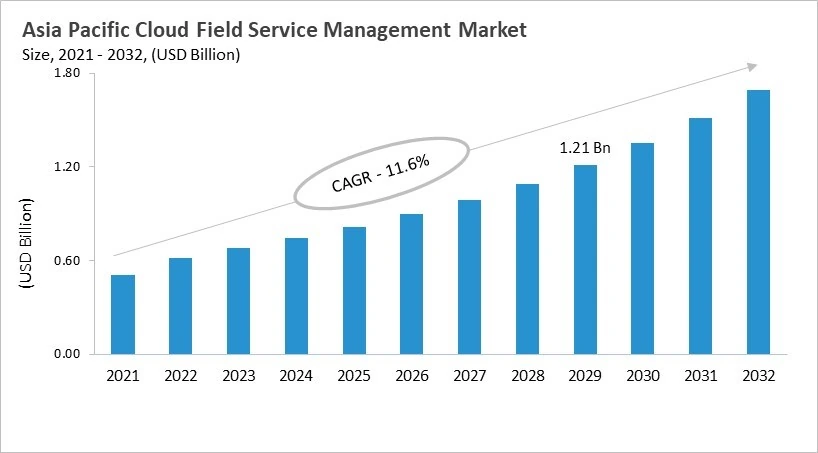
The Asia Pacific Cloud Field Service Management (CFSM) market has changed quickly as the region's digital transformation and cloud adoption efforts have picked up speed. Through national digital strategies, governments in places like Australia and Singapore have actively promoted scalable cloud infrastructure. This has pushed businesses to modernize how they provide services. In the past, field service tasks depended on paper-based work orders, manual scheduling, and phone-based dispatch systems. These systems made it hard to see what was going on in different areas. The growth of broadband internet, smartphones, and enterprise cloud platforms made it possible for businesses to switch to centralized, cloud-based service management solutions. Major enterprise software companies like Microsoft, SAP, Oracle, Salesforce, and IFS have rolled out integrated CFSM platforms across the region. These platforms make it possible to schedule tasks in real time, send out workers automatically, manage a mobile workforce, and make operations more transparent.
Technological advances are having a bigger and bigger impact on the market, especially the use of AI, mobile-first service models, and IoT-enabled predictive maintenance. AI-powered scheduling tools help businesses make the best use of their technicians, increase the number of first-time fixes, and handle rising service demands more effectively. Mobile apps also let technicians see work orders, customer histories, and technical documentation in real time, even in remote areas, thanks to offline synchronization. IoT integration makes service operations even better by letting connected equipment sensors send predictive alerts and automatically create work orders. There is still a lot of competition in the Asia Pacific CFSM market. Vendors set themselves apart by offering ecosystem integration, predictive analytics, cybersecurity standards, and customization for specific industries. They also form regional partnerships to deal with different regulatory and infrastructure situations.
Based on Service Type, the market is segmented into Software as a Service (SaaS), Platform as a Service (PaaS) and Infrastructure as a Service (IaaS). With a compound annual growth rate (CAGR) of 8.6% over the projection period, the Software as a Service (SaaS) Market, dominate the China Cloud Field Service Management Market by Service Type in 2024 and would be a prominent market until 2032. The Infrastructure as a Service (IaaS) market is expected to witness a CAGR of 10.4% during (2025 - 2032).
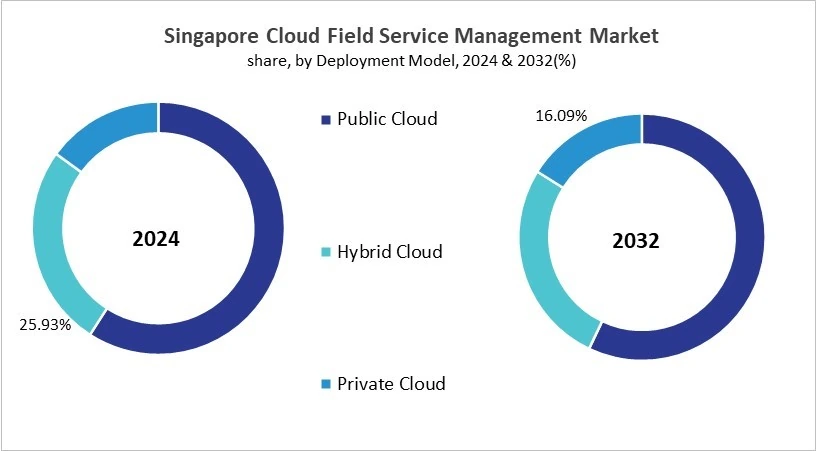
Based on Deployment Model, the market is segmented into Public Cloud, Hybrid Cloud and Private Cloud. The Public Cloud market segment dominated the Singapore Cloud Field Service Management Market by Deployment Model is expected to grow at a CAGR of 12.2 % during the forecast period thereby continuing its dominance until 2032. Also, The Private Cloud market is anticipated to grow as a CAGR of 13.7 % during the forecast period during (2025 - 2032).
Free Valuable Insights: Cloud Field Service Management Market is Predicted to reach USD 6.49 billion by 2032, at a CAGR of 10.1%
China is quickly becoming a major market for Cloud Field Service Management in the Asia Pacific region. This is due to its large industrial base, growing telecommunications infrastructure, and strong national digital transformation efforts. More and more businesses in manufacturing, utilities, logistics, and smart infrastructure are using cloud-based platforms to coordinate field technicians, keep track of assets that are spread out, and make service more responsive. The rise of digital ecosystems led by companies like Huawei, Alibaba Cloud, and Inspur is speeding up the rollout of cloud-based service management systems that can be scaled up. A big trend in the market is the use of IoT-enabled devices with service lifecycle platforms. This lets technicians do predictive maintenance, remote diagnostics, and access data in real time. Cloud leaders in the US and around the world are both competitors. They often work together through hybrid deployment models to make sure that their services can grow and meet regulatory requirements. Because of this, the market is expected to grow even more as China makes progress in smart manufacturing, renewable energy, and intelligent industrial ecosystems.

By User Type
By Service Type
By Deployment Model
By Functionality
By Industry Vertical
By Country
Market will reach $1.21 billion by 2029, growing at 11.0% CAGR during 2025-2032.
China dominates with 29.5% market share in 2024 and will reach $433.1 million by 2032.
Rapid digital transformation and increasing mobile workforce adoption across enterprises fuel regional expansion.
Japan holds 17.7% market share in 2024 and grows at 10.2% CAGR during 2025-2032.
India shows strong potential with 11.7% CAGR during 2025-2032, outpacing several regional markets.
Software as a Service (SaaS) leads China's market with 8.6% CAGR during 2025-2032.
Our team of dedicated experts can provide you with attractive expansion opportunities for your business.




 Unique Offerings