The sample copy of this report is available for access.
The LAMEA Breast Pump Market is expected to reach USD 158.7 million by 2029, growing at a CAGR of 8.6% during (2026 – 2033).
Breast pump adoption across LAMEA evolved from bulky mechanical devices used mainly in hospitals toward increasingly portable, efficient, and consumer-oriented maternal care products. Early adoption remained limited by affordability, cultural perceptions, and uneven healthcare access, while the transition from manual to electric and battery-operated pumps gradually improved convenience and milk expression efficiency. Advances in ergonomic design, quieter motors, hygiene standards, and portable configurations further broadened product acceptance. More recently, smart controls, mobile connectivity, and rechargeable wearable devices have strengthened the role of breast pumps within modern maternal and infant healthcare.
Digital integration, expanding maternal health awareness, improving healthcare access, and increasing acceptance of breastfeeding support are reshaping the regional market. Manufacturers are increasingly focusing on smart connectivity, personalized suction settings, rechargeable designs, quieter operation, and easy-to-clean components suited to diverse consumer environments. Policy and insurance support in selected markets is improving product accessibility, while hospitals and healthcare professionals are strengthening breast pump adoption through lactation programs and clinical use. At the same time, affordability, localization, regional distribution, and culturally appropriate product designs remain important for expanding adoption beyond higher-income urban consumers.
Based on Configuration, the market is segmented into Single Pumps and Double Pumps. The Single Pumps market dominated the LAMEA Breast Pump Market by Configuration in 2025, and would continue to be a dominant market till 2033; thereby, achieving a market value of USD 91.0 million by 2029, growing at a CAGR of 8.2 % during the forecast period. The Double Pumps market is expected to witness a CAGR of 9.1% during (2026 - 2033).
Single pumps remain important among mothers seeking affordable, portable, and easy-to-use devices for occasional milk expression, particularly across price-sensitive and underserved markets. Improvements in battery-powered operation, ergonomic design, and user comfort are helping strengthen their appeal. Double pumps support simultaneous milk expression and are increasingly relevant among working mothers, frequent users, and mothers requiring more efficient pumping routines. Adjustable suction, enhanced battery performance, improved hygiene, and digital monitoring features are strengthening adoption, although higher costs continue to limit wider penetration in economically constrained areas.
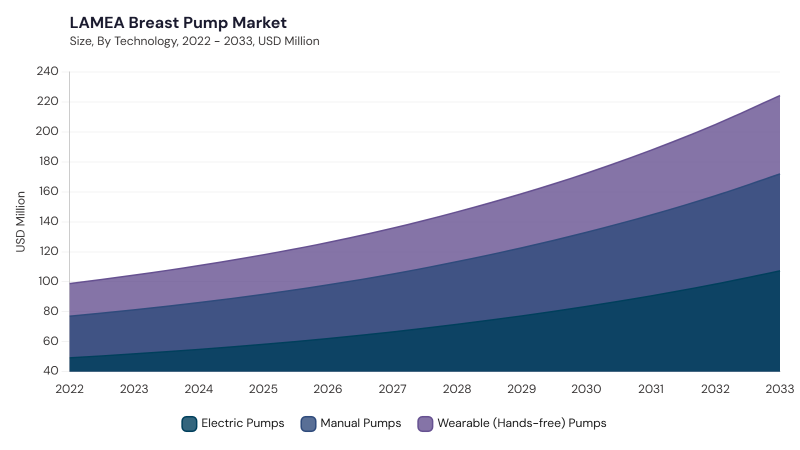
Based on Technology, the market is segmented into Electric Pumps, Manual Pumps, and Wearable (Hands-free) Pumps. The Electric Pumps market dominated the LAMEA Breast Pump Market by Technology in 2025, and would continue to be a dominant market till 2033; thereby, achieving a market value of USD 77.1 million by 2029, growing at a CAGR of 8.1 % during the forecast period. The Manual Pumps market is expected to witness a CAGR of 8.8% during (2026 - 2033).
Electric pumps provide efficient and adjustable milk expression for both home and clinical use, with improvements in battery life, noise reduction, suction control, and digital interfaces enhancing usability. Manual pumps continue to serve mothers seeking affordable, portable, simple, and electricity-independent solutions, particularly in rural and lower-income markets. Wearable (Hands-free) Pumps are gaining interest among urban working mothers seeking greater mobility, discretion, and rechargeable operation. Miniaturized designs, smart connectivity, quieter performance, and personalized settings are strengthening their appeal, although relatively high pricing and limited availability continue to constrain mass adoption.
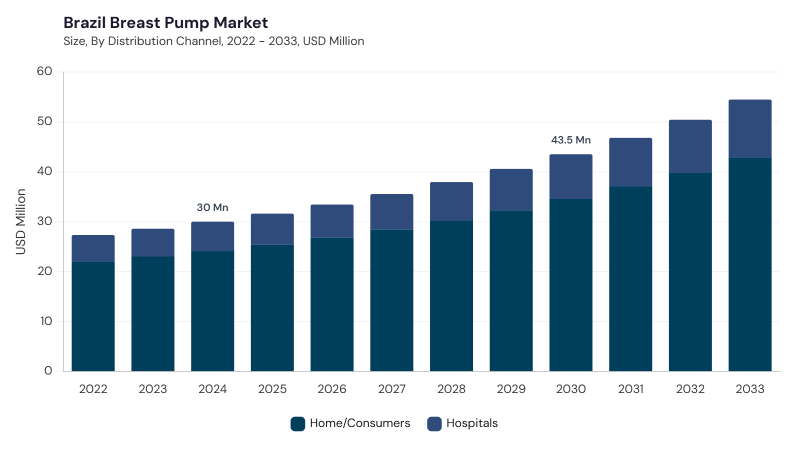
Based on Distribution Channel, the market is segmented into Home/Consumers and Hospitals. Home/Consumers access breast pumps through pharmacies, specialty baby stores, online platforms, and other retail channels, with demand spanning manual, electric, rechargeable, and increasingly wearable products. Purchasing decisions are influenced by affordability, portability, suction performance, ease of cleaning, product safety, and after-sales support.
Hospitals use professional-grade pumps across maternity wards, neonatal intensive care units, lactation clinics, and postnatal care facilities where durability, hygiene, adjustable suction, regulatory compliance, and dependable service are essential. Institutional demand is supported by improving maternity infrastructure, clinical breastfeeding programs, and increasing integration of breast pumps into neonatal and maternal care.
Free Valuable Insights: Breast Pump Market Size Worth USD 2733.5 Million billion by 2033
Based on Country, the market is segmented into Brazil, Argentina, UAE, Saudi Arabia, South Africa, Nigeria, and Rest of LAMEA. The Brazil market dominated the LAMEA Breast Pump Market by Country in 2025, and would continue to be a dominant market till 2033; thereby, achieving a market value of USD 40.6 million by 2029, growing at a CAGR of 7.2 % during the forecast period. The Argentina market is expected to witness a CAGR of 9.8% during (2026 - 2033). Additionally, The UAE market is expected to witness a CAGR of 7.5% during (2026 - 2033).
Across LAMEA, breast pump demand is increasingly influenced by maternal health awareness, workforce participation, affordability, digital adoption, and improving healthcare access. Brazil and Argentina are advancing smart, ergonomic, sustainable, and app-enabled products, while the UAE and Saudi Arabia are strengthening connected, portable, and culturally localized solutions alongside growing maternal healthcare support. South Africa is balancing digitally connected pumps with affordability and accessibility, whereas Nigeria is emphasizing durable, hygienic, battery-supported, and cost-effective products suited to local infrastructure conditions. Rest of LAMEA is also progressing through smart technologies, safer materials, localized supply, and more affordable pumping options.

By Configuration
By Technology
By Distribution Channel
By Country
Set to reach $158.7 Million by 2029, growing at 8.6% CAGR during 2026-2033.
Brazil leads with a market value of USD 40.6 million by 2029, growing at a CAGR of 7.2% during the forecast period.
Single Pumps dominate with a market value of USD 91.0 million by 2029, growing at a CAGR of 8.2% during the forecast period.
Electric Pumps will achieve a market value of USD 77.1 million by 2029, growing at a CAGR of 8.1% during the forecast period.
The Argentina market is expected to witness a CAGR of 9.8% during 2026-2033.
Manual Pumps are expected to witness a CAGR of 8.8% during 2026-2033.
Our team of dedicated experts can provide you with attractive expansion opportunities for your business.




 Unique Offerings