The sample copy of this report is available for access.
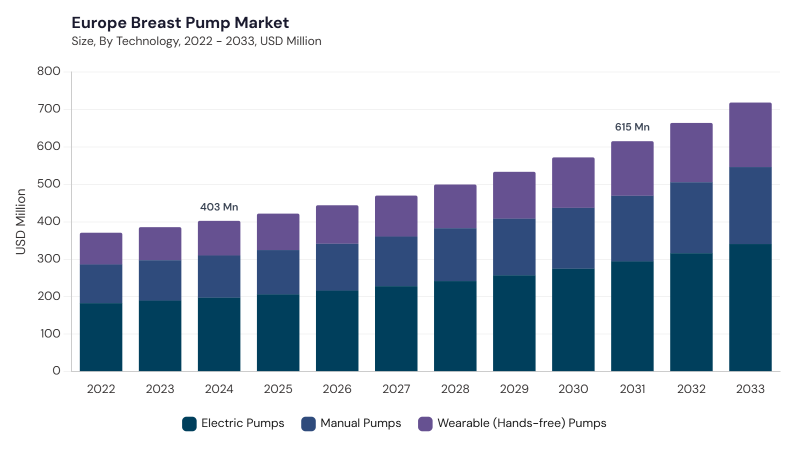
The Europe Breast Pump Market is expected to reach USD 615.2 million by 2031, growing at a CAGR of 7.1% during (2026 – 2033).
Breast pump adoption across Europe has progressed from basic manual devices toward increasingly efficient electric, battery-operated, and digitally connected lactation solutions. Early development focused primarily on mechanical milk expression, while improvements in suction technology, materials, hygiene, ergonomics, and portability gradually strengthened product acceptance across home and clinical settings. Growing awareness of breastfeeding benefits and greater workforce participation among women further supported this transition. More recently, smart controls, wireless connectivity, data tracking, wearable formats, and personalized pumping settings have positioned breast pumps as increasingly sophisticated maternal health devices.
Market development is now being shaped by smart technology integration, sustainability considerations, changing workforce needs, and stronger emphasis on maternal health support. Manufacturers are increasingly focusing on quieter motors, adjustable suction, compact designs, hands-free operation, recyclable materials, and connected applications that support personalized lactation management. Regional healthcare frameworks, reimbursement mechanisms, and regulatory requirements continue to influence accessibility and product design. At the same time, partnerships with hospitals, lactation consultants, healthcare providers, and digital health platforms are strengthening clinical credibility and expanding consumer engagement across diverse European markets.
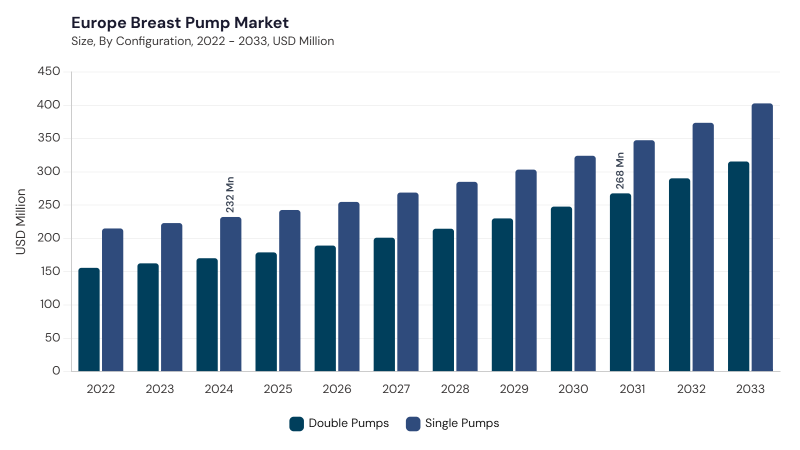
Based on Configuration, the market is segmented into Single Pumps and Double Pumps. The Single Pumps market dominated the Europe Breast Pump Market by Configuration in 2025, and would continue to be a dominant market till 2033; thereby, achieving a market value of USD 347.5 million by 2031, growing at a CAGR of 6.8 % during the forecast period. The Double Pumps market is expected to witness a CAGR of 7.6% during (2026 - 2033).
Single pumps remain relevant for mothers seeking compact, portable, and affordable devices for occasional milk expression, with manufacturers improving ergonomic design, quieter operation, suction control, and battery performance. Their simpler operation and lower upfront cost continue to support adoption among infrequent users. Double pumps address mothers requiring simultaneous milk expression and greater time efficiency, particularly frequent pumpers and working mothers. Adjustable pumping modes, improved comfort, digital tracking, better battery systems, and increasing workplace lactation support continue to strengthen the appeal of double pump configurations.
Based on Technology, the market is segmented into Electric Pumps, Manual Pumps, and Wearable (Hands-free) Pumps. The Electric Pumps market dominated the Europe Breast Pump Market by Technology in 2025, and would continue to be a dominant market till 2033; thereby, achieving a market value of USD 294.2 million by 2031, growing at a CAGR of 6.7 % during the forecast period. The Manual Pumps market is expected to witness a CAGR of 7.4% during (2026 - 2033).
Electric pumps remain widely used for regular home pumping and clinical lactation support because of their efficiency, adjustable settings, quieter motors, and increasingly portable designs. Manual pumps continue to serve consumers seeking affordable, lightweight, travel-friendly, and electricity-independent options for occasional milk expression. Wearable (Hands-free) Pumps are gaining traction among mothers requiring discreet and flexible pumping during work or daily activities. Improvements in miniaturized motors, battery performance, quiet operation, ergonomic fit, and smart connectivity are reinforcing adoption among technology-oriented and convenience-focused consumers.
Based on Distribution Channel, the market is segmented into Home/Consumers and Hospitals. Home/Consumers access breast pumps through pharmacies, specialist maternity retailers, e-commerce platforms, and other consumer channels, with purchasing decisions influenced by ergonomics, portability, material safety, quiet operation, sterilization convenience, and smart functionality.
Hospitals use professional-grade pumps across maternity wards, neonatal intensive care units, birthing clinics, and lactation-support facilities where reliability, adjustable suction, hygiene, easy disinfection, and compatibility with sterile or disposable pumping kits are essential. Institutional procurement is also influenced by clinical evidence, staff familiarity, maintenance support, equipment durability, sustainability requirements, and compliance with European medical-device standards.
Free Valuable Insights: The Worldwide Breast Pump Market is projected to reach USD 2733.5 Million billion by 2033, at a CAGR of 7.3%
Based on Country, the market is segmented into Germany, UK, France, Russia, Spain, Italy, and Rest of Europe. The Germany market dominated the Europe Breast Pump Market by Country in 2025, and would continue to be a dominant market till 2033; thereby, achieving a market value of USD 132.8 million by 2031, growing at a CAGR of 5.8 % during the forecast period. The UK market is expected to witness a CAGR of 6.2% during (2026 - 2033). Additionally, The France market is expected to witness a CAGR of 7.8% during (2026 - 2033).
Across Europe, breast pump demand is increasingly influenced by maternal health awareness, workforce participation, digital healthcare adoption, and demand for more comfortable and portable lactation solutions. Germany is emphasizing smart connectivity, safer materials, wearable designs, and regulatory compliance, while the UK is advancing connected pumps, sustainable materials, and inclusive user-oriented products. France is strengthening app-enabled, ergonomic, and environmentally conscious solutions, whereas Russia is expanding wearable technologies, localized product availability, and digitally supported lactation management. Spain is focusing on portable, quiet, smart, and safety-oriented products, while Italy continues to develop hands-free pumps, digital tracking, and sustainable designs suited to modern maternal lifestyles. Rest of Europe is also progressing through connected devices, reusable components, improved safety standards, and localized maternal-care solutions.

By Configuration
By Technology
By Distribution Channel
By Country
Set to reach $615.2 Million by 2031, growing at 7.1% CAGR during 2026-2033.
Germany leads with $132.8 million by 2031, growing at a CAGR of 5.8% during the forecast period.
Rising demand for electric pumps, reaching $294.2 million by 2031, is a major growth driver.
Single Pumps will achieve $347.5 million by 2031, growing at a CAGR of 6.8% during the forecast period.
The UK market is expected to witness a CAGR of 6.2% during 2026-2033.
Manual Pumps are expected to grow at a CAGR of 7.4% during 2026-2033.
Our team of dedicated experts can provide you with attractive expansion opportunities for your business.




 Unique Offerings