The sample copy of this report is available for access.
“Global Breast Pump Market to reach a market value of USD 2,733.49 Million by 2033 growing at a CAGR of 7.3%”
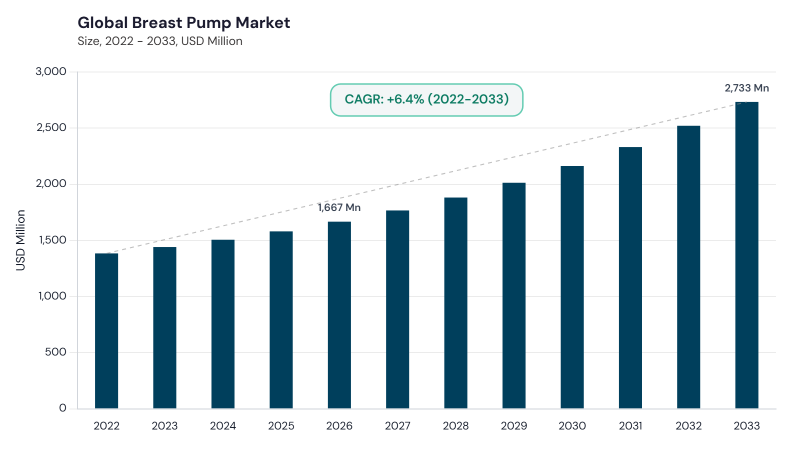
The Global Breast Pump Market is expected to reach USD 2733.5 million by 2033, growing at a CAGR of 7.3% during (2026 – 2033).
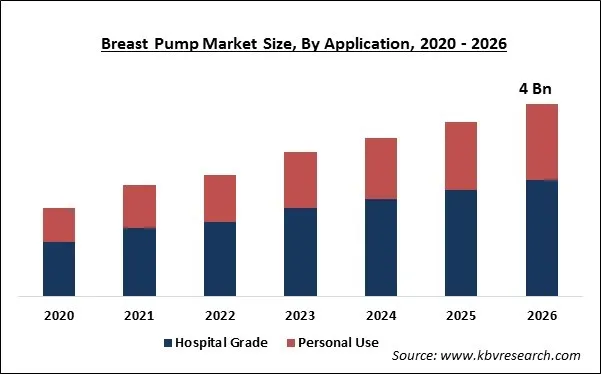
Increasing breastfeeding awareness, rising workforce participation among women, and growing demand for convenient maternal care solutions are supporting product adoption across hospitals and homecare settings. Demand is increasingly shaped by comfort, portability, hygiene, efficient milk expression, and flexible feeding schedules. Manufacturers are focusing on ergonomic designs, adjustable suction settings, closed-system technology, lightweight construction, smart monitoring, and affordable pumping solutions.
The breast pump industry has evolved from basic manually operated devices toward electric, portable, wearable, and digitally connected pumping systems. Electric pumps marked an important shift toward more efficient milk expression, while subsequent innovation emphasized portability, comfort, hygiene, and designs that mimic natural feeding patterns. More recently, wearable technology, smartphone connectivity, personalized tracking, and user-friendly interfaces have expanded breast pump adoption from predominantly clinical settings toward home and mobile use.
Competition increasingly revolves around suction efficiency, battery performance, quiet operation, ergonomic design, portability, smart connectivity, and affordability. Established manufacturers benefit from research capabilities, healthcare relationships, and distribution scale, while specialized entrants increasingly compete through wearable and app-connected products. Partnerships with healthcare providers, lactation consultants, technology firms, insurers, and distributors are also strengthening product credibility and market accessibility.
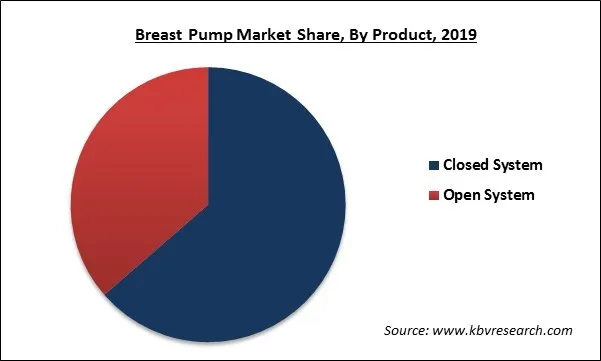
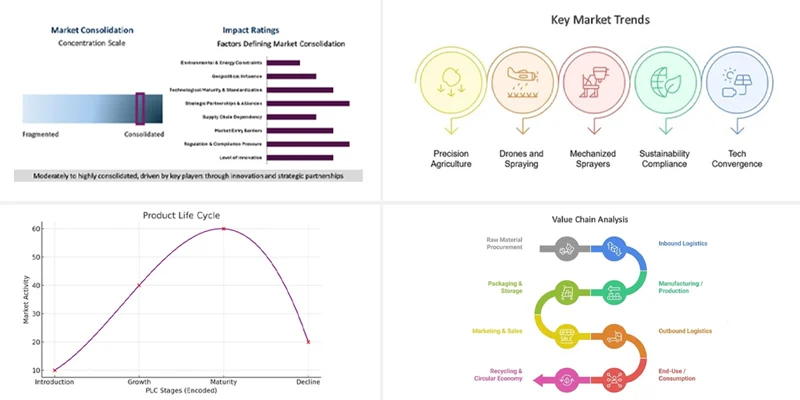

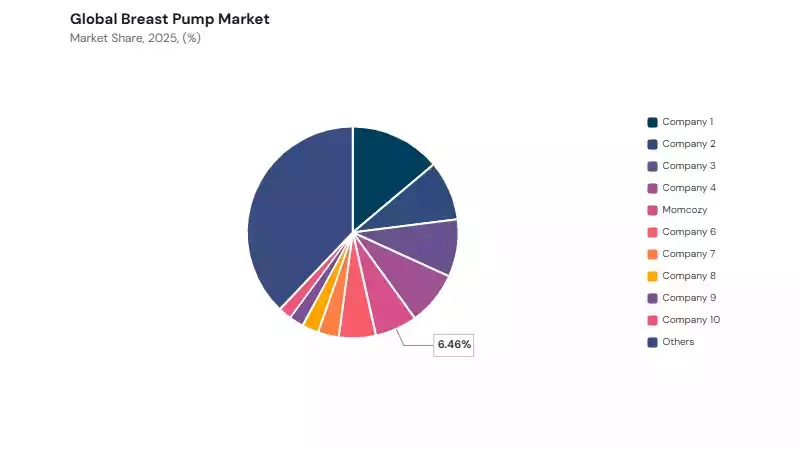
The Breast Pump Market exhibits a moderately consolidated and innovation-driven competitive landscape. Medela AG maintains the leading competitive position through its broad hospital-grade and consumer pumping portfolio, while Koninklijke Philips N.V. and Uzinmedicare Co., Ltd. maintain strong positions through established electric and maternal-care offerings. Pigeon Corporation also benefits from its broad infant-care ecosystem, while Momcozy and Willow Innovations are strengthening competition through wearable and connected pumping technologies. Ameda, Artsana, and Motif Medical further contribute through clinical, consumer, and insurance-supported solutions. Future competition is expected to focus on wearable comfort, intelligent pumping technology, digital integration, insurance accessibility, and personalized lactation support.
On the basis of Configuration, the Breast Pump Market is classified into Single Pumps and Double Pumps. The Single Pumps market dominated the Global Breast Pump Market by Configuration in 2025, and would continue to be a dominant market till 2033; thereby, achieving a market value of USD 1531.1 million by 2033, growing at a CAGR of 7 % during the forecast period. The Double Pumps market is expected to witness a CAGR of 7.8% during (2026 - 2033).
Single Pumps address occasional and part-time pumping requirements through compact size, affordability, portability, and ease of handling. Double Pumps enable simultaneous milk expression from both breasts, improving time efficiency and milk output for frequent users. Increasing workforce participation, reimbursement availability, adjustable suction settings, rechargeable operation, quieter motors, and closed-system technology are strengthening demand across both configurations.
On the basis of Technology, the Breast Pump Market is classified into Electric Pumps, Manual Pumps, and Wearable (Hands-free) Pumps. The Electric Pumps market dominated the Global Breast Pump Market by Technology in 2025, and would continue to be a dominant market till 2033; thereby, achieving a market value of USD 1294.6 million by 2033, growing at a CAGR of 6.9 % during the forecast period. The Manual Pumps market is expected to witness a CAGR of 7.6% during (2026 - 2033).
Electric Pumps provide automated milk expression, adjustable suction control, speed, and convenience for frequent use. Manual Pumps remain relevant for consumers prioritizing affordability, portability, simplicity, and electricity-independent operation. Wearable Pumps represent a rapidly evolving technology category focused on discreet, cordless, hands-free operation and greater mobility, with miniaturized motors, rechargeable batteries, noise reduction, and app connectivity strengthening product development.
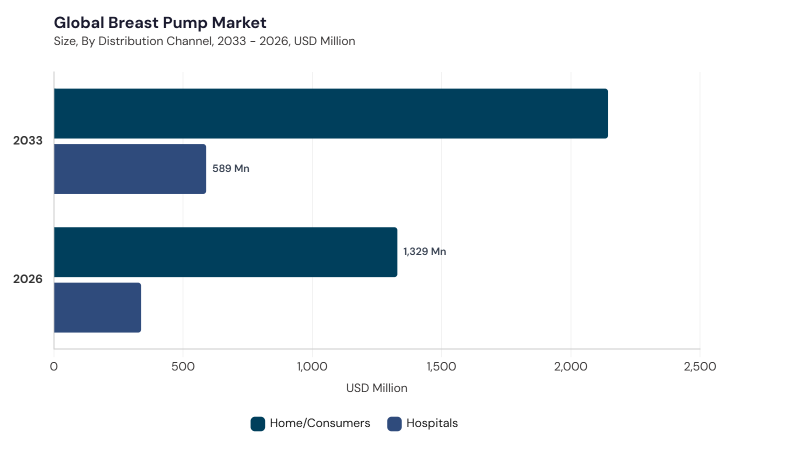
On the basis of Distribution Channel, the Breast Pump Market is classified into Home/Consumers and Hospitals. The Home/Consumers market dominated the Global Breast Pump Market by Distribution Channel in 2025, and would continue to be a dominant market till 2033; thereby, achieving a market value of USD 2144.2 million by 2033, growing at a CAGR of 7.1 % during the forecast period. Additionally, The Hospitals market is expected to witness highest CAGR of 8.3% during (2026 - 2033).
Home/Consumers includes mothers purchasing manual, electric, double electric, and wearable pumps through pharmacies, maternity stores, manufacturer websites, and online marketplaces. Demand emphasizes portability, comfort, quiet operation, battery performance, hygiene, and affordability. Hospitals require reliable hospital-grade electric pumps for maternity wards, NICUs, birthing centers, and lactation clinics, with procurement emphasizing clinical performance, closed systems, infection control, regulatory compliance, durability, and technical support.
Free Valuable Insights: Breast Pump Market Size to reach $2733.5 Million by 2033
Region-wise, the Breast Pump Market is analyzed across North America, Europe, Asia Pacific, and LAMEA. The North America market dominated the Global Breast Pump Market by Region in 2025, and would continue to be a dominant market till 2033; thereby, achieving a market value of USD 1064.3 million by 2033, growing at a CAGR of 6.7 % during the forecast period. The Asia Pacific market is expected to witness a CAGR of 8.2% during (2026 - 2033). Additionally, The Europe market is expected to witness a CAGR of 7.1% during (2026 - 2033).
North America maintains the leading position, supported by breastfeeding awareness, reimbursement policies, established healthcare infrastructure, and adoption of advanced pumping technologies. Europe benefits from maternal and infant health initiatives and demand for innovative breastfeeding solutions, while Asia Pacific is supported by improving healthcare access, increasing awareness, and evolving maternal-care requirements. LAMEA continues to develop through expanding maternal healthcare services and improving availability of breastfeeding support products.
| Report Attribute | Details |
|---|---|
| Market size value in 2026 | USD 1666.7 million |
| Market size forecast in 2033 | USD 2733.5 million |
| Base Year | 2025 |
| Historical Period | 2022 to 2024 |
| Forecast Period | 2026 to 2033 |
| Revenue Growth Rate | CAGR of 7.3% from 2026 to 2033 |
| Number of Pages | 452 |
| Tables | 540 |
| Report Coverage | Market Trends, Revenue Estimation and Forecast, Segmentation Analysis, Regional and Country Breakdown, Competitive Landscape, Market Share Analysis, Company Profiling, Companies Strategic Developments, SWOT Analysis, Product Life Cycle Analysis, Value Chain Analysis, Market Consolidation Analysis, Key Customer Criteria, Pandemic Impact Analysis, and Winning Imperatives |
| Segments Covered | Configuration, Technology, Distribution Channel, and Geography |
| Country Scope |
|
| Companies Included | Medela AG; Koninklijke Philips N.V.; Uzinmedicare Co., Ltd.; Pigeon Corporation; Momcozy; Willow Innovations, Inc.; Ameda, Inc.; Artsana S.p.A.; Motif Medical |
By Configuration
By Technology
By Distribution Channel
By Geography
Expected to reach USD 2733.5 million by 2033, growing at 7.3% CAGR during the forecast period (2026-2033).
North America is expected to dominate the market, driven by advanced healthcare infrastructure and high awareness.
Medela AG, Koninklijke Philips N.V., Uzinmedicare Co., Ltd., Pigeon Corporation, and Momcozy are key players.
Increasing demand for convenient breastfeeding solutions and digital health integration are key growth drivers.
The market is expected to grow at 7.3% CAGR during the forecast period (2026-2033).
Regulatory and insurance factors are enhancing market accessibility, contributing to growth.
Our team of dedicated experts can provide you with attractive expansion opportunities for your business.








 Unique Offerings