The sample copy of this report is available for access.
The Asia Pacific Breast Pump Market is expected to reach USD 560.6 million by 2030, growing at a CAGR of 8.2% during (2026 – 2033).
Breast pump adoption across Asia Pacific developed alongside increasing awareness of breastfeeding benefits, expanding maternal healthcare support, and rising workforce participation among women. Early demand centered on basic manual devices, while the introduction of battery-operated and electric pumps significantly improved convenience, efficiency, and user comfort. Product development later progressed toward quieter motors, better suction control, compact designs, and enhanced hygiene standards. More recently, wearable pumps, mobile connectivity, lactation tracking, and personalized pumping settings have transformed breast pumps into increasingly sophisticated maternal care solutions serving both household and clinical requirements.
Digital health integration, rising maternal wellness awareness, remote lactation support, and increasing demand for convenient pumping solutions are now shaping regional market development. Manufacturers are focusing on battery-efficient, lightweight, quieter, wearable, and app-connected devices that provide greater flexibility to working mothers. E-commerce and digital health platforms are also expanding product accessibility, while healthcare partnerships support consumer education and institutional adoption. At the same time, growing emphasis on product safety, eco-friendly materials, localized designs, and affordability is encouraging suppliers to develop differentiated portfolios suited to the region's diverse economic and healthcare environments.
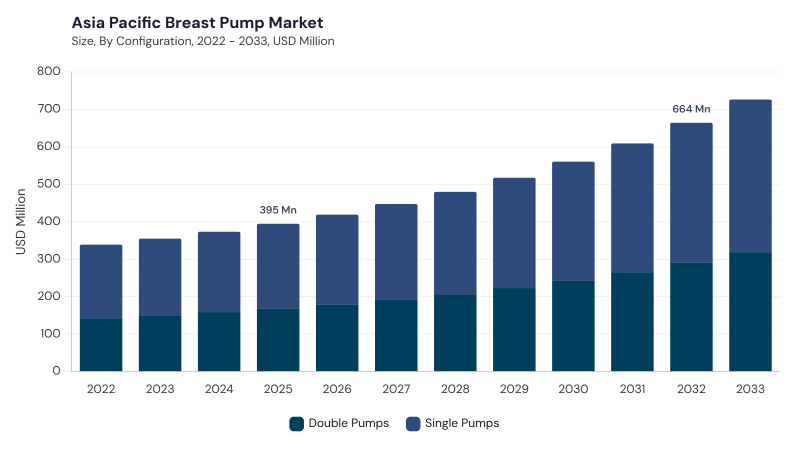
Based on Configuration, the market is segmented into Single Pumps and Double Pumps. The Single Pumps market dominated the Asia Pacific Breast Pump Market by Configuration in 2025, and would continue to be a dominant market till 2033; thereby, achieving a market value of USD 317.8 million by 2030, growing at a CAGR of 7.8 % during the forecast period. The Double Pumps market is expected to witness a CAGR of 8.6% during (2026 - 2033).
Single pumps remain important for mothers seeking lightweight, portable, economical, and easy-to-use devices for occasional milk expression. Improvements in suction comfort, quieter operation, battery-powered designs, and user-friendly construction continue to strengthen their relevance across price-sensitive and emerging markets. Double pumps cater primarily to working mothers and frequent users requiring simultaneous milk expression and reduced pumping time. Adjustable suction patterns, ergonomic designs, improved motor efficiency, digital monitoring, and growing availability through e-commerce channels are strengthening demand for double pump configurations, particularly across urban and higher-income consumer segments.
Based on Technology, the market is segmented into Electric Pumps, Manual Pumps, and Wearable (Hands-free) Pumps. The Electric Pumps market dominated the Asia Pacific Breast Pump Market by Technology in 2025, and would continue to be a dominant market till 2033; thereby, achieving a market value of USD 269.3 million by 2030, growing at a CAGR of 7.8 % during the forecast period. The Manual Pumps market is expected to witness a CAGR of 8.4% during (2026 - 2033).
Electric pumps provide automated suction, adjustable pumping cycles, rechargeable operation, and faster milk expression, making them suitable for working mothers, frequent users, and healthcare institutions. Manual pumps continue to serve price-sensitive consumers seeking portable, simple, and electricity-independent devices for occasional pumping, particularly in developing and resource-constrained markets. Wearable (Hands-free) Pumps are gaining attention among urban consumers requiring greater mobility and discretion, supported by improvements in miniaturized motors, battery efficiency, noise reduction, smart connectivity, and app-based monitoring. Their higher cost and comparatively limited availability continue to influence adoption outside affluent urban markets.
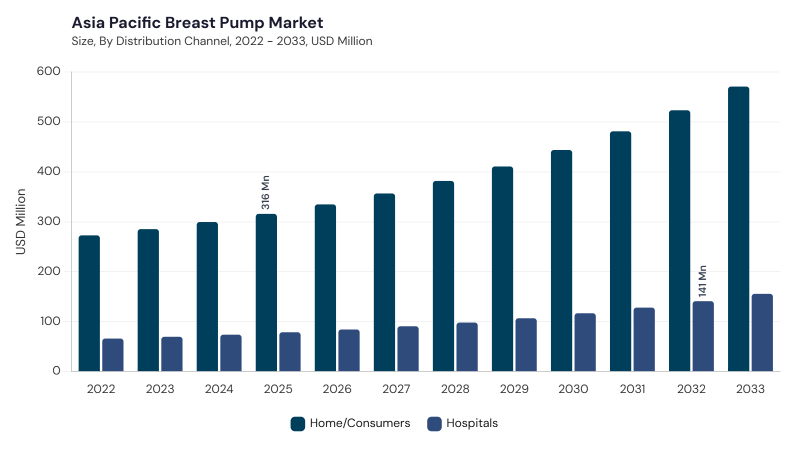
Based on Distribution Channel, the market is segmented into Home/Consumers and Hospitals. Home/Consumers purchase breast pumps through pharmacies, baby-product stores, online marketplaces, department stores, and direct brand platforms, with demand spanning affordable manual pumps, standard electric models, double pumps, rechargeable devices, and premium wearable systems.
Consumers increasingly consider portability, comfort, ease of cleaning, product authenticity, localized instructions, and after-sales support when selecting products. Hospitals use professional-grade pumps across maternity wards, neonatal intensive care units, birthing facilities, and maternal health centers where durability, hygiene, adjustable suction, regulatory approval, sterilization, and technical service are essential. Institutional demand continues to benefit from expanding maternity infrastructure and maternal-child healthcare programs across the region.
Free Valuable Insights: Breast Pump Market is Predicted to reach USD 2733.5 Million billion by 2033, at a CAGR of 7.3%
Based on Country, the market is segmented into China, Japan, India, South Korea, Singapore, Malaysia, and Rest of Asia Pacific. The China market dominated the Asia Pacific Breast Pump Market by Country in 2025, and would continue to be a dominant market till 2033; thereby, achieving a market value of USD 159.4 million by 2030, growing at a CAGR of 6.3 % during the forecast period. The Japan market is expected to witness a CAGR of 7.5% during (2026 - 2033). Additionally, The India market is expected to witness a CAGR of 8.8% during (2026 - 2033).
Across Asia Pacific, breast pump demand is increasingly influenced by maternal health awareness, workforce participation, digital adoption, and the need for more convenient lactation support. China is expanding smart, ergonomic, and sustainability-oriented products through broader retail access, while Japan is emphasizing portable, quiet, connected, and safety-focused devices. India is seeing stronger adoption of affordable electric pumps, e-commerce distribution, app-enabled features, and hygienic designs, whereas South Korea continues to advance wearable pumps, digital tracking, and public-health-supported access. Singapore is focusing on personalized smart pumps, quieter operation, and sustainable materials, while Malaysia is strengthening wearable, closed-system, and app-connected solutions suited to working mothers. Rest of Asia Pacific is also progressing through portable designs, eco-conscious materials, digital distribution, and localized maternal-care products.

By Configuration
By Technology
By Distribution Channel
By Country
Set to reach $560.6 Million by 2030, growing at 8.2% CAGR during (2026–2033).
China leads with a market value of USD 159.4 million by 2030, growing at a CAGR of 6.3% during the forecast period.
Single Pumps will achieve USD 317.8 million by 2030, growing at a 7.8% CAGR during the forecast period.
The India market is expected to witness a CAGR of 8.8% during (2026 - 2033).
Electric Pumps will reach USD 269.3 million by 2030, growing at a 7.8% CAGR during the forecast period.
Our team of dedicated experts can provide you with attractive expansion opportunities for your business.




 Unique Offerings