The sample copy of this report is available for access.
The LAMEA Agentic Commerce Market is expected to reach USD 1.4 billion by 2029, growing at a CAGR of 35.5% during (2026 – 2033).
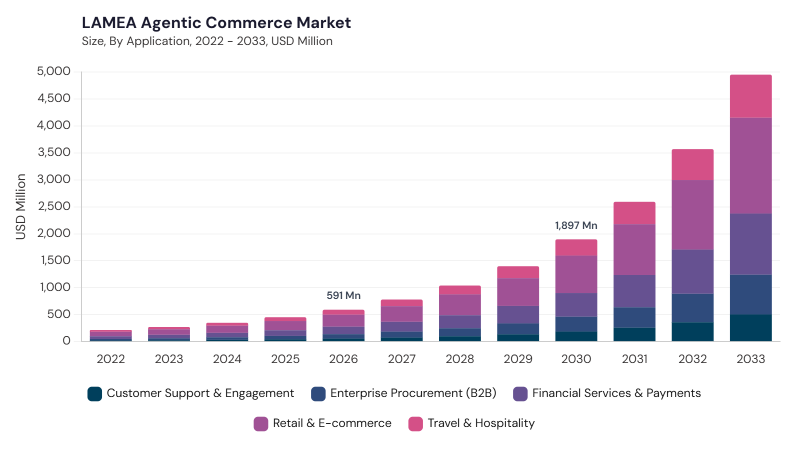
The LAMEA Agentic Commerce Market developed from the wider use of artificial intelligence in e-commerce, digital payments, customer service, and recommendation-based shopping across Latin America, the Middle East, and Africa. Early systems focused on simple automation, digital assistants, rule-based recommendations, and limited customer interaction support. Over time, progress in natural language processing, machine learning, intent classification, and autonomous agent frameworks enabled AI systems to move from passive assistance toward proactive transaction execution. The market gradually expanded as AI-powered payment processors, commerce platforms, agent frameworks, and retail technology providers entered the ecosystem.
The LAMEA Agentic Commerce Market is being shaped by smartphone adoption, digital payment expansion, AI-powered shopping, enterprise automation, government digital initiatives, and localized agentic AI development. Businesses are adopting agentic commerce tools to improve customer engagement, automate procurement, support dynamic pricing, manage transactions, strengthen fraud monitoring, and personalize product discovery. Demand is supported by online marketplace growth, fintech ecosystems, tourism modernization, smart city initiatives, mobile commerce, and enterprise digital transformation across banking, retail, energy, telecom, and public-sector operations. Vendors are focusing on multilingual AI, secure transaction flows, scalable cloud platforms, on-device intelligence, compliance-ready architecture, and regional customization.
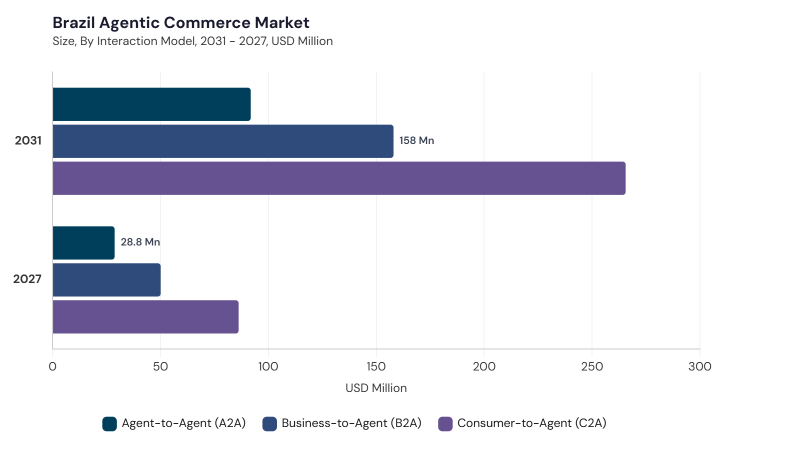
Based on Interaction Model, the market is segmented into Consumer-to-Agent (C2A), Business-to-Agent (B2A), and Agent-to-Agent (A2A). The Consumer-to-Agent (C2A) market dominated the LAMEA Agentic Commerce Market by Interaction Model in 2025, and would continue to be a dominant market till 2033; thereby, achieving a market value of USD 730.2 million by 2029, growing at a CAGR of 35 % during the forecast period. The Business-to-Agent (B2A) market is expected to witness a CAGR of 35.9% during (2026 - 2033). The Agent-to-Agent (A2A) market is expected to witness a CAGR of 36.1% during (2026 - 2033).
Consumer-to-Agent (C2A) leads due to rising use of AI-enabled online shopping, virtual assistants, personalized product discovery, mobile commerce, and digital payment-supported consumer journeys. These agents help users research options, compare offers, receive recommendations, complete purchases, and access customer support with reduced manual effort. Business-to-Agent (B2A) is gaining importance as enterprises deploy autonomous agents for procurement, customer engagement, inventory management, fraud detection, workflow automation, and operational decision-making. Agent-to-Agent (A2A) remains at an early stage, but its relevance is increasing through logistics optimization, intelligent enterprise coordination, industrial automation, smart contracts, and autonomous collaboration across commercial ecosystems.
Based on Technology, the market is segmented into Generative AI & Large Language Models (LLMs), Multi-Agent Systems, On-Device AI, and Blockchain & Smart Contracts. The Generative AI & Large Language Models (LLMs) market dominated the LAMEA Agentic Commerce Market by Technology in 2025, and would continue to be a dominant market till 2033; thereby, achieving a market value of USD 652.2 million by 2029, growing at a CAGR of 34.7 % during the forecast period. The Multi-Agent Systems market is expected to witness a CAGR of 35.7% during (2026 - 2033). Additionally, The On-Device AI market is expected to witness highest CAGR of 36.5% during (2026 - 2033).
Generative AI & Large Language Models (LLMs) lead due to their role in customer engagement, conversational commerce, intent recognition, automated recommendations, content generation, and multilingual digital support across diverse regional markets. These technologies enable AI agents to interpret consumer requests, generate contextual responses, personalize buying journeys, and support commerce interactions across text, voice, and digital channels. Multi-Agent Systems are gaining adoption in logistics, smart city projects, procurement workflows, enterprise operations, and decentralized decision-making. On-Device AI supports low-latency and privacy-focused experiences on smartphones and connected devices, while Blockchain & Smart Contracts are gradually adopted for cross-border payments, digital identity, trade documentation, secure settlements, and automated agreements.
Based on Application, the market is segmented into Retail & E-commerce, Financial Services & Payments, Travel & Hospitality, Enterprise Procurement (B2B), and Customer Support & Engagement. Retail & E-commerce leads due to expanding online marketplaces, rising internet accessibility, mobile-first shopping, AI-assisted purchasing, automated checkout support, and growing consumer confidence in digital commerce.
Financial Services & Payments follows as fintech platforms, digital banking providers, payment processors, and mobile wallet ecosystems use AI agents for fraud monitoring, payment routing, transaction automation, and compliance support. Travel & Hospitality benefits from tourism investments, digital booking platforms, itinerary planning, dynamic offers, and personalized guest services. Enterprise Procurement (B2B) and Customer Support & Engagement add demand through vendor discovery, purchase automation, virtual assistants, conversational AI, multilingual support, complaint resolution, post-purchase engagement, and service accessibility across diverse markets.
Free Valuable Insights: Agentic Commerce Market Size Worth USD 60.0 Billion billion by 2033
Based on Country, the market is segmented into Brazil, Argentina, UAE, Saudi Arabia, South Africa, Nigeria, and Rest of LAMEA. The Brazil market dominated the LAMEA Agentic Commerce Market by Country in 2025, and would continue to be a dominant market till 2033; thereby, achieving a market value of USD 286.9 million by 2029, growing at a CAGR of 33.4 % during the forecast period. The Argentina market is expected to witness a CAGR of 37% during (2026 - 2033). Additionally, The UAE market is expected to witness a CAGR of 34.3% during (2026 - 2033).
Brazil leads due to its expanding e-commerce base, fintech activity, AI regulation focus, digital payment adoption, and growing use of autonomous agents across retail and financial services. Argentina supports market growth through localized AI platforms, digital commerce modernization, fraud prevention demand, and increasing use of agentic AI in financial transaction management. The UAE contributes through smart city programs, national AI strategies, Arabic-language AI development, venture funding, and enterprise-grade autonomous commerce deployment. Saudi Arabia, South Africa, and Nigeria add momentum through Vision-led AI initiatives, fintech growth, mobile commerce, localized AI development, digital infrastructure investment, and enterprise automation, while Rest of LAMEA benefits from digital inclusion, payment ecosystem expansion, and emerging AI commerce adoption.

By Interaction Model
By Technology
By Application
By Country
Set to reach $1.4 Billion by 2029, growing at 35.5% CAGR during 2026-2033.
Brazil leads, achieving $286.9 million by 2029, with a CAGR of 33.4% during the forecast period.
Generative AI & Large Language Models dominate, reaching $652.2 million by 2029 at a 34.7% CAGR.
The Consumer-to-Agent segment will reach $730.2 million by 2029, growing at a 35% CAGR during the forecast period.
The UAE market is expected to witness a CAGR of 34.3% during 2026-2033.
The On-Device AI segment is expected to witness the highest CAGR of 36.5% during 2026-2033.
Our team of dedicated experts can provide you with attractive expansion opportunities for your business.




 Unique Offerings