The sample copy of this report is available for access.
The Asia Pacific Agentic Commerce Market is expected to reach USD 6.4 billion by 2030, growing at a CAGR of 34.6% during (2026 – 2033).
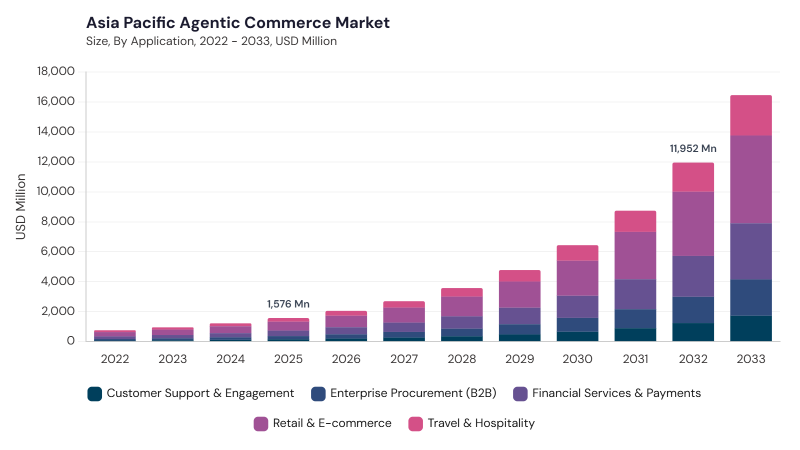
The Asia Pacific Agentic Commerce Market developed from the broader expansion of digital commerce, mobile payments, online retail platforms, and artificial intelligence adoption across the region. Early commerce systems relied mainly on manual user inputs, static algorithms, recommendation engines, and basic automation with limited decision-making ability. Over time, advances in natural language processing, machine learning, cloud computing, and autonomous AI frameworks enabled agents to support purchasing, negotiation, service delivery, and workflow execution. Initial adoption was visible in technology-forward economies such as China, Japan, South Korea, and Singapore, where digital platforms began embedding intelligent agents into consumer and enterprise commerce.
The Asia Pacific Agentic Commerce Market is being shaped by enterprise AI adoption, super app ecosystems, personalized commerce, digital payments, smart factories, multilingual AI, and regional data governance requirements. Businesses are deploying agentic AI to automate product discovery, manage customer support, improve procurement, personalize recommendations, forecast demand, and optimize supply chain actions. Demand is supported by booming e-commerce activity, live commerce, social commerce, fintech expansion, smartphone penetration, cloud infrastructure growth, and increasing use of AI across banking, telecom, manufacturing, and retail. Vendors are focusing on regional language models, privacy-focused AI, secure payment integration, interoperable agent systems, and scalable cloud and edge AI platforms.
Based on Interaction Model, the market is segmented into Consumer-to-Agent (C2A), Business-to-Agent (B2A), and Agent-to-Agent (A2A). The Consumer-to-Agent (C2A) market dominated the Asia Pacific Agentic Commerce Market by Interaction Model in 2025, and would continue to be a dominant market till 2033; thereby, achieving a market value of USD 3.3 billion by 2030, growing at a CAGR of 34.1 % during the forecast period. The Business-to-Agent (B2A) market is expected to witness a CAGR of 35.1% during (2026 - 2033). The Agent-to-Agent (A2A) market is expected to witness a CAGR of 35.2% during (2026 - 2033).
Consumer-to-Agent (C2A) leads due to widespread use of mobile commerce, AI shopping assistants, virtual product advisors, super apps, personalized recommendation engines, and conversational commerce tools. These agents help consumers search, compare, select, and purchase products with less manual effort while improving convenience and personalization. Business-to-Agent (B2A) is gaining traction as enterprises use autonomous agents for procurement, supplier coordination, inventory management, customer support, workflow automation, and banking operations. Agent-to-Agent (A2A) remains smaller but is progressing through use cases in intelligent logistics, smart factories, automated negotiations, multi-agent supply chains, and autonomous enterprise ecosystems across advanced Asia Pacific economies.
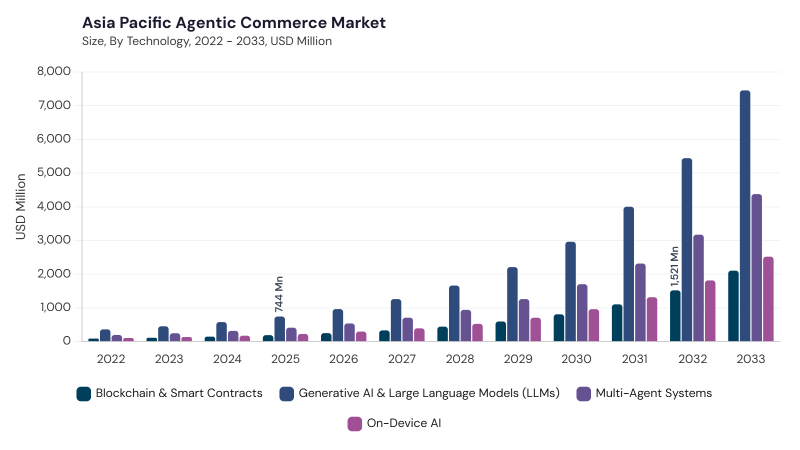
Based on Technology, the market is segmented into Generative AI & Large Language Models (LLMs), Multi-Agent Systems, On-Device AI, and Blockchain & Smart Contracts. The Generative AI & Large Language Models (LLMs) market dominated the Asia Pacific Agentic Commerce Market by Technology in 2025, and would continue to be a dominant market till 2033; thereby, achieving a market value of USD 3.0 billion by 2030, growing at a CAGR of 33.9 % during the forecast period. The Multi-Agent Systems market is expected to witness a CAGR of 34.9% during (2026 - 2033). Additionally, The On-Device AI market is expected to witness highest CAGR of 35.7% during (2026 - 2033).
Generative AI & Large Language Models (LLMs) lead due to their strong role in multilingual conversational commerce, virtual shopping assistants, automated product content, customer service automation, and personalized engagement across diverse regional markets. These models enable AI agents to understand local languages, interpret consumer intent, generate responses, and support more natural commerce interactions. Multi-Agent Systems are gaining adoption in manufacturing, warehouse automation, logistics, supply chain orchestration, dynamic pricing, and enterprise decision workflows. On-Device AI supports privacy-focused and low-latency commerce experiences on smartphones and connected devices, while Blockchain & Smart Contracts are emerging in cross-border payments, trade finance, digital identity, decentralized marketplaces, and automated contract execution.
Based on Application, the market is segmented into Retail & E-commerce, Financial Services & Payments, Travel & Hospitality, Enterprise Procurement (B2B), and Customer Support & Engagement. Retail & E-commerce leads due to rapid growth in online marketplaces, mobile commerce, social commerce, live commerce, AI-enabled product discovery, automated purchasing, and personalized customer journeys.
Financial Services & Payments follows as digital wallets, QR-code payments, embedded finance, fraud monitoring, credit evaluation, payment routing, and AI-powered financial assistance expand across the region. Travel & Hospitality benefits from intelligent itinerary planning, booking support, dynamic pricing, and personalized service coordination. Enterprise Procurement (B2B) and Customer Support & Engagement add demand through supplier evaluation, purchase automation, contract management, multilingual chatbots, sentiment analysis, automated issue resolution, and scalable support across culturally diverse markets.
Free Valuable Insights: Agentic Commerce Market is Predicted to reach USD 60.0 Billion billion by 2033, at a CAGR of 33.9%
Based on Country, the market is segmented into China, Japan, India, South Korea, Singapore, Malaysia, and Rest of Asia Pacific. The China market dominated the Asia Pacific Agentic Commerce Market by Country in 2025, and would continue to be a dominant market till 2033; thereby, achieving a market value of USD 1.9 billion by 2030, growing at a CAGR of 32.4 % during the forecast period. The Japan market is expected to witness a CAGR of 33.7% during (2026 - 2033). Additionally, The India market is expected to witness a CAGR of 35.5% during (2026 - 2033).
China leads due to its strong digital commerce ecosystem, AI innovation, cloud infrastructure, mobile payments, logistics automation, and large-scale adoption of intelligent agents across retail, finance, and platform commerce. Japan supports market growth through labor-saving automation, personalized retail AI, customer service modernization, secure commerce frameworks, and adoption of agentic platforms in retail and manufacturing. India is advancing through e-commerce growth, multilingual customer support needs, digital payment expansion, AI-enabled logistics, inventory automation, and regional marketplace partnerships. South Korea, Singapore, and Malaysia add momentum through telecom-linked AI services, regulatory innovation, privacy-focused AI, SME digitization, and localized agentic solutions, while Rest of Asia Pacific benefits from digital commerce expansion and enterprise automation.

By Interaction Model
By Technology
By Application
By Country
Set to reach $6.4 Billion by 2030, growing at 34.6% CAGR during 2026-2033.
China leads with $1.9 billion by 2030, growing at a CAGR of 32.4% during the forecast period.
Generative AI & LLMs dominate, reaching $3.0 billion by 2030 with a CAGR of 33.9% during the forecast period.
C2A segment reaches $3.3 billion by 2030, growing at a CAGR of 34.1% during the forecast period.
India's market is expected to witness a CAGR of 35.5% during 2026-2033.
On-Device AI segment expected to witness highest CAGR of 35.7% during 2026-2033.
Our team of dedicated experts can provide you with attractive expansion opportunities for your business.




 Unique Offerings