The sample copy of this report is available for access.
The Europe Agentic Commerce Market is expected to reach USD 8.8 billion by 2031, growing at a CAGR of 33.7% during (2026 – 2033).
The Europe Agentic Commerce Market developed from early autonomous software agents and rule-based automation used for commerce, supply chain, inventory, and digital retail functions. Initially, these systems supported limited decision-making and basic workflow automation rather than independent commercial actions. Over time, progress in machine learning, natural language processing, generative AI, and multi-agent architectures enabled more advanced agentic systems capable of autonomous decision execution. European adoption evolved cautiously due to strong data privacy expectations, regulatory scrutiny, and demand for transparent AI behavior.
The Europe Agentic Commerce Market is being shaped by AI-first retail strategies, autonomous risk management, localized governance requirements, multilingual engagement, and demand for trusted AI-driven commerce. Enterprises are adopting agentic platforms to automate customer journeys, personalize product discovery, manage inventory, improve procurement decisions, and reduce transaction friction. Demand is supported by mature e-commerce networks, fintech adoption, Open Banking, cross-border retail, digital procurement modernization, and rising interest in responsible AI frameworks. Vendors are focusing on explainable AI, secure identity, audit-ready workflows, interoperability, privacy-preserving intelligence, and region-specific compliance capabilities.
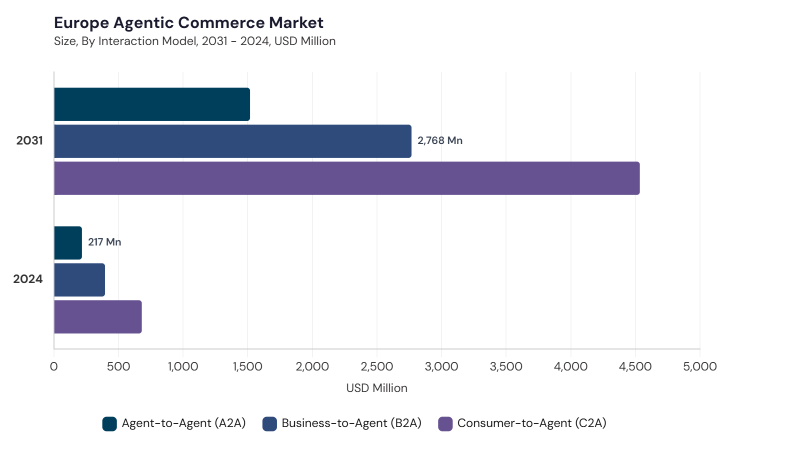
Based on Interaction Model, the market is segmented into Consumer-to-Agent (C2A), Business-to-Agent (B2A), and Agent-to-Agent (A2A). The Consumer-to-Agent (C2A) market dominated the Europe Agentic Commerce Market by Interaction Model in 2025, and would continue to be a dominant market till 2033; thereby, achieving a market value of USD 8347.4 million by 2031, growing at a CAGR of 33.2 % during the forecast period. The Business-to-Agent (B2A) market is expected to witness a CAGR of 34.2% during (2026 - 2033). The Agent-to-Agent (A2A) market is expected to witness a CAGR of 34.2% during (2026 - 2033).
Consumer-to-Agent (C2A) leads due to rising use of multilingual AI shopping assistants, virtual product advisors, personalized recommendation agents, and autonomous customer-facing commerce tools across European digital marketplaces. These agents help consumers search products, compare options, receive tailored suggestions, and complete purchases with greater convenience while respecting privacy and consent requirements. Business-to-Agent (B2A) is gaining strong adoption as enterprises use agents for procurement automation, inventory planning, pricing optimization, compliance checks, and supplier coordination. Agent-to-Agent (A2A) remains at an earlier stage, but its role is expanding through pilots in autonomous supply chains, smart contracts, agent negotiation, industrial automation, and interoperable commerce ecosystems.
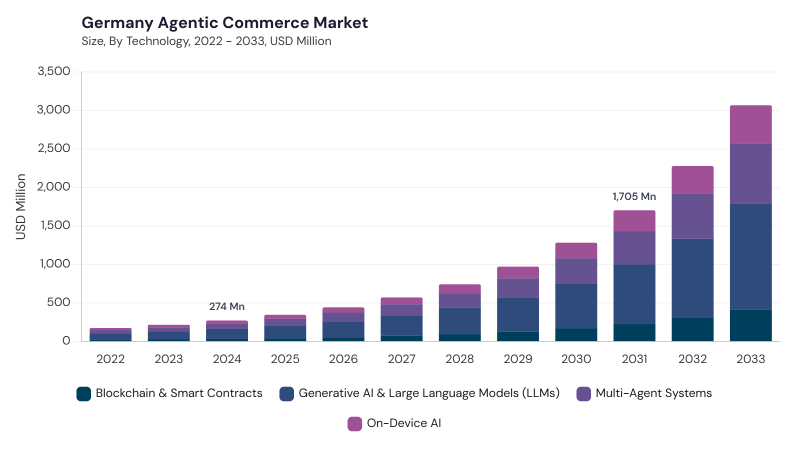
Based on Technology, the market is segmented into Generative AI & Large Language Models (LLMs), Multi-Agent Systems, On-Device AI, and Blockchain & Smart Contracts. The Generative AI & Large Language Models (LLMs) market dominated the Europe Agentic Commerce Market by Technology in 2025, and would continue to be a dominant market till 2033; thereby, achieving a market value of USD 7407.9 million by 2031, growing at a CAGR of 33 % during the forecast period. The Multi-Agent Systems market is expected to witness a CAGR of 33.9% during (2026 - 2033). Additionally, The On-Device AI market is expected to witness highest CAGR of 34.7% during (2026 - 2033).
Generative AI & Large Language Models (LLMs) lead due to their role in conversational commerce, multilingual customer support, intelligent product discovery, automated content generation, and personalized engagement across diverse European markets. These technologies enable AI agents to understand user intent, generate contextual responses, guide purchase journeys, and improve customer interaction quality. Multi-Agent Systems are gaining traction as businesses seek coordinated autonomous agents for supply chain workflows, fraud detection, procurement, pricing, and resource optimization. On-Device AI supports privacy-focused and low-latency commerce experiences, while Blockchain & Smart Contracts are selectively adopted for secure payments, digital identity, automated agreements, transparent supply chains, and auditable transaction execution.
Based on Application, the market is segmented into Retail & E-commerce, Financial Services & Payments, Travel & Hospitality, Enterprise Procurement (B2B), and Customer Support & Engagement. Retail & E-commerce leads due to strong demand for AI-enabled personalization, multilingual product discovery, autonomous shopping assistance, dynamic pricing, fraud-aware checkout, and omnichannel customer journeys.
Financial Services & Payments follows as banks, fintech firms, and payment providers adopt intelligent agents for payment orchestration, fraud prevention, credit decisions, transaction monitoring, and compliance automation. Travel & Hospitality benefits from AI-enabled itinerary planning, booking management, dynamic offers, and personalized guest support across Europe’s tourism ecosystem. Enterprise Procurement (B2B) and Customer Support & Engagement add demand through supplier selection, purchase automation, contract workflows, conversational support, real-time issue resolution, sentiment analysis, and privacy-compliant service automation.
Free Valuable Insights: The Worldwide Agentic Commerce Market is projected to reach USD 60.0 Billion billion by 2033, at a CAGR of 33.9%
Based on Country, the market is segmented into Germany, UK, France, Russia, Spain, Italy, and Rest of Europe. The Germany market dominated the Europe Agentic Commerce Market by Country in 2025, and would continue to be a dominant market till 2033; thereby, achieving a market value of USD 1.7 billion by 2031, growing at a CAGR of 31.8 % during the forecast period. The UK market is expected to witness a CAGR of 32.5% during (2026 - 2033). Additionally, The France market is expected to witness a CAGR of 34.6% during (2026 - 2033).
Germany leads due to its strong digital infrastructure, enterprise automation demand, responsible AI focus, retail modernization, and advanced procurement ecosystems. The UK supports market growth through dynamic pricing agents, AI-enabled customer experience, fintech integration, cloud infrastructure, and strong adoption across retail and SME operations. France contributes through secure AI architectures, localized commerce automation, regulatory alignment, and collaboration between AI innovators and traditional commerce players. Russia, Spain, and Italy add demand through localized AI solutions, digital retail expansion, omnichannel commerce, automation-led efficiency, and region-specific compliance needs, while Rest of Europe benefits from trusted AI frameworks, personalization, cross-border commerce, and expanding agentic platform investments.

By Interaction Model
By Technology
By Application
By Country
Set to reach $8.8 Billion by 2031, growing at 33.7% CAGR during 2026-2033.
Germany leads with $1.7 billion by 2031, growing at 31.8% CAGR during the forecast period.
Generative AI & Large Language Models dominate, reaching $7407.9 million by 2031 at 33% CAGR during the forecast period.
Consumer-to-Agent (C2A) hits $8347.4 million by 2031, growing at 33.2% CAGR during the forecast period.
The UK market is expected to witness a CAGR of 32.5% during 2026-2033.
On-Device AI is expected to witness the highest CAGR of 34.7% during 2026-2033.
Our team of dedicated experts can provide you with attractive expansion opportunities for your business.




 Unique Offerings