The sample copy of this report is available for access.
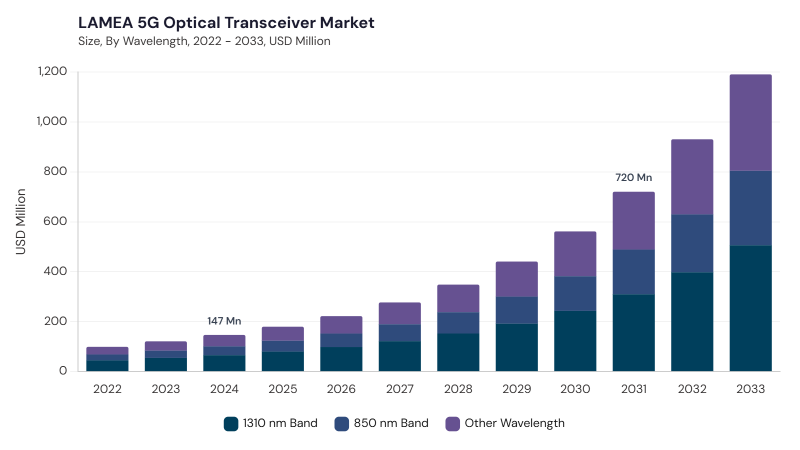
The LAMEA 5G Optical Transceiver Market is expected to reach USD 440.8 million by 2029, growing at a CAGR of 27.1% during (2026 - 2033).
The LAMEA 5G Optical Transceiver Market evolved from conventional optical modules supporting earlier mobile networks into advanced components designed for high-capacity 5G fronthaul, midhaul, and backhaul connectivity. The transition from 4G to 5G increased requirements for higher bandwidth, ultra-low latency, improved power efficiency, and reliable fiber integration across geographically diverse networks. Developments in coherent optics, advanced modulation, photonic integration, WDM, compact form factors, and fiber-to-the-antenna architectures further accelerated adoption. Optical transceivers now support commercial 5G rollouts, smart-city infrastructure, cloud connectivity, industrial automation, private networks, and regional backbone expansion across Latin America, the Middle East, and Africa.
Energy-efficient designs, small-cell densification, intelligent network management, open optical architectures, and customized regional solutions are shaping current market development. Operators increasingly require compact, low-power modules capable of supporting higher transmission rates while operating reliably across demanding climatic and infrastructure conditions. Integration of AI-based monitoring, predictive maintenance, software-configurable optics, coherent transmission, and advanced photonics is improving network efficiency and resilience. Growing private 5G, cloud computing, edge infrastructure, smart-city programs, industrial IoT, and regional localization are also encouraging more scalable and adaptable optical transceiver deployments.
Based on Infrastructure, the market is segmented into 5G Fronthaul and 5G Midhaul/Backhaul. The 5G Fronthaul market dominated the LAMEA 5G Optical Transceiver Market by Infrastructure in 2025, and would continue to be a dominant market till 2033; thereby, achieving a market value of USD 325.4 million by 2029, growing at a CAGR of 26.8 % during the forecast period. The 5G Midhaul/Backhaul market is expected to witness a CAGR of 27.9% during (2026 - 2033).
5G Fronthaul enables high-bandwidth, low-latency connectivity between radio units and centralized or distributed processing resources, making compact, energy-efficient, and synchronized optical modules important for dense urban and industrial deployments. 5G Midhaul/Backhaul aggregates traffic toward carrier facilities, edge nodes, data centers, and core networks, requiring longer reach, higher capacity, and greater reliability. Expansion of fixed-mobile convergence, coherent optics, DWDM, cloud infrastructure, enterprise connectivity, and regional fiber corridors is strengthening demand across this segment.
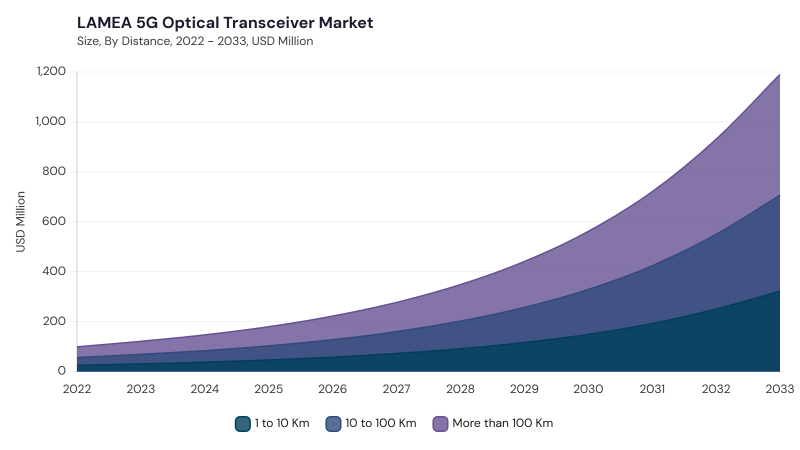
Based on Distance, the market is segmented into More than 100 Km, 10 to 100 Km, and 1 to 10 Km. The More than 100 Km market dominated the LAMEA 5G Optical Transceiver Market by Distance in 2025, and would continue to be a dominant market till 2033; thereby, achieving a market value of USD 183.8 million by 2029, growing at a CAGR of 26.3 % during the forecast period. The 10 to 100 Km market is expected to witness a CAGR of 27.5% during (2026 - 2033). Additionally, The 1 to 10 Km market is expected to witness highest CAGR of 27.8% during (2026 - 2033).
More than 100 Km transceivers support regional backbones and long-haul transport using coherent detection, advanced modulation, digital signal processing, and wavelength-division multiplexing to preserve signal quality. The 10 to 100 Km segment addresses metropolitan and regional connectivity between radio clusters, edge facilities, aggregation points, and carrier infrastructure while balancing reach and deployment economics. The 1 to 10 Km category supports localized fronthaul, small cells, airports, industrial zones, business districts, technology campuses, and private 5G environments where compact size, low latency, and power efficiency are important.
Based on Wavelength, the market is segmented into 1310 nm Band, 850 nm Band, and Other Wavelength. The 1310 nm Band market dominated the LAMEA 5G Optical Transceiver Market by Wavelength in 2025, and would continue to be a dominant market till 2033; thereby, achieving a market value of USD 191.8 million by 2029, growing at a CAGR of 26.3 % during the forecast period. The 850 nm Band market is expected to witness a CAGR of 27.6% during (2026 - 2033). Additionally, The Other Wavelength market is expected to witness highest CAGR of 27.7% during (2026 - 2033).
The 1310 nm Band provides a balance of reach, signal integrity, cost efficiency, and compatibility with existing fiber infrastructure, supporting varied 5G deployment distances. The 850 nm Band serves short-reach applications using multimode fiber across equipment locations, edge facilities, data centers, campuses, and localized network connections. Other Wavelength includes configurations such as 1550 nm and other specialized bands supporting DWDM, coherent transmission, extended reach, and improved fiber utilization. These solutions are increasingly relevant where additional fiber deployment is costly or geographically difficult.
Based on Form Factor, the market is segmented into SFP56, SFP28, QSFP28, and Other Form Factor. SFP56 supports short- to medium-range connectivity where operators require increased bandwidth without substantially expanding equipment footprint or power consumption. SFP28 remains relevant for phased 5G upgrades because of mature availability, equipment compatibility, plug-and-play operation, and favorable economics.
QSFP28 provides multi-lane 100G capability suited to aggregation, backhaul, carrier facilities, cloud connectivity, and data-center applications. Other Form Factor includes CFP, CFP2, CFP4, and specialized modules addressing ultra-long reach, high-density aggregation, thermal constraints, environmental resilience, and customized network requirements.
Based on Type, the market is segmented into 25G, 100G, 50G, 400G, and 200G. 25G provides an accessible solution for fronthaul, midhaul, and smaller-site connectivity, while 50G offers an intermediate migration path for operators requiring greater bandwidth without immediately moving to higher-capacity interfaces. 100G supports metropolitan aggregation, backhaul, core transport, cloud services, and data-center interconnection where growing traffic requires higher throughput.
200G serves advanced high-capacity transport and emerging technology hubs, whereas 400G supports hyperscale facilities, major aggregation points, cloud infrastructure, and traffic-intensive digital corridors. Coherent optics, PAM4, integrated photonics, advanced DSP, and growing data-center investment are strengthening migration toward higher transmission classes.
Free Valuable Insights: 5G Optical Transceiver Market Size Worth USD 17244.9 Million billion by 2033
Based on Country, the market is segmented into Brazil, Argentina, UAE, Saudi Arabia, South Africa, Nigeria, and Rest of LAMEA. The Brazil market dominated the LAMEA 5G Optical Transceiver Market by Country in 2025, and would continue to be a dominant market till 2033; thereby, achieving a market value of USD 125.9 million by 2029, growing at a CAGR of 25.7 % during the forecast period. The Argentina market is expected to witness a CAGR of 28.2% during (2026 - 2033). Additionally, The UAE market is expected to witness a CAGR of 25.8% during (2026 - 2033).
Across LAMEA, 5G optical transceiver adoption is being shaped by coherent optics, localization, energy efficiency, open architectures, climate-resilient design, and expanding fiber infrastructure. Brazil emphasizes coherent transceivers, advanced DSP, regional manufacturing, modular capacity upgrades, and software-defined optics, while Argentina focuses on DWDM, private 5G, RedCap, energy-efficient modules, and silicon photonics. The UAE is advancing Open RAN, 400G connectivity, localized R&D, AI-driven monitoring, and modular optical systems, whereas Saudi Arabia emphasizes silicon photonics, 400G and higher-speed optics, data-center connectivity, localization, and smart-city infrastructure. South Africa focuses on FTTA, open RAN, high-capacity modules, low-power designs, and localized supply chains, while Nigeria emphasizes coherent optics, scalable modules, regulatory modernization, localized assembly, and edge-oriented connectivity. Rest of LAMEA continues to develop compact photonic solutions, ruggedized modules, software-defined optics, adaptive modulation, and localized manufacturing suited to varied environmental and infrastructure conditions.

By Infrastructure
By Distance
By Wavelength
By Form Factor
By Type
By Country
Set to reach $440.8 Million by 2029, growing at 27.1% CAGR during 2026-2033.
Brazil leads with $125.9 million by 2029, growing at a CAGR of 25.7% during the forecast period.
The 5G Fronthaul segment will reach $325.4 million by 2029, growing at 26.8% CAGR during 2026-2033.
The 5G Midhaul/Backhaul segment is expected to witness a CAGR of 27.9% during 2026-2033.
The UAE market is expected to witness a CAGR of 25.8% during 2026-2033.
The More than 100 Km segment will reach $183.8 million by 2029, growing at a CAGR of 26.3% during 2026-2033.
Our team of dedicated experts can provide you with attractive expansion opportunities for your business.




 Unique Offerings