The sample copy of this report is available for access.
The Asia Pacific 5G Optical Transceiver Market is expected to reach USD 2425.7 million by 2030, growing at a CAGR of 25.2% during (2026 - 2033).
The Asia Pacific 5G Optical Transceiver Market evolved alongside the commercialization of 5G networks from early metropolitan trials using existing fiber backhaul toward widespread deployment of higher-capacity optical infrastructure. Progression from conventional SFP modules to SFP+, QSFP, coherent optical transceivers, and DWDM-enabled systems significantly improved bandwidth, reach, and network scalability. Expanding fiber-to-the-antenna architectures, small-cell densification, regional manufacturing capabilities, and increasingly sophisticated transport networks further strengthened adoption. Optical transceivers now form an essential part of heterogeneous 5G infrastructure spanning radio access, metro transport, data centers, edge networks, and regional backbone connectivity.
Higher data rates, localized manufacturing, AI-enabled network management, photonic integration, and energy efficiency are shaping current market development. Operators increasingly require compact transceivers supporting longer reach, higher bandwidth density, and lower power consumption for dense 5G radio environments. Expansion of hyperscale data centers, cloud infrastructure, AI workloads, smart cities, and industrial IoT is encouraging adoption of coherent optics, DWDM, silicon photonics, and intelligent optical management. Regional supply-chain localization is also strengthening production resilience and customization, while Open RAN, standalone 5G, edge computing, and future 6G readiness are influencing product development across Asia Pacific.
Based on Infrastructure, the market is segmented into 5G Fronthaul and 5G Midhaul/Backhaul. The 5G Fronthaul market dominated the Asia Pacific 5G Optical Transceiver Market by Infrastructure in 2025, and would continue to be a dominant market till 2033; thereby, achieving a market value of USD 1768.9 million by 2030, growing at a CAGR of 25 % during the forecast period. The 5G Midhaul/Backhaul market is expected to witness a CAGR of 25.9% during (2026 - 2033).
5G Fronthaul supports ultra-low-latency and high-bandwidth connections between centralized or distributed processing units and radio infrastructure, making compact and power-efficient optical modules important for massive MIMO, small cells, and dense metropolitan deployments. 5G Midhaul/Backhaul aggregates traffic toward regional facilities, edge nodes, data centers, and core networks, requiring higher capacity, longer reach, and greater transmission resilience. Expansion of standalone 5G, enterprise connectivity, coherent optics, WDM, and cloud infrastructure is strengthening requirements for scalable optical transport across this segment.
Based on Distance, the market is segmented into More than 100 Km, 10 to 100 Km, and 1 to 10 Km. The More than 100 Km market dominated the Asia Pacific 5G Optical Transceiver Market by Distance in 2025, and would continue to be a dominant market till 2033; thereby, achieving a market value of USD 995.1 million by 2030, growing at a CAGR of 24.5 % during the forecast period. The 10 to 100 Km market is expected to witness a CAGR of 25.7% during (2026 - 2033). Additionally, The 1 to 10 Km market is expected to witness highest CAGR of 25.8% during (2026 - 2033).
More than 100 Km transceivers support long-haul backbone and regional connectivity using coherent detection, advanced modulation, digital signal processing, and wavelength-division multiplexing to preserve signal integrity. The 10 to 100 Km category serves metropolitan aggregation, edge facilities, radio clusters, and regional data hubs where operators require a balance between bandwidth, reach, and cost. The 1 to 10 Km segment addresses localized fronthaul, small-cell, industrial-campus, edge, and private 5G applications where compact dimensions, low latency, energy efficiency, and rapid deployment are important.
Based on Wavelength, the market is segmented into 1310 nm Band, 850 nm Band, and Other Wavelength. The 1310 nm Band market dominated the Asia Pacific 5G Optical Transceiver Market by Wavelength in 2025, and would continue to be a dominant market till 2033; thereby, achieving a market value of USD 1039.0 million by 2030, growing at a CAGR of 24.5 % during the forecast period. The 850 nm Band market is expected to witness a CAGR of 25.8% during (2026 - 2033). Additionally, The Other Wavelength market is expected to witness highest CAGR of 25.7% during (2026 - 2033).
The 1310 nm Band provides a balance of reach, signal integrity, and compatibility with established single-mode fiber infrastructure, supporting metropolitan and medium-distance 5G connectivity. The 850 nm Band primarily addresses short-reach applications across data centers, edge facilities, equipment rooms, enterprise networks, and localized 5G environments using multimode fiber. Other Wavelength includes bands such as 1550 nm and 1625 nm as well as specialized wavelength configurations supporting DWDM, coherent transmission, long-haul networks, and high-capacity fiber optimization. Increasing traffic density and demand for greater spectral efficiency are widening the relevance of alternative wavelength solutions.
Based on Form Factor, the market is segmented into SFP56, SFP28, QSFP28, and Other Form Factor. SFP56 supports intermediate-to-high-capacity 5G links requiring a balance of performance, power consumption, and module density. SFP28 remains widely relevant for 25G connectivity and cost-sensitive network expansion because of its established telecom ecosystem, infrastructure compatibility, and straightforward integration.
QSFP28 provides multi-lane 100G transmission suited to aggregation, backhaul, cloud, and data-center connectivity where traffic from numerous radio sites converges. Other Form Factor includes specialized and emerging configurations such as XFP, CFP, and other advanced modules addressing extended reach, thermal management, higher bandwidth density, and customized network requirements.
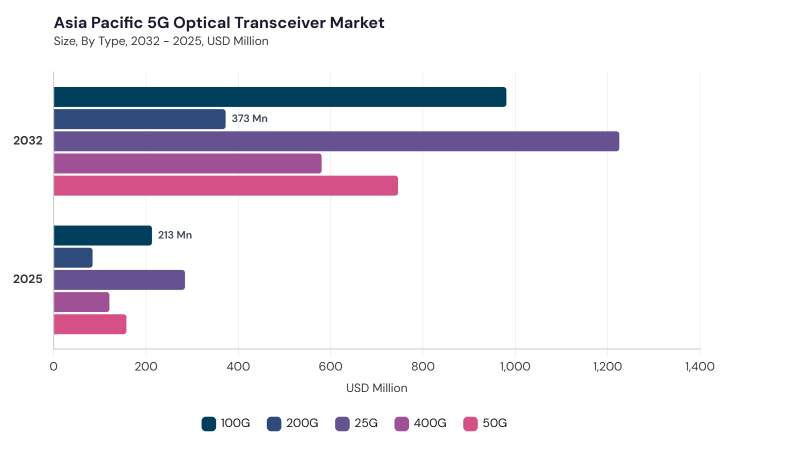
Based on Type, the market is segmented into 25G, 100G, 50G, 400G, and 200G. 25G supports cost-effective fronthaul and small-cell connectivity, while 50G provides an intermediate capacity option as operators increase throughput without immediately transitioning to substantially higher-speed interfaces. 100G supports metro aggregation, backhaul, edge, and data-center connectivity where growing mobile traffic requires greater transmission capacity.
200G serves specialized high-capacity transport and advanced data-center applications, whereas 400G addresses traffic-intensive backbone, hyperscale data-center, AI, cloud, and advanced 5G transport environments. Silicon photonics, coherent optics, PAM4, DWDM, and increasing AI workloads are accelerating the transition toward higher-speed optical modules.
Free Valuable Insights: 5G Optical Transceiver Market is Predicted to reach USD 17244.9 Million billion by 2033, at a CAGR of 24.3%
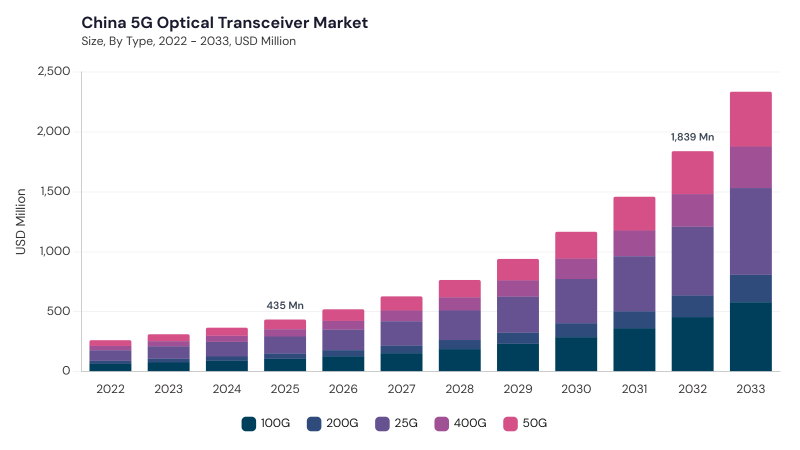
Based on Country, the market is segmented into China, Japan, India, South Korea, Singapore, Malaysia, and Rest of Asia Pacific. The China market dominated the Asia Pacific 5G Optical Transceiver Market by Country in 2025, and would continue to be a dominant market till 2033; thereby, achieving a market value of USD 1166.6 million by 2030, growing at a CAGR of 23.9 % during the forecast period. The Japan market is expected to witness a CAGR of 23.7% during (2026 - 2033). Additionally, The India market is expected to witness a CAGR of 26.3% during (2026 - 2033).
Across Asia Pacific, 5G optical transceiver adoption is being shaped by silicon photonics, coherent optics, localization, energy efficiency, AI-enabled network management, and increasingly advanced manufacturing ecosystems. China emphasizes domestic manufacturing, silicon photonics, AI-enabled optimization, QSFP-DD technologies, and large-scale 5G infrastructure, while Japan focuses on silicon photonics, advanced packaging, all-photonics networks, and high-efficiency optical modules. India is advancing DWDM, coherent optics, domestic manufacturing, multi-rate designs, and scalable 5G transport, whereas South Korea emphasizes FTTA, high-capacity modules, green networking, photonic integration, and AI-assisted optical management. Singapore focuses on co-packaged optics, open hardware, photonic integration, localized manufacturing, and AI-oriented connectivity, while Malaysia emphasizes active optical cables, silicon photonics, advanced packaging, localized production, and energy-efficient network solutions. Rest of Asia Pacific continues to develop integrated photonics, ruggedized FTTA solutions, DWDM, localized manufacturing, and customized optical infrastructure for diverse deployment environments.

By Infrastructure
By Distance
By Wavelength
By Form Factor
By Type
By Country
Set to reach $2425.7 Million by 2030, growing at 25.2% CAGR during 2026-2033.
China leads with a market value of $1166.6 million by 2030, growing at a 23.9% CAGR during 2026-2033.
Rising demand for 5G Fronthaul, expected to reach $1768.9 million by 2030, is a key driver.
The 5G Fronthaul segment will reach $1768.9 million by 2030, growing at a 25% CAGR during 2026-2033.
The India market is expected to witness a CAGR of 26.3% during 2026-2033.
The 1310 nm Band segment will reach $1039.0 million by 2030, growing at a 24.5% CAGR during 2026-2033.
Our team of dedicated experts can provide you with attractive expansion opportunities for your business.




 Unique Offerings