The sample copy of this report is available for access.
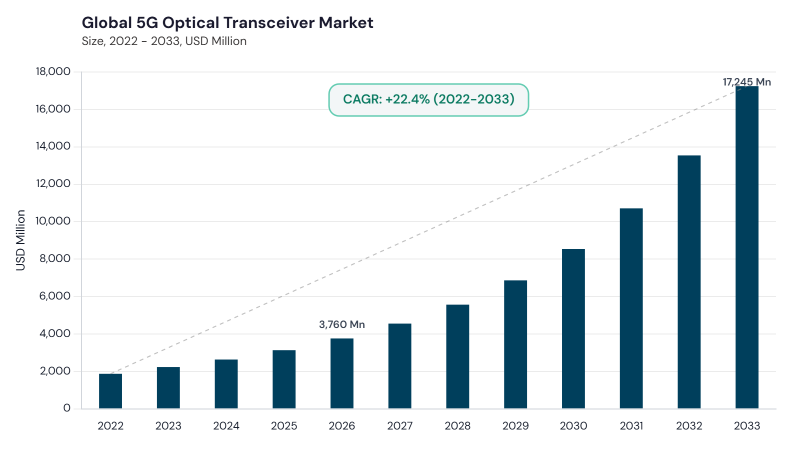
“Global 5G Optical Transceiver Market to reach a market value of USD 17,244.98 Million by 2033 growing at a CAGR of 24.3%”
The Global 5G Optical Transceiver Market is expected to reach USD 17244.9 million by 2033, growing at a CAGR of 24.3% during (2026 - 2033).
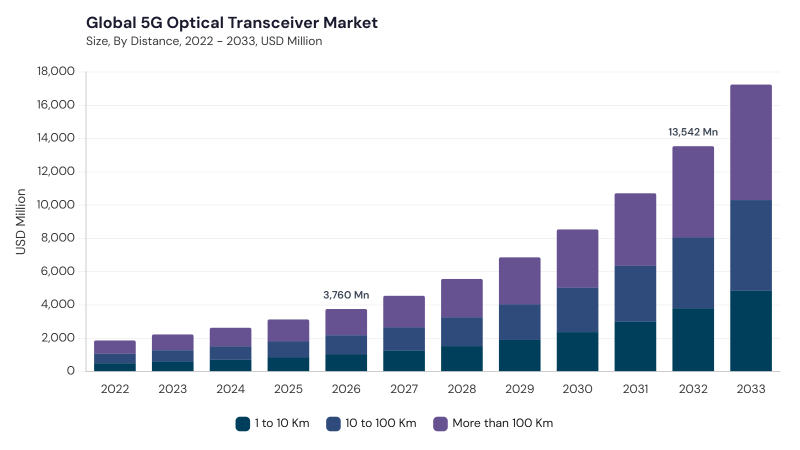
Growing need for high-speed data transmission, low-latency connectivity, higher network capacity, 5G base station expansion, mobile network densification, edge computing, data center growth, and fiber-based connectivity is driving the 5G Optical Transceiver Market. Adoption is increasing across telecom operators, cloud infrastructure providers, enterprise networks, and digital infrastructure ecosystems. The market originated from the broader evolution of optical communication technologies, where fiber-optic networks were first used to improve telecom capacity and transmission efficiency.
Rising 5G deployment, mobile data growth, edge computing, cloud adoption, hyperscale data center expansion, and enterprise connectivity needs are strengthening demand for optical transceivers across network layers. Telecom operators require reliable, compact, and power-efficient modules to manage high-capacity traffic between radio units, distributed units, aggregation nodes, and core infrastructure. At the same time, private 5G, IoT, smart cities, industrial automation, and AI workloads are expanding the role of optical connectivity beyond conventional telecom transport. This is driving innovation in photonic integration, tunable optics, WDM, coherent modules, and next-generation high-speed transceiver designs.
The competitive environment is moderately consolidated and technology-intensive, with optical communications specialists, photonics manufacturers, high-speed module suppliers, and regional telecom component vendors competing across product performance, cost efficiency, reach, reliability, and interoperability. Vendors are differentiating through 25G fronthaul modules, 50G and 100G transport products, higher-capacity 200G and 400G modules, tunable DWDM solutions, WDM architectures, BiDi fiber-saving designs, and industrial-temperature products. Future competition will depend on high-speed module roadmaps, photonic integration, manufacturing scale, power efficiency, supply-chain resilience, and the ability to support evolving 5G network architectures.
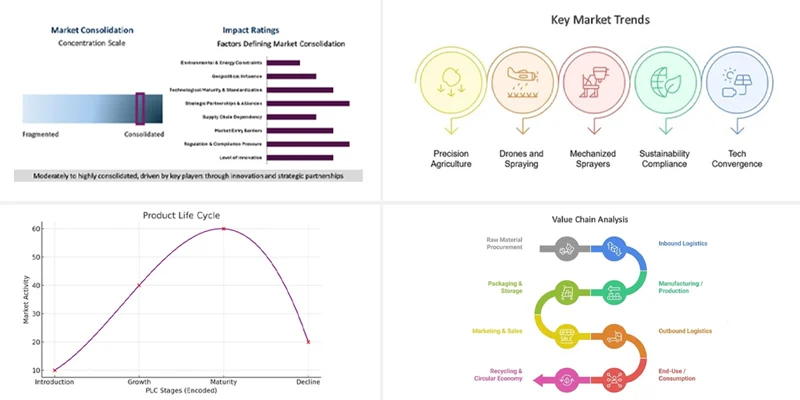

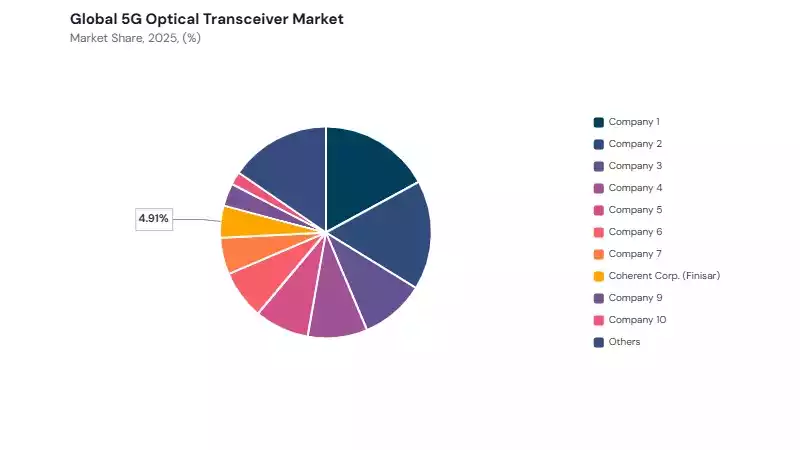
The global 5G Optical Transceiver Market is moderately consolidated and technology-intensive, with competition led by Accelink Technologies, Huagong Tech through HG Genuine Optics, Hisense Broadband Multimedia Technologies, Source Photonics, InnoLight, Eoptolink, Lumentum, Coherent, Cambridge Industries Group, and EverProX Technologies. These companies compete through optical module breadth, 5G fronthaul and transport portfolios, WDM capabilities, BiDi fiber-saving designs, tunable DWDM technology, high-speed transceiver development, industrial-temperature products, and manufacturing scale. Competitive positioning is increasingly shaped by photonic integration, transmission speed, power efficiency, module density, thermal performance, telecom-grade reliability, interoperability, and support for fronthaul, midhaul, and backhaul network evolution.
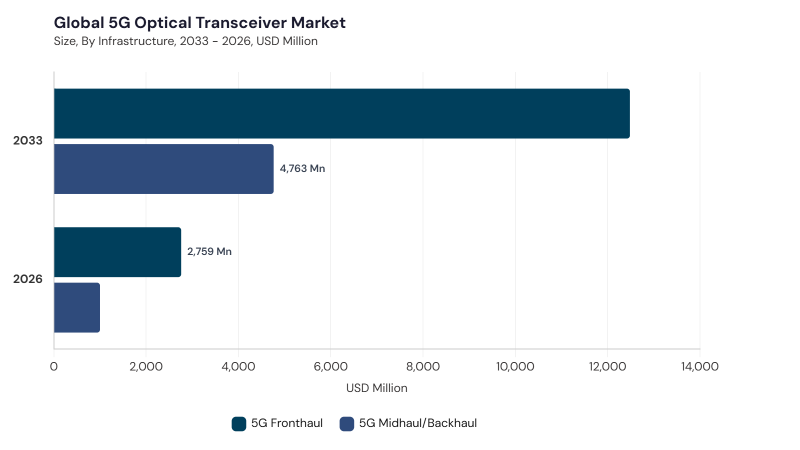
Based on Infrastructure, the market is segmented into 5G Fronthaul and 5G Midhaul/Backhaul. The 5G Fronthaul market dominated the Global 5G Optical Transceiver Market by Infrastructure in 2025, and would continue to be a dominant market till 2033; thereby, achieving a market value of USD 12481.5 million by 2033, growing at a CAGR of 24.1 % during the forecast period. The 5G Midhaul/Backhaul market is expected to witness a CAGR of 25% during (2026 - 2033).
5G Fronthaul remains central to the market because it connects radio units with distributed or centralized processing elements in dense 5G radio access networks. Demand is supported by massive MIMO, small-cell deployment, fiber-to-the-antenna architecture, and low-latency connectivity requirements. 5G Midhaul/Backhaul supports aggregated traffic movement between distributed units, centralized units, transport networks, and core infrastructure. Both infrastructure segments are shaped by network densification, cloud RAN, edge computing, higher bandwidth demand, and the need for scalable optical transport systems.
Based on Distance, the market is segmented into More than 100 Km, 10 to 100 Km, and 1 to 10 Km. The More than 100 Km market dominated the Global 5G Optical Transceiver Market by Distance in 2025, and would continue to be a dominant market till 2033; thereby, achieving a market value of USD 6938.4 million by 2033, growing at a CAGR of 23.6 % during the forecast period. The 10 to 100 Km market is expected to witness a CAGR of 24.8% during (2026 - 2033). Additionally, The 1 to 10 Km market is expected to witness highest CAGR of 24.9% during (2026 - 2033).
More than 100 Km transceivers are important for long-haul and regional transport links connecting aggregation facilities, core networks, and geographically separated infrastructure. The 10 to 100 Km segment supports metro aggregation, midhaul, backhaul, and regional connectivity where operators require balanced reach, capacity, and cost efficiency. The 1 to 10 Km segment serves short-reach fronthaul, access networks, dense urban sites, and edge facilities where compact form factors, low latency, and power efficiency are essential. Demand across all distance categories is influenced by fiber availability, network architecture, data traffic concentration, and optical transmission performance.
Based on Wavelength, the market is segmented into 1310 nm Band, 850 nm Band, and Other Wavelength. The 1310 nm Band market dominated the Global 5G Optical Transceiver Market by Wavelength in 2025, and would continue to be a dominant market till 2033; thereby, achieving a market value of USD 7250.6 million by 2033, growing at a CAGR of 23.6 % during the forecast period. The 850 nm Band market is expected to witness a CAGR of 24.9% during (2026 - 2033). Additionally, The Other Wavelength market is expected to witness highest CAGR of 24.8% during (2026 - 2033).
The 1310 nm Band remains widely used because of its suitability for single-mode fiber transmission, reliable telecom links, and balanced performance across access and transport networks. The 850 nm Band supports short-reach optical connectivity, multimode fiber environments, localized network facilities, and cost-efficient deployment in compact infrastructure settings. Other Wavelength includes specialized bands used for WDM, longer-distance transmission, higher fiber utilization, and network capacity expansion. Wavelength selection is increasingly shaped by reach requirements, fiber type, cost, capacity planning, and operator strategies for scalable optical transport.
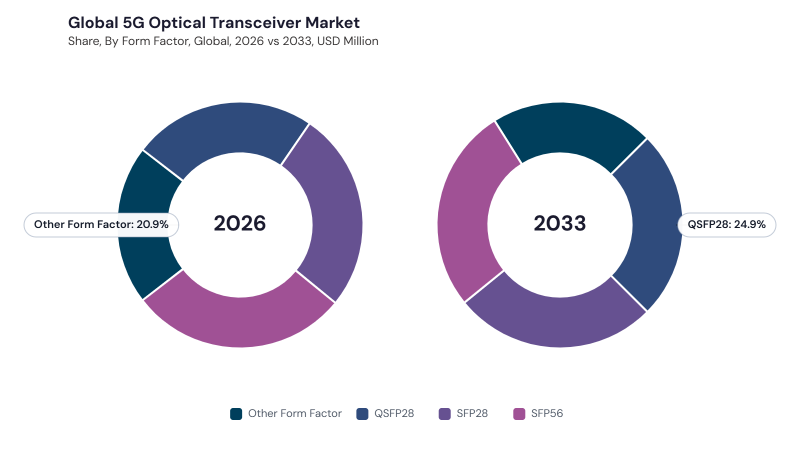
Based on Form Factor, the market is segmented into SFP56, SFP28, QSFP28, and Other Form Factor. The SFP56 market dominated the Global 5G Optical Transceiver Market by Form Factor in 2025, and would continue to be a dominant market till 2033; thereby, achieving a market value of USD 4644.8 million by 2033, growing at a CAGR of 23.2 % during the forecast period. The SFP28 market is expected to witness a CAGR of 24.6% during (2026 - 2033). Additionally, The QSFP28 market is expected to witness highest CAGR of 24.9% during (2026 - 2033).
SFP56 is gaining strong relevance as operators seek compact modules with higher per-lane transmission capability and efficient bandwidth density. SFP28 continues to support established 25G fronthaul and access-network deployments due to its cost efficiency, maturity, and broad equipment compatibility. QSFP28 is important for aggregation and higher-throughput environments where multi-lane transmission and 100G connectivity are required. Other Form Factor includes emerging and specialized module designs that address higher-capacity transport, advanced thermal efficiency, and future-ready optical architectures.
Based on Type, the market is segmented into 25G, 100G, 50G, 400G, and 200G. The 25G market dominated the Global 5G Optical Transceiver Market by Type in 2025, and would continue to be a dominant market till 2033; thereby, achieving a market value of USD 5360.5 million by 2033, growing at a CAGR of 23.4 % during the forecast period. The 100G market is expected to witness a CAGR of 24.6% during (2026 - 2033). Additionally, The 50G market is expected to witness highest CAGR of 25.1% during (2026 - 2033).
25G remains a foundational transceiver type for 5G fronthaul because it provides a practical balance of bandwidth, cost, power efficiency, and deployment maturity. 100G supports aggregation, midhaul, and backhaul links where traffic from multiple access points must move toward edge and core infrastructure. 50G serves as an intermediate upgrade path for operators increasing capacity without moving directly to higher-speed interfaces. 400G and 200G support high-capacity transport, metro aggregation, data-center-linked infrastructure, and advanced network architectures requiring stronger bandwidth density and scalability.
Free Valuable Insights: 5G Optical Transceiver Market Size to reach $17244.9 Million by 2033
Region-wise, the 5G Optical Transceiver Market is analyzed across North America, Europe, Asia Pacific, and LAMEA. The North America market dominated the Global 5G Optical Transceiver Market by Region in 2025, and would continue to be a dominant market till 2033; thereby, achieving a market value of USD 5808.9 million by 2033, growing at a CAGR of 23.4 % during the forecast period. The Europe market is expected to witness a CAGR of 23.9% during (2026 - 2033). Additionally, The Asia Pacific market is expected to witness a CAGR of 25.2% during (2026 - 2033).
North America is supported by strong 5G infrastructure modernization, hyperscale data center expansion, edge computing growth, and demand for high-speed fronthaul, aggregation, and backhaul connectivity. Europe benefits from fiber-rich telecom infrastructure, 5G densification, digital sovereignty priorities, and rising deployment of private 5G networks across industrial and enterprise environments. Asia Pacific is strongly positioned due to large-scale 5G rollout, broad telecom manufacturing strength, dense mobile networks, and rapid growth in data traffic across major economies. LAMEA is developing through network modernization, smart city initiatives, expanding fiber connectivity, and gradual adoption of cost-efficient 5G transport infrastructure.
| Report Attribute | Details |
|---|---|
| Market size value in 2026 | USD 3760.1 million |
| Market size forecast in 2033 | USD 17244.9 million |
| Base Year | 2025 |
| Historical Period | 2022 to 2024 |
| Forecast Period | 2026 to 2033 |
| Revenue Growth Rate | CAGR of 24.3% from 2026 to 2033 |
| Number of Pages | 711 |
| Tables | 900 |
| Report Coverage | Market Trends, Revenue Estimation and Forecast, Segmentation Analysis, Regional and Country Breakdown, Competitive Landscape, Market Share Analysis, Company Profiling, Companies Strategic Developments, SWOT Analysis, Product Life Cycle Analysis, Value Chain Analysis, Market Consolidation Analysis, Key Customer Criteria, Pandemic Impact Analysis, and Winning Imperatives |
| Segments Covered | Infrastructure, Distance, Wavelength, Form Factor, Type, and Region |
| Country Scope |
|
| Companies Included | Accelink Technologies, Huagong Tech, Hisense Broadband Multimedia Technologies, Source Photonics, InnoLight, Eoptolink, Lumentum, Coherent, Cambridge Industries Group, and EverProX Technologies |
By Infrastructure
By Distance
By Wavelength
By Form Factor
By Type
By Geography
Expected to reach USD 17244.9 million by 2033, with a 24.3% CAGR during the forecast period (2026-2033).
Public cloud tops the chart, projected to hit $188.02 billion by 2033.
Accelink Technologies, Huagong Tech, Hisense Broadband Multimedia Technologies, Source Photonics, InnoLight dominate the market.
North America leads at $111.24 billion by 2033; Asia Pacific grows at 13.1% CAGR during 2026-2033.
Advanced photonic integration and escalating data traffic enhance 5G network performance.
Demand for cost-effective, scalable 5G network solutions among enterprises is increasing.
Our team of dedicated experts can provide you with attractive expansion opportunities for your business.








 Unique Offerings