The sample copy of this report is available for access.
“Global Virtual Extensible LAN Market to reach a market value of USD 5,948.09 Million by 2033 growing at a CAGR of 15.5%”
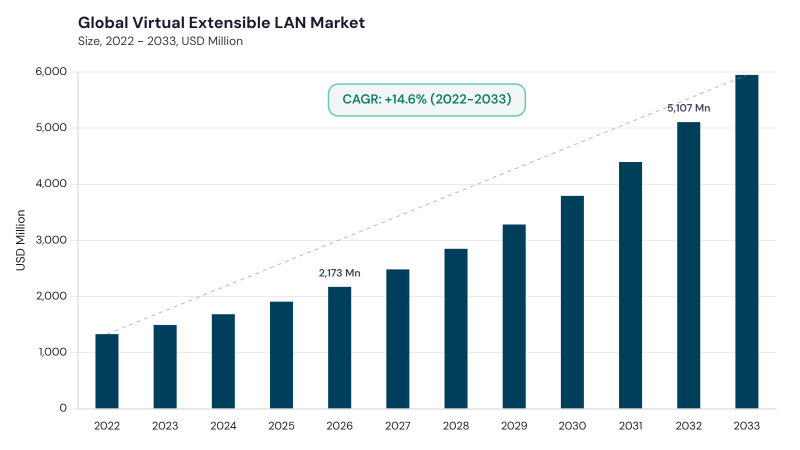
The Global Virtual Extensible LAN Market is expected to reach USD 5948.1 million by 2033, growing at a CAGR of 15.5% during (2026 - 2033).
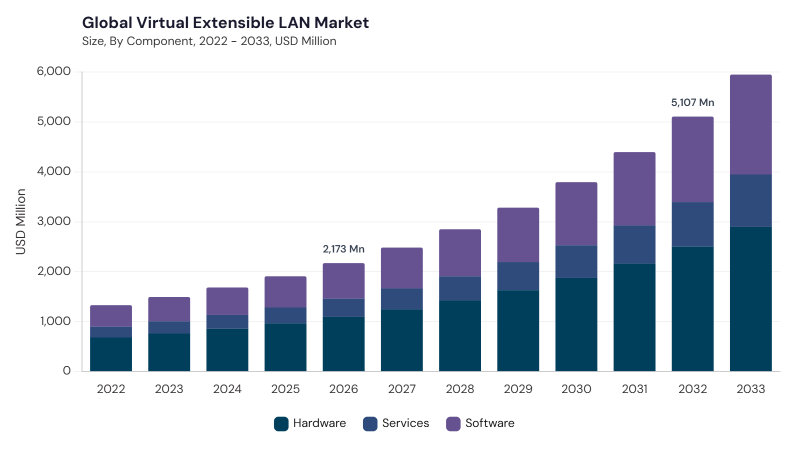
Virtual extensible LAN market is witnessing significant growth supported by growing demand for scalable network virtualization, multi-tenant cloud infrastructure, efficient data center connectivity, and workload mobility. Rising adoption of software-defined networking, cloud computing, edge computing, hyperscale data centers, and automated network provisioning is further supporting the market adoption. Market evolved from the requirement to overcome scalability limitations in traditional VLAN architectures across cloud networking environments and data centers. VXLAN allow Layer 2 overlays over Layer 3, strengthening large-scale virtualized networks and multi-tenant segmentation across distributed infrastructure.
Virtual extensible LAN market is experiencing expansion as telecom operators, enterprises, hyperscale data centers, and cloud service providers seek scalable network overlays for distributed workloads. VXLAN supports multi-tenancy, virtual network segmentation, large-scale logical network expansion, and workload mobility thereby expanding beyond traditional VLAN limits. Market demand is further supported by hybrid cloud deployment, EVPN-VXLAN adoption, edge computing, network automation, software-defined networking, secure traffic isolation, and micro-segmentation across largely complex data and cloud environments.
Virtual extensible LAN market is innovation driven and consolidated with competition supported by software-defined networking providers, network equipment vendors, Ethernet infrastructure companies, and cloud fabric specialists. Market players are competing through switching performance, EVPN-VXLAN support, network visibility, switching performance, interoperability, security segmentation, and cloud integration. Market competition relies on multi-cloud networking, AI-ready Ethernet fabrics, intent-based operations, automation platforms, and unified management of virtual and physical network environments.
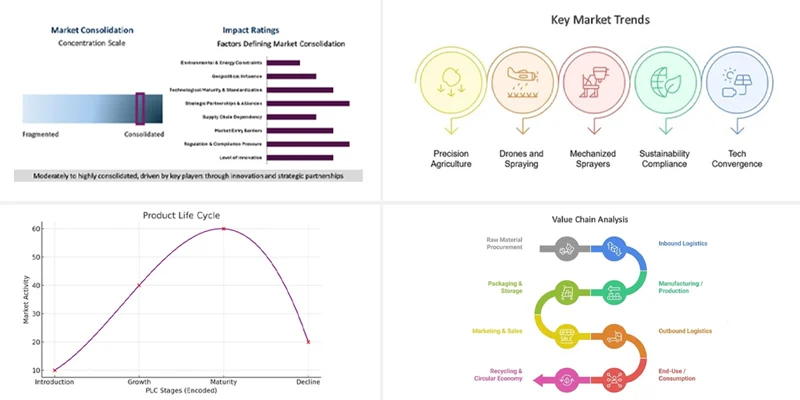

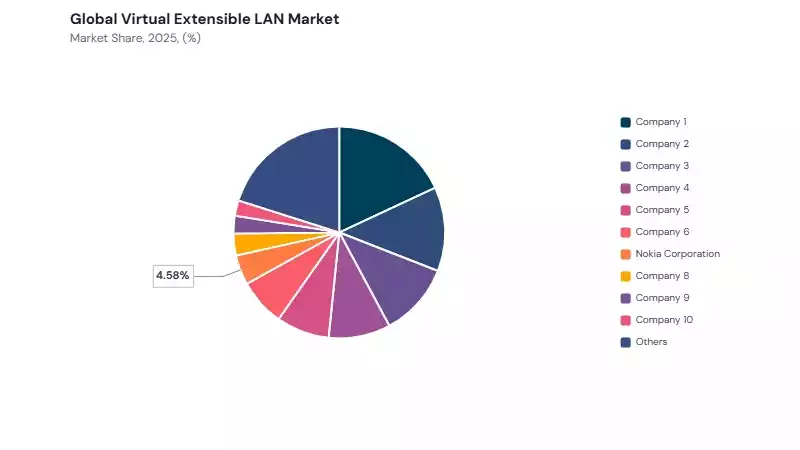
Virtual extensible LAN market is consolidated with Arista Networks, Cisco Systems, and Hewlett Packard Enterprise including Juniper Networks forming the leading competitive tier across network virtualization, EVPN-VXLAN, cloud networking, and data center fabrics. Broadcom, Huawei, NVIDIA including Mellanox support the market through overlay networking, cloud fabric, software-defined networking capabilities, high-performance Ethernet, and cloud fabric. Extreme Networks, Nokia, Dell Technologies, and H3C support competition across open networking, enterprise fabrics, telecom cloud, and regional data center deployments. Market competition is anticipated to depend on telemetry, EVPN automation, AI-ready fabrics, multi-cloud integration, secure distributed workload connectivity, and open networking.
Based on Enterprise Type, the market is segmented into Large Enterprises and Small and Medium Enterprises. The Large Enterprises market dominated the Global Virtual Extensible LAN Market by Enterprise Type in 2025, and would continue to be a dominant market till 2033; thereby, achieving a market value of USD 4119.1 million by 2033, growing at a CAGR of 15.2 % during the forecast period. The Small and Medium Enterprises market is expected to witness a CAGR of 16.2% during (2026 - 2033).
Large Enterprises lead the market due to extensive data center footprints, hybrid cloud strategies, complex multi-tenant environments, and requirements for scalable network virtualization beyond traditional VLAN limitations. These organizations use VXLAN to support workload mobility, disaster recovery, secure segmentation, and distributed application connectivity. Small and Medium Enterprises are gaining traction as cloud migration, managed networking, and software-defined infrastructure make VXLAN-based network virtualization more accessible. This segment is supported by simplified deployment models and demand for flexible network management without major physical expansion.
Based on Component, the market is segmented into Hardware, Software, and Services. The Hardware market dominated the Global Virtual Extensible LAN Market by Component in 2025, and would continue to be a dominant market till 2033; thereby, achieving a market value of USD 2896.9 million by 2033, growing at a CAGR of 14.9 % during the forecast period. The Software market is expected to witness a CAGR of 15.9% during (2026 - 2033). The Services market is expected to witness a CAGR of 16.3% during (2026 - 2033).
Hardware dominates the market due to the deployment of VXLAN-capable switches, routers, network interface equipment, and high-throughput data center infrastructure. Software is gaining strong demand as SDN controllers, network virtualization platforms, automation tools, and orchestration systems simplify VXLAN configuration and management. Services support network architecture design, implementation, integration, optimization, troubleshooting, and managed operations. Together, these components enable scalable overlay networking across enterprise, telecom, cloud, and hyperscale environments.
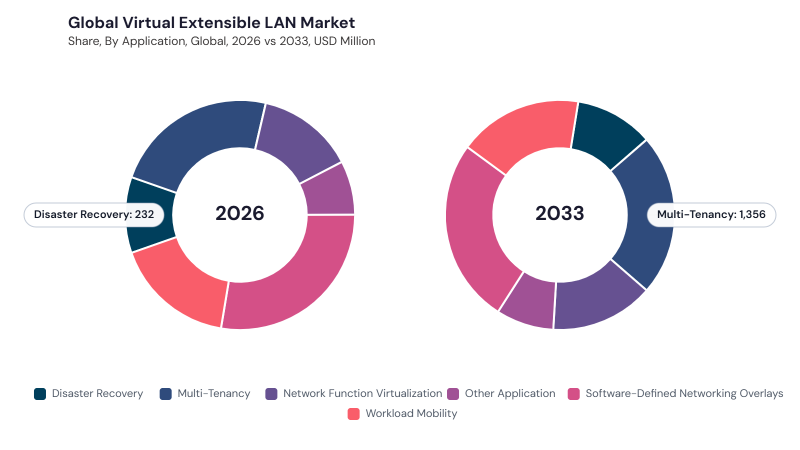
Based on Application, the market is segmented into Software-Defined Networking Overlays, Multi-Tenancy, Workload Mobility, Network Function Virtualization, Disaster Recovery, and Other Application. The Software-Defined Networking Overlays market dominated the Global Virtual Extensible LAN Market by Application in 2025, and would continue to be a dominant market till 2033; thereby, achieving a market value of USD 1546.8 million by 2033, growing at a CAGR of 14.4 % during the forecast period. The Multi-Tenancy market is expected to witness a CAGR of 15.1% during (2026 - 2033). Additionally, The Workload Mobility market is expected to witness highest CAGR of 15.9% during (2026 - 2033).
Software-Defined Networking Overlays lead the market as enterprises require programmable network fabrics, centralized control, and automated provisioning across Layer 3 infrastructure. Multi-Tenancy remains important for cloud and data center operators that need secure logical isolation for multiple tenants. Workload Mobility supports movement of virtual machines and applications across distributed environments, while Network Function Virtualization enables flexible deployment of software-based network services. Disaster Recovery and Other Application are supported by business continuity, hybrid cloud connectivity, infrastructure modernization, and specialized segmentation use cases.
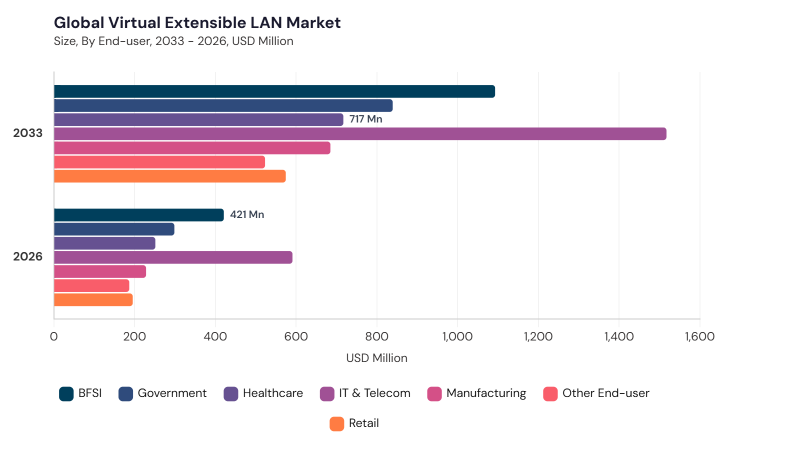
Based on End-user, the market is segmented into IT & Telecom, BFSI, Government, Healthcare, Manufacturing, Retail, and Other End-user. The IT & Telecom market dominated the Global Virtual Extensible LAN Market by End-user in 2025, and would continue to be a dominant market till 2033; thereby, achieving a market value of USD 1517.0 million by 2033, growing at a CAGR of 14.4 % during the forecast period. The BFSI market is expected to witness a CAGR of 14.6% during (2026 - 2033). Additionally, The Government market is expected to witness highest CAGR of 15.9% during (2026 - 2033).
IT & Telecom dominates the market due to large-scale data center operations, telecom cloud infrastructure, network virtualization, and requirements for scalable multi-tenant connectivity. BFSI demand is supported by secure segmentation, resilient digital banking infrastructure, and hybrid cloud modernization. Government adoption is driven by data center modernization and software-defined infrastructure. Healthcare, Manufacturing, and Retail use VXLAN to support secure application connectivity, industrial digitalization, omnichannel platforms, distributed applications, and cloud-based operations. Other End-user includes education, media, professional services, and other data-intensive industries.
Free Valuable Insights: Virtual Extensible LAN Market Size to reach $5948.0 Million by 2033
Region-wise, the Virtual Extensible LAN Market is analyzed across North America, Europe, Asia Pacific, and LAMEA. In 2025, the North America region dominated the virtual extensible LAN market and is anticipated to remain the same till 2033, capturing a market value of USD 2187.9 million by 2033, with a CAGR of 14.7% during 2026-2033. The Europe market is predicted to grow at a CAGR of 15% in the upcoming years. Moreover, the Asia Pacific region is expected to expand at a CAGR of 16.4% in the forecast period.
North America led the market because of enterprise data center infrastructure and extensive hyperscale, advanced SDN deployments, cloud adoption, and ongoing network modernization. Europe region is driven by data center expansion, enterprise digital transformation, demand for secure network virtualization, and cloud migration. Asia Pacific region is experiencing expansion through data center construction, cloud infrastructure growth, software-defined networking adoption, and enterprise digitization. LAMEA is experiencing growth through digital infrastructure, cloud adoption, enterprise network modernization, digital infrastructure investment, and expanding data center capacity.
| Report Attribute | Details |
|---|---|
| Market size value in 2026 | USD 2172.7 million |
| Market size forecast in 2033 | USD 5948.0 million |
| Base Year | 2025 |
| Historical Period | 2022 to 2024 |
| Forecast Period | 2026 to 2033 |
| Revenue Growth Rate | CAGR of 15.5% from 2026 to 2033 |
| Number of Pages | 747 |
| Tables | 900 |
| Report Coverage | Market Trends, Revenue Estimation and Forecast, Segmentation Analysis, Regional and Country Breakdown, Competitive Landscape, Market Share Analysis, Company Profiling, Companies Strategic Developments, SWOT Analysis, Product Life Cycle Analysis, Value Chain Analysis, Market Consolidation Analysis, Key Customer Criteria, Pandemic Impact Analysis, and Winning Imperatives |
| Segments Covered | Enterprise Type, Component, Application, End-user, Region |
| Country Scope |
|
| Companies Included | Cisco Systems, Inc., Arista Networks, Inc., Hewlett Packard Enterprise including Juniper Networks, Huawei Technologies Co., Ltd., Broadcom Inc. including VMware NSX, NVIDIA Corporation including Mellanox, Nokia Corporation, Extreme Networks, Inc., Dell Technologies Inc., and H3C Technologies Co., Ltd. |
By Enterprise Type
By Component
By Application
By End-user
By Geography
Expected to reach USD 5948.1 million by 2033, rising at 15.5% CAGR during 2026-2033.
Public cloud tops the chart, projected to hit $188.02 billion by 2033.
Cisco Systems, Inc., Arista Networks, Inc., Hewlett Packard Enterprise, and Juniper Networks are key players.
North America leads at $111.24 billion by 2033; Asia Pacific grows at 13.1% CAGR during 2026-2033.
Enhanced demand for network virtualization and scalability solutions boosts market growth.
Rising adoption of cloud computing and hybrid cloud architectures significantly impacts market expansion.
Our team of dedicated experts can provide you with attractive expansion opportunities for your business.








 Unique Offerings