The sample copy of this report is available for access.
The North America Virtual Extensible LAN Market is expected to reach USD 1891.1 million by 2032, growing at a CAGR of 14.7% during (2026 - 2033).
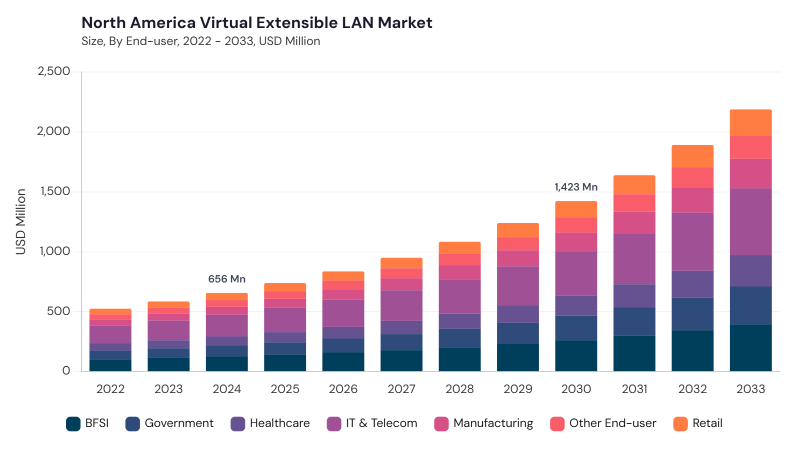
The North America Virtual Extensible LAN Market evolved in response to scalability and segmentation limitations associated with traditional VLAN architectures across large data centers and cloud environments. VXLAN emerged as an overlay technology capable of extending Layer 2 connectivity across Layer 3 infrastructure, supporting multi-tenant environments, distributed workloads, and broader network virtualization. Integration with software-defined networking, orchestration platforms, and cloud-native architectures further expanded its role in enterprise networks. The market has consequently progressed from specialized virtualization deployments toward a foundational networking approach supporting scalable, programmable, and secure data center and hybrid-cloud infrastructures.
Hybrid and multi-cloud adoption, software-defined networking, automation, micro-segmentation, and scalable data center interconnects are shaping current market development. Enterprises increasingly use VXLAN to maintain consistent policies, workload mobility, and network isolation across distributed environments while reducing dependence on physical topology. Integration with EVPN, SDN controllers, analytics platforms, and intent-based management is strengthening automation and operational visibility. Security requirements are also elevating demand for granular segmentation and isolation, while edge computing, NFV, and high-capacity data center architectures are broadening the technology's applicability across North America.
Based on Enterprise Type, the market is segmented into Large Enterprises and Small and Medium Enterprises. The Large Enterprises market dominated the North America Virtual Extensible LAN Market by Enterprise Type in 2025, and would continue to be a dominant market till 2033; thereby, achieving a market value of USD 1308.1 million by 2032, growing at a CAGR of 14.4 % during the forecast period. The Small and Medium Enterprises market is expected to witness a CAGR of 15.4% during (2026 - 2033).
Large Enterprises deploy VXLAN to support high-capacity virtualized infrastructure, multi-tenant environments, hybrid cloud connectivity, workload isolation, and distributed data center operations. Their larger IT budgets and specialized networking teams facilitate advanced integration with SDN, automation, and security frameworks. Small and Medium Enterprises increasingly adopt VXLAN through cloud-based infrastructure, managed networking solutions, and simplified software-defined platforms that reduce dependence on physical network expansion. Managed services and modular deployments are particularly important in addressing limited in-house expertise and investment capacity across this segment.
Based on Component, the market is segmented into Hardware, Software, and Services. The Hardware market dominated the North America Virtual Extensible LAN Market by Component in 2025, and would continue to be a dominant market till 2033; thereby, achieving a market value of USD 921.9 million by 2032, growing at a CAGR of 14.2 % during the forecast period. The Software market is expected to witness a CAGR of 15.1% during (2026 - 2033). The Services market is expected to witness a CAGR of 15.6% during (2026 - 2033).
Hardware forms the physical foundation for VXLAN encapsulation, tunneling, traffic forwarding, and high-performance connectivity across data center and edge environments. Software supports centralized overlay control through network operating systems, SDN controllers, orchestration platforms, automation tools, analytics, and virtualization management applications. Services include architecture consulting, deployment, migration, integration, optimization, and managed operations, helping organizations address technical complexity and interoperability challenges. Increasing integration of AI, automation, and analytics is also strengthening demand for specialized service support across larger and more sophisticated VXLAN deployments.
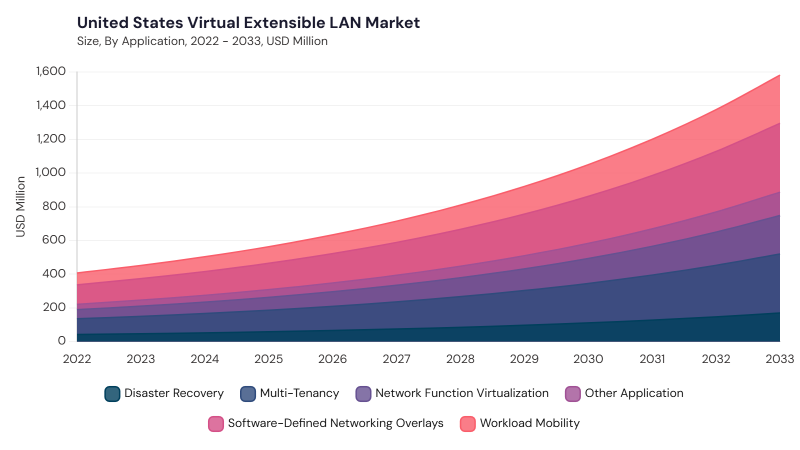
Based on Application, the market is segmented into Software-Defined Networking Overlays, Multi-Tenancy, Workload Mobility, Network Function Virtualization, Disaster Recovery, and Other Application. Software-Defined Networking Overlays enable programmable and scalable virtual fabrics across cloud and data center environments. Multi-Tenancy supports isolated tenant, customer, department, and application networks over shared infrastructure, while Workload Mobility enables virtual machines and applications to move across servers, facilities, and cloud environments without extensive network reconfiguration.
Network Function Virtualization uses VXLAN to connect virtualized firewalls, routers, and other network services, whereas Disaster Recovery benefits from extended virtual networks supporting rapid failover and workload restoration. Other Application includes network testing, development environments, IoT segmentation, AI infrastructure, specialized cloud architectures, and customized data center networking.
Based on End-user, the market is segmented into IT & Telecom, BFSI, Government, Healthcare, Manufacturing, Retail, and Other End-user. IT & Telecom uses VXLAN for cloud infrastructure, NFV, data center interconnectivity, and highly programmable network fabrics. BFSI emphasizes secure segmentation, disaster recovery, hybrid cloud connectivity, and isolation of sensitive workloads, while Government applies VXLAN to infrastructure modernization, secure network partitioning, and cloud migration.
Healthcare uses segmented virtual networks to support digital clinical systems and protected data environments, whereas Manufacturing relies on VXLAN for industrial IoT, smart factories, edge computing, and separation of operational and enterprise traffic. Retail uses the technology for distributed applications, omnichannel platforms, branch connectivity, and digital transaction environments, while Other End-user includes education, media, transportation, energy, professional services, and other organizations adopting virtualized networking.
Free Valuable Insights: The Global Virtual Extensible LAN Market will hit USD 5948.0 Million billion by 2033, at a CAGR of 15.5%
Based on Country, the market is segmented into US, Canada, Mexico, and Rest of North America. The US market dominated the North America Virtual Extensible LAN Market by Country in 2025, and would continue to be a dominant market till 2033; thereby, achieving a market value of USD 1376.3 million by 2032, growing at a CAGR of 14 % during the forecast period. The Canada market is expected to witness a CAGR of 17.1% during (2026 - 2033). Additionally, The Mexico market is expected to witness a CAGR of 16.2% during (2026 - 2033).
Across North America, VXLAN adoption is being influenced by cloud migration, data center modernization, SDN integration, automation, edge computing, and secure network segmentation. The US emphasizes EVPN-VXLAN fabrics, hardware acceleration, high-performance data center networking, AI-driven automation, and micro-segmentation, while Canada focuses on hybrid cloud connectivity, network orchestration, cybersecurity, interoperability, and localized data governance requirements. Mexico is advancing cloud transformation, SDN and NFV integration, 5G and edge infrastructure, network automation, and secure segmentation, whereas Rest of North America continues to expand multi-cloud connectivity, programmable overlays, advanced traffic orchestration, security-by-design, and VXLAN integration with emerging edge and virtualized environments.

By Enterprise Type
By Component
By Application
By End-user
By Country
Set to reach $1891.1 Million by 2032, growing at 14.7% CAGR during 2026-2033.
The US leads with $1376.3 million by 2032, growing at a 14% CAGR during the forecast period.
Rising enterprise cloud adoption and AI-driven workloads are the main catalysts.
Large Enterprises will reach $1308.1 million by 2032, growing at a 14.4% CAGR during 2026-2033.
The Canada market is expected to witness a CAGR of 17.1% during 2026-2033.
The Hardware segment will reach $921.9 million by 2032, growing at a 14.2% CAGR during the forecast period.
Our team of dedicated experts can provide you with attractive expansion opportunities for your business.




 Unique Offerings