The sample copy of this report is available for access.
The LAMEA Virtual Extensible LAN Market is expected to reach USD 305.0 million by 2029, growing at a CAGR of 17.3% during (2026 - 2033).
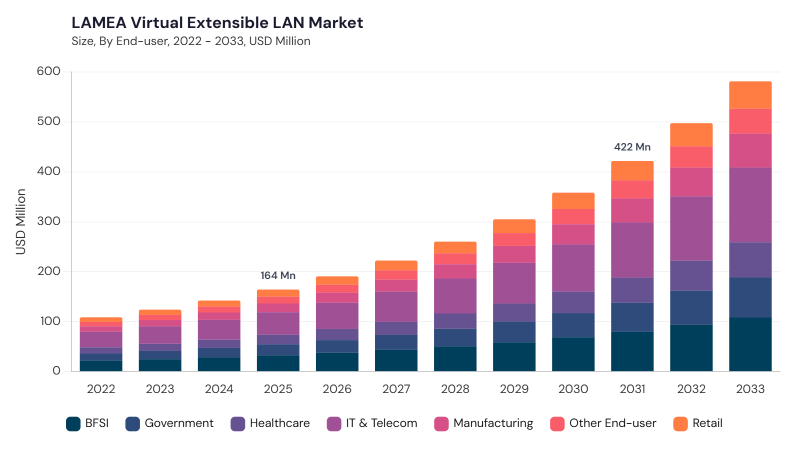
The LAMEA Virtual Extensible LAN Market developed as enterprises and service providers sought to overcome the scalability limitations of conventional VLAN architectures. VXLAN introduced a more extensible overlay approach by carrying Layer 2 traffic across Layer 3 infrastructure, supporting larger virtual network domains, tenant isolation, and geographically distributed connectivity. Adoption strengthened alongside cloud computing, data center virtualization, Software-Defined Networking, and broader vendor support for VXLAN-enabled devices and hypervisors. The regional landscape has since progressed toward distributed cloud, hybrid networking, and virtualized infrastructure where scalable overlays support enterprise, telecom, and government modernization.
SDN and NFV convergence, secure segmentation, cloud integration, localization, and network automation are shaping current market development. Organizations are increasingly using centrally orchestrated VXLAN overlays to automate provisioning, support workload mobility, and reduce manual network administration. Security requirements are encouraging encryption, micro-segmentation, policy-based controls, and stronger traffic isolation across shared environments. Data sovereignty and regional compliance requirements are also influencing localized network architectures, while 5G, edge computing, IoT, and hybrid cloud initiatives are expanding VXLAN deployment into more distributed and latency-sensitive environments.
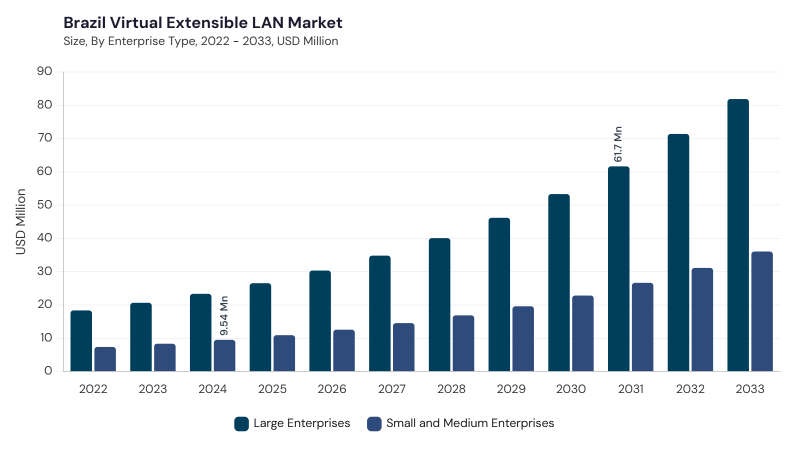
Based on Enterprise Type, the market is segmented into Large Enterprises and Small and Medium Enterprises. The Large Enterprises market dominated the LAMEA Virtual Extensible LAN Market by Enterprise Type in 2025, and would continue to be a dominant market till 2033; thereby, achieving a market value of USD 215.4 million by 2029, growing at a CAGR of 16.9 % during the forecast period. The Small and Medium Enterprises market is expected to witness a CAGR of 18% during (2026 - 2033).
Large Enterprises use VXLAN to support multi-cloud environments, distributed data centers, workload mobility, secure segmentation, and complex multi-tenant architectures across geographically dispersed operations. Their larger infrastructure investments support deeper integration with SDN, NFV, automation, and advanced security frameworks. Small and Medium Enterprises are gradually adopting VXLAN through managed IT providers, subscription-based infrastructure, hosted platforms, and simplified virtualization solutions. These approaches allow smaller organizations to improve scalability, secure regional connectivity, and expand virtualized environments without substantial physical network investment or extensive internal expertise.
Based on Component, the market is segmented into Hardware, Software, and Services. The Hardware market dominated the LAMEA Virtual Extensible LAN Market by Component in 2025, and would continue to be a dominant market till 2033; thereby, achieving a market value of USD 152.7 million by 2029, growing at a CAGR of 16.7 % during the forecast period. The Software market is expected to witness a CAGR of 17.6% during (2026 - 2033). The Services market is expected to witness a CAGR of 18.3% during (2026 - 2033).
Hardware includes switches, routers, network interface components, and VXLAN-capable infrastructure that support encapsulation, forwarding, and scalable Layer 3 underlay environments. Software includes centralized control platforms, virtual network managers, orchestration systems, automation tools, and network virtualization solutions used to configure and administer overlays. Services encompass consulting, architecture design, implementation, integration, audits, troubleshooting, training, performance optimization, and managed network operations. Limited regional availability of specialized networking expertise is increasing reliance on professional and managed services for complex VXLAN deployments.
Based on Application, the market is segmented into Software-Defined Networking Overlays, Multi-Tenancy, Workload Mobility, Network Function Virtualization, Disaster Recovery, and Other Application. Software-Defined Networking Overlays enable programmable network fabrics, centralized policy enforcement, automated provisioning, and flexible virtual segmentation. Multi-Tenancy allows hosting providers, telecom operators, enterprises, and business groups to isolate customers, applications, and organizational units over shared infrastructure, while Workload Mobility supports movement of applications between local facilities, colocation environments, and cloud platforms without major network reconfiguration.
Network Function Virtualization supports software-based routing, firewall, load-balancing, and other functions, whereas Disaster Recovery enables geographically distributed backup and failover environments. Other Application includes energy operations, education platforms, IoT segmentation, smart infrastructure, campus networks, and development environments.
Based on End-user, the market is segmented into IT & Telecom, BFSI, Government, Healthcare, Manufacturing, Retail, and Other End-user. IT & Telecom uses VXLAN for carrier virtualization, cloud infrastructure, data center networking, NFV, 5G, and distributed service delivery. BFSI applies secure overlays to isolate transaction-sensitive workloads, support hybrid cloud environments, and strengthen business continuity, while Government uses VXLAN across e-government platforms, national data infrastructure, smart-city projects, and consolidated public computing.
Healthcare relies on network segmentation for hospital information systems, telehealth, and connected medical environments, whereas Manufacturing uses VXLAN across industrial automation, connected assets, and integrated operational technology. Retail uses virtual networking for digital payments, online marketplaces, distributed stores, and inventory platforms, while Other End-user includes utilities, transportation, universities, media, hospitality, energy, and professional services.
Free Valuable Insights: Virtual Extensible LAN Market Size Worth USD 5948.0 Million billion by 2033
Based on Country, the market is segmented into Brazil, Argentina, UAE, Saudi Arabia, South Africa, Nigeria, and Rest of LAMEA. The Brazil market dominated the LAMEA Virtual Extensible LAN Market by Country in 2025, and would continue to be a dominant market till 2033; thereby, achieving a market value of USD 65.8 million by 2029, growing at a CAGR of 15.5 % during the forecast period. The Argentina market is expected to witness a CAGR of 18.6% during (2026 - 2033). Additionally, The UAE market is expected to witness a CAGR of 16.3% during (2026 - 2033).
Across LAMEA, VXLAN adoption is being shaped by cloud modernization, secure segmentation, SDN automation, data sovereignty, and distributed digital infrastructure. Brazil emphasizes hybrid and multi-cloud connectivity, network orchestration, AI-supported management, and integrated security, while Argentina is advancing cloud migration, automated provisioning, and secure software-defined networking. The UAE focuses on hybrid-cloud architectures, orchestration, micro-segmentation, 5G, and edge integration, whereas Saudi Arabia is strengthening programmable networks, localized cloud infrastructure, compliance, and SDN/NFV integration. South Africa emphasizes hybrid-cloud connectivity, AI-enabled automation, localized network control, and secure segmentation, while Nigeria is progressing through digital infrastructure investment, cloud expansion, resilient virtual networks, and regional technology partnerships. Rest of LAMEA continues to expand cloud-native networking, SDN orchestration, multi-tenancy, security, edge computing, and 5G-ready virtual network environments.

By Enterprise Type
By Component
By Application
By End-user
By Country
Set to reach $305.0 Million by 2029, growing at 17.3% CAGR during 2026-2033.
Brazil leads with $65.8 million by 2029, growing at 15.5% CAGR during the forecast period.
Rising demand from large enterprises, reaching $215.4 million by 2029 at 16.9% CAGR during 2026-2033.
Hardware segment to reach $152.7 million by 2029, growing at 16.7% CAGR during 2026-2033.
Argentina market is expected to grow at 18.6% CAGR during 2026-2033.
Services segment is expected to witness a CAGR of 18.3% during 2026-2033.
Our team of dedicated experts can provide you with attractive expansion opportunities for your business.




 Unique Offerings