The sample copy of this report is available for access.
“Global Trade Management Software Market to reach a market value of USD 3,029.02 Million by 2033 growing at a CAGR of 9.8%”
The Global Trade Management Software Market is expected to reach USD 3029.0 million by 2033, growing at a CAGR of 9.8% during (2026 - 2033).

Trade management market is driven by rising global trade volumes, rising demand for efficient export & import operations across industries, complex regulatory requirements. Market demand is further surging as enterprises focus on shipment visibility, compliance management, accurate trade documentation, cost optimization, and automated cross-border workflows. Trade management software market evolved from the rising complexity of global trade operations, initially using semi-automated, and manual systems from tariff calculations, custom documentation, and regulatory compliance.
Trade management software market is expanding as enterprises shift from trade operations toward automated, integrated and compliance-ready digital platforms. Trade management software is largely used to manage tariff classification, custom compliance, documentation, restricted-party screening, international supply chain visibility, and duty optimization. Predictive analytics, AI, regulatory intelligence, and cloud deployment are supporting more proactive trade risk management, and reshaping software functionality.
Competitive landscape of trade management market is intensively dynamic and compliance-driven, supported by global trade compliance specialists, enterprise software providers, customs management providers, supply chain technology companies, and logistics software vendors. Market players compete through ERP integration, content accuracy, AI-enabled compliance, custom automation, cloud scalability, workflow automation, and industry-specific trade management capabilities. Market competition further depends on AI-powered automation, stronger supply chain integration, and real-time regulatory intelligence.


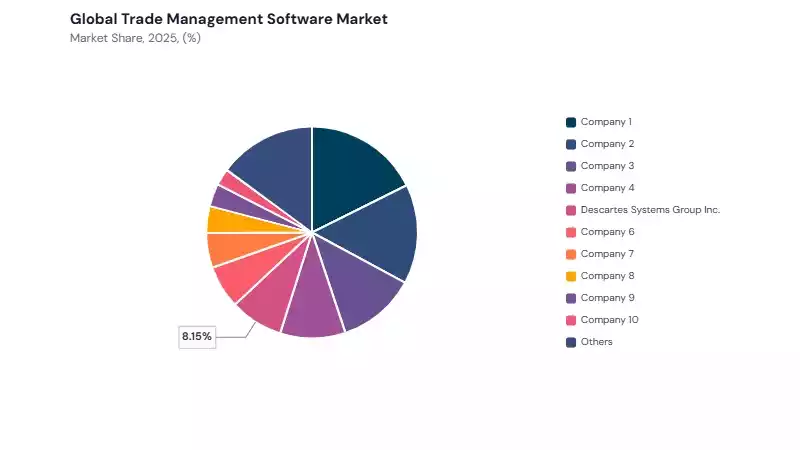
Trade management software market represents a highly intensive competitive landscape shaped by global trade compliance specialists, custom management vendors, enterprise software providers, supply chain technology companies, and international logistic software providers. Oracle Corporation and SAP SE maintain strong leadership through custom management, enterprise application ecosystems, compliance automation, and customs management. Thomson Reuter, QAD, WiseTech Global, Bamboo Rose, and MIC Datenverarbeitung support competition through regulatory intelligence, global trade content, customs filing, logistics connectivity, and industry-specific trade workflows.
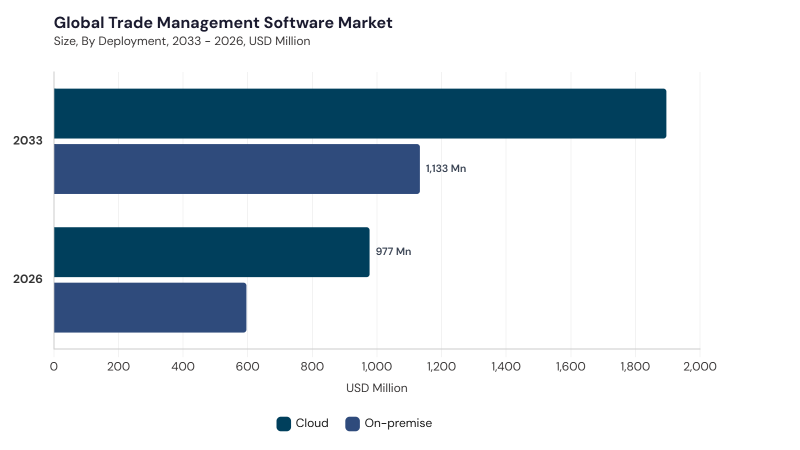
Based on Deployment, the market is segmented into Cloud and On-premise. The Cloud market dominated the Global Trade Management Software Market by Deployment in 2025, and would continue to be a dominant market till 2033; thereby, achieving a market value of USD 1896.0 million by 2033, growing at a CAGR of 9.9 % during the forecast period. The On-premise market is expected to witness a CAGR of 9.6% during (2026 - 2033).
Cloud leads the market as organizations increasingly adopt SaaS platforms for scalability, real-time trade visibility, seamless updates, collaboration, and lower infrastructure burden. Cloud deployment supports faster regulatory updates, AI-enabled analytics, and global accessibility across distributed trade teams. On-premise remains relevant among enterprises requiring stronger control over sensitive trade data, customized deployment environments, legacy system integration, and strict internal security requirements.
Based on Component, the market is segmented into Solutions and Services. The Solutions market dominated the Global Trade Management Software Market by Component in 2025, and would continue to be a dominant market till 2033; thereby, achieving a market value of USD 2143.8 million by 2033, growing at a CAGR of 9.6 % during the forecast period. The Services market is expected to witness a CAGR of 10.4% during (2026 - 2033).
Solutions lead the market as enterprises require platforms for customs compliance, tariff management, trade documentation, restricted-party screening, duty optimization, and supply chain visibility. Services support consulting, implementation, customization, integration, training, maintenance, and compliance advisory. Both segments are essential as organizations need strong software functionality along with expert support to manage complex trade regulations and cross-border workflows.
Based on End Use, the market is segmented into Manufacturing, Retail, Transportation & Logistics, Government, Energy, Healthcare, and Other End Uses. The Manufacturing market dominated the Global Trade Management Software Market by End Use in 2025, and would continue to be a dominant market till 2033; thereby, achieving a market value of USD 688.6 million by 2033, growing at a CAGR of 7.9 % during the forecast period. The Retail market is expected to witness a CAGR of 9.4% during (2026 - 2033). Additionally, The Transportation & logistics market is expected to witness highest CAGR of 10.1% during (2026 - 2033).
Manufacturing leads due to global sourcing, supplier management, customs compliance, and complex import-export operations. Retail depends on trade software for international sourcing, e-commerce, inventory visibility, and product documentation, while Transportation & Logistics uses it for freight movement, customs filing, and shipment tracking. Government, Energy, Healthcare, and Other End Uses adopt these platforms for regulatory enforcement, commodity trade, medical supply compliance, and operational efficiency.
Free Valuable Insights: Trade Management Software Market Size to reach $3029.0 Million by 2033
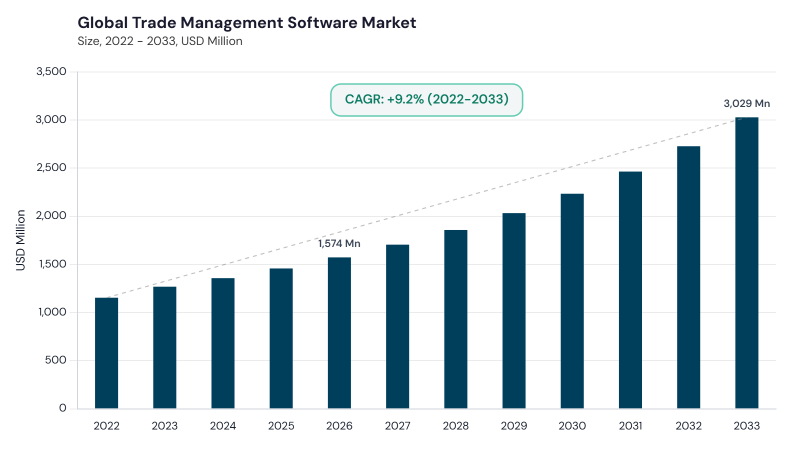
Region-wise, the Trade Management Software Market is analyzed across North America, Europe, Asia Pacific, and LAMEA. The North America region led the trade management software market in 2025, and is predicted to hold the same position till 2033, with a market value of USD 1065 million and a CAGR of 9.2% by 2033. The Europe market is predicted to grow at a CAGR of 9.6% during 2026-2033. Moreover, Asia Pacific is predicted to expand at a CAGR of 10.4%.
North America region dominated the market because of advanced trade compliance, strong enterprise digitalization, and large investment in supply chain optimization. Europe is driven by customs modernization, cross-border compliance needs, and digital documentation initiatives. APAC region is gaining traction through cloud enterprise software adoption, trade growth, and manufacturing expansion, while LAMEA is experiencing lucrative opportunities through logistics improvement, infrastructure modernization, and rising digital platform adoption.
| Report Attribute | Details |
|---|---|
| Market size value in 2026 | USD 1573.5 million |
| Market size forecast in 2033 | USD 3029.0 million |
| Base Year | 2025 |
| Historical Period | 2022 to 2024 |
| Forecast Period | 2026 to 2033 |
| Revenue Growth Rate | CAGR of 9.8% from 2026 to 2033 |
| Number of Pages | 584 |
| Tables | 660 |
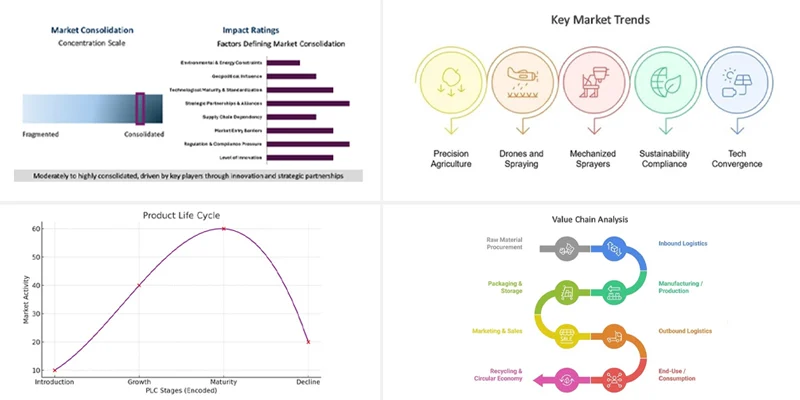
| Report Coverage | Market Trends, Revenue Estimation and Forecast, Segmentation Analysis, Regional and Country Breakdown, Competitive Landscape, Market Share Analysis, Company Profiling, Companies Strategic Developments, SWOT Analysis, Product Life Cycle Analysis, Value Chain Analysis, Market Consolidation Analysis, Key Customer Criteria, Pandemic Impact Analysis, and Winning Imperatives |
| Segments Covered | Deployment, Component, End Use, and Geography |
| Country Scope |
|
| Companies Included | SAP SE; Oracle Corporation; e2open Parent Holdings, Inc.; Thomson Reuters Corporation; Descartes Systems Group Inc.; WiseTech Global Limited; Infor, Inc.; QAD Inc. (Thoma Bravo, L.P.); MIC Datenverarbeitung GmbH; Bamboo Rose LLC |
By Deployment
By Component
By End Use
By Geography
Expected to reach USD 3029.0 million by 2033, with a 9.8% CAGR during the forecast period (2026-2033).
Public cloud tops the chart, projected to hit $188.02 billion by 2033.
SAP SE, Oracle Corporation, e2open Parent Holdings, Inc., and Thomson Reuters Corporation lead the market.
North America leads at $111.24 billion by 2033; Asia Pacific grows at 13.1% CAGR during 2026-2033.
Growing demand for enhanced trade efficiency and risk mitigation is a major driver.
The market is projected to grow at a 9.8% CAGR during the forecast period (2026-2033).
Our team of dedicated experts can provide you with attractive expansion opportunities for your business.






 Unique Offerings
