The sample copy of this report is available for access.
The North America Trade Management Software Market is expected to reach USD 964.7 million by 2032, growing at a CAGR of 9.2% during (2026 – 2033).
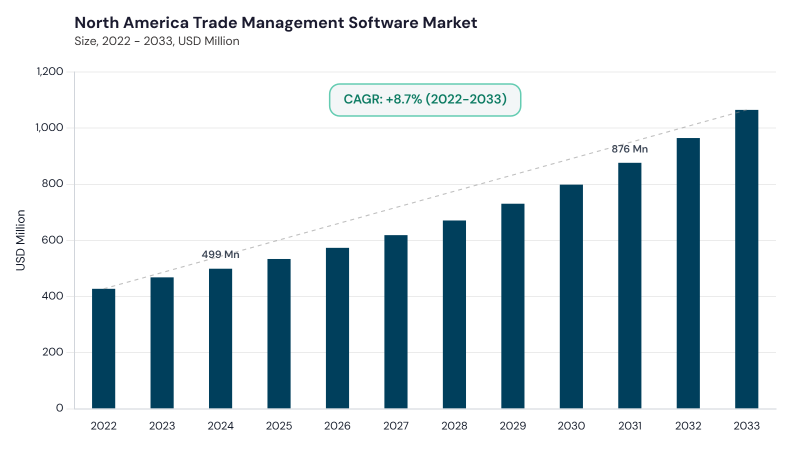
The North America Trade Management Software Market developed as companies began digitizing customs documentation, shipment tracking, tariff classification, and cross-border compliance workflows. Early adoption focused on replacing manual trade processes with structured systems that reduced filing errors and improved operational efficiency. As supply chains became more global and regulations grew more complex, software platforms expanded into integrated compliance, logistics, finance, and visibility tools. Cloud computing, AI, automation, real-time data exchange, and analytics later transformed the market from basic documentation support into strategic trade intelligence.
The North America Trade Management Software Market is being shaped by AI-enabled compliance, cloud-based platforms, nearshoring, supply chain realignment, regulatory complexity, and the need for end-to-end trade visibility. Enterprises are adopting these platforms to manage customs filings, sanctions screening, tariff updates, origin determination, logistics coordination, and trade risk assessment. Demand is supported by e-commerce growth, multi-modal transportation, cross-border manufacturing, real-time regulatory updates, and tighter data security requirements. Vendors are focusing on predictive analytics, automated documentation, ERP integration, SaaS delivery, block chain-enabled audit trails, and configurable workflows.
Based on Deployment, the market is segmented into Cloud and On-premise. The Cloud market dominated the North America Trade Management Software Market by Deployment in 2025, and would continue to be a dominant market till 2033; thereby, achieving a market value of USD 600.6 million by 2032, growing at a CAGR of 9.4 % during the forecast period. The On-premise market is expected to witness a CAGR of 9% during (2026 - 2033).
Cloud deployment leads due to enterprise demand for scalable access, faster implementation, remote collaboration, automatic regulatory updates, and lower infrastructure burden. Cloud platforms support real-time compliance monitoring, ERP integration, tariff management, shipment visibility, and AI-enabled trade risk analytics across distributed teams. On-premise deployment remains significant among organizations with strict data control, customized workflows, confidential compliance processes, and legacy IT environments. This segment is supported by regulated industries, defense-linked trade, healthcare, finance, and enterprises requiring internally managed systems with deep customization and localized security control.
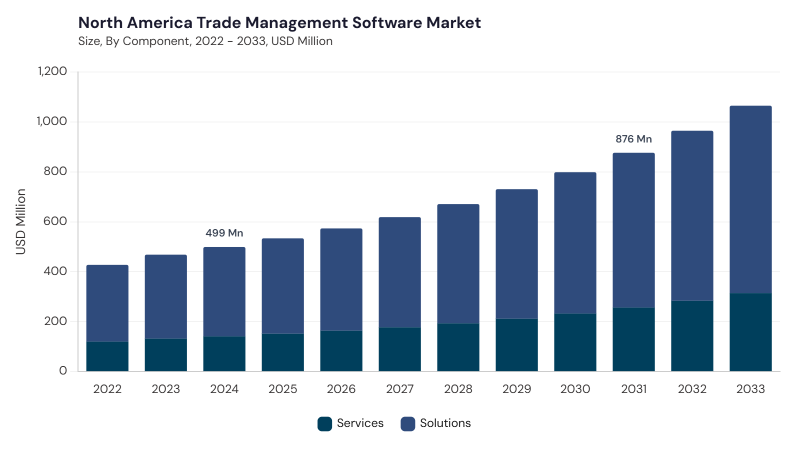
Based on Component, the market is segmented into Solutions and Services. The Solutions market dominated the North America Trade Management Software Market by Component in 2025, and would continue to be a dominant market till 2033; thereby, achieving a market value of USD 681.3 million by 2032, growing at a CAGR of 9 % during the forecast period. The Services market is expected to witness a CAGR of 9.8% during (2026 - 2033).
Solutions lead as enterprises rely on software platforms for customs management, trade compliance, import-export documentation, tariff classification, duty optimization, shipment tracking, and risk monitoring. These tools help companies automate manual processes, reduce errors, improve audit readiness, and respond quickly to regulatory changes. Services remain significant because organizations require consulting, implementation, integration, customization, training, regulatory support, and maintenance to maximize software value. This segment benefits from complex ERP environments, evolving trade policies, AI adoption, cloud migration, and the need for expert configuration across industry-specific workflows.
Based on End Use, the market is segmented into Manufacturing, Retail, Transportation & Logistics, Government, Energy, Healthcare, and Other End Uses. Manufacturing leads due to global sourcing, complex supplier networks, cross-border production, nearshoring activity, and the need for automated trade compliance across raw materials and finished goods. Retail remains significant as e-commerce, international sourcing, inventory visibility, customs compliance, and omni-channel distribution increase demand for scalable trade platforms.
Transportation & Logistics uses these systems for freight movement, shipment visibility, customs automation, and carrier coordination. Government adoption is driven by customs modernization, while Energy and Healthcare require export controls, sanctions checks, equipment tracking, pharmaceutical compliance, medical device documentation, and supply chain traceability.
Free Valuable Insights: The Global Trade Management Software Market will hit USD 3029.0 Million billion by 2033, at a CAGR of 9.8%
Based on Country, the market is segmented into US, Canada, Mexico, and Rest of North America. The US market dominated the North America Trade Management Software Market by Country in 2025, and would continue to be a dominant market till 2033; thereby, achieving a market value of USD 708.7 million by 2032, growing at a CAGR of 8.5 % during the forecast period. The Canada market is expected to witness a CAGR of 11.2% during (2026 - 2033). Additionally, The Mexico market is expected to witness a CAGR of 10.8% during (2026 - 2033).
The US leads due to large import-export volumes, advanced enterprise software adoption, complex customs requirements, AI-enabled compliance investment, and strong integration between trade, logistics, ERP, and supply chain systems. Canada supports market growth through regulated trade workflows, cloud-based documentation, bilingual compliance needs, real-time regulatory updates, and rising use of AI for customs and risk management. Mexico is advancing through nearshoring, manufacturing expansion, customs modernization, supply chain digitization, and demand for trade visibility across North American corridors. Rest of North America benefits from cloud adoption, regulatory automation, regional trade integration, and growing demand for flexible platforms that manage diverse cross-border workflows.

By Deployment
By Component
By End Use
By Country
Set to reach $964.7 Million by 2032, growing at 9.2% CAGR during 2026-2033.
The US leads with $708.7 million by 2032, growing at 8.5% CAGR during the forecast period.
Rising enterprise cloud adoption is the main catalyst, with the Cloud segment reaching $600.6 million by 2032.
Cloud-based segment hits $600.6 million by 2032 at 9.4% CAGR during the forecast period.
The Canada market is expected to witness a CAGR of 11.2% during 2026-2033.
The Services market is expected to witness a CAGR of 9.8% during 2026-2033.
Our team of dedicated experts can provide you with attractive expansion opportunities for your business.




 Unique Offerings
