The LAMEA Trade Management Software Market is expected to reach USD 211.5 million by 2029, growing at a CAGR of 10.8% during (2026 – 2033).
The LAMEA Trade Management Software Market developed as enterprises across Latin America, the Middle East, and Africa began replacing manual trade workflows with digital systems. Early solutions focused on transaction recording, customs documentation, and basic compliance reporting across fragmented regulatory environments. As trade volumes increased and supply chains became more interconnected, software platforms expanded into ERP-linked trade lifecycle management tools. Cloud deployment, automation, analytics, and AI later strengthened compliance monitoring, risk evaluation, and operational visibility.
The LAMEA Trade Management Software Market is being shaped by AI-enabled analytics, cloud adoption, compliance automation, regional trade facilitation, and the need for cost-efficient operations. Enterprises are using these platforms to manage customs procedures, tariff classification, regulatory updates, shipment visibility, trade documentation, and supplier coordination. Demand is supported by expanding e-commerce, port development, freight digitization, energy trade, pharmaceutical imports, medical device movement, and government-led customs modernization. Vendors are focusing on country-specific compliance modules, multilingual interfaces, cybersecurity, API integration, blockchain-enabled records, and scalable subscription models.
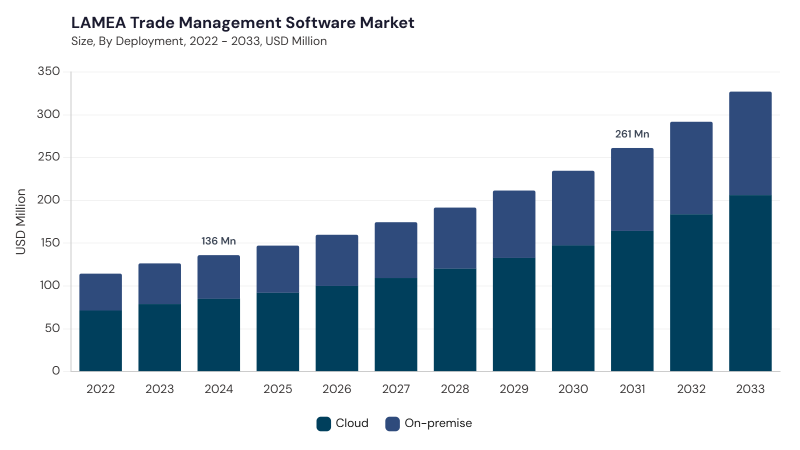
Based on Deployment, the market is segmented into Cloud and On-premise. The Cloud market dominated the LAMEA Trade Management Software Market by Deployment in 2025, and would continue to be a dominant market till 2033; thereby, achieving a market value of USD 132.8 million by 2029, growing at a CAGR of 10.9 % during the forecast period. The On-premise market is expected to witness a CAGR of 10.6% during (2026 - 2033).
Cloud deployment leads as organizations seek scalable, accessible, and lower-cost platforms that support real-time compliance updates, remote collaboration, and faster implementation. Cloud-based systems help companies manage customs documentation, shipment tracking, tariff changes, trade visibility, and AI-driven risk analytics across dispersed markets. On-premise deployment remains significant among government agencies, large enterprises, financial institutions, and regulated sectors requiring stronger control over sensitive trade data. This segment is supported by internal security policies, legacy infrastructure, customized workflows, limited connectivity in some locations, and data sovereignty concerns across parts of LAMEA.
Based on Component, the market is segmented into Solutions and Services. The Solutions market dominated the LAMEA Trade Management Software Market by Component in 2025, and would continue to be a dominant market till 2033; thereby, achieving a market value of USD 152.0 million by 2029, growing at a CAGR of 10.5 % during the forecast period. The Services market is expected to witness a CAGR of 11.4% during (2026 - 2033).
Solutions lead as enterprises increasingly require platforms for customs management, trade compliance automation, tariff classification, transaction reconciliation, supply chain visibility, and regulatory documentation. These systems help users reduce manual errors, improve audit readiness, accelerate clearance, and manage changing rules across multiple countries. Services remain significant because companies need consulting, implementation, system integration, training, maintenance, localization, and regulatory support to achieve effective deployment. This segment benefits from fragmented trade environments, limited in-house expertise, language diversity, legacy systems, and the need for continuous software optimization.
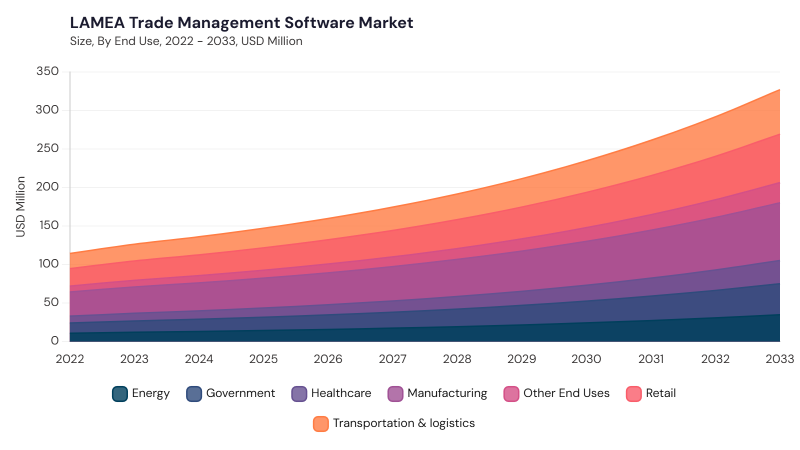
Based on End Use, the market is segmented into Manufacturing, Retail, Transportation & Logistics, Government, Energy, Healthcare, and Other End Uses. Manufacturing leads due to expanding industrial activity, export-oriented production, supplier coordination, cross-border procurement, and the need for automated compliance across diverse tariff and customs environments. Retail remains significant as e-commerce growth, international sourcing, inventory synchronization, and faster shipment cycles increase the need for digital trade platforms.
Transportation & Logistics uses these systems for freight documentation, customs declarations, shipment visibility, and route coordination. Government adoption is supported by customs modernization and border security, while Energy and Healthcare require commodity tracking, sanctions checks, pharmaceutical documentation, medical device compliance, cold chain visibility, and traceability.
Free Valuable Insights: Trade Management Software Market Size Worth USD 3029.0 Million billion by 2033
Based on Country, the market is segmented into Brazil, Argentina, UAE, Saudi Arabia, South Africa, Nigeria, and Rest of LAMEA. The Brazil market dominated the LAMEA Trade Management Software Market by Country in 2025, and would continue to be a dominant market till 2033; thereby, achieving a market value of USD 55.1 million by 2029, growing at a CAGR of 9.4 % during the forecast period. The Argentina market is expected to witness a CAGR of 12.1% during (2026 - 2033). Additionally, The UAE market is expected to witness a CAGR of 9.8% during (2026 - 2033).
Brazil leads due to complex customs and tax frameworks, growing cloud-native trade platforms, AI-based compliance checks, sustainability tracking, and demand for interoperable systems across logistics and ERP environments. Argentina supports market growth through cloud adoption, AI-enabled classification, localization, and regional trade technology partnerships. The UAE contributes through free zone trade, digital infrastructure, AI and blockchain integration, and adaptive compliance platforms aligned with customs and VAT requirements. Saudi Arabia, South Africa, and Nigeria add momentum through trade digitization, customs reform, cloud adoption, Vision-led modernization, AfCFTA-linked compliance needs, and public-private trade facilitation, while Rest of LAMEA benefits from localized SaaS platforms and SME-focused digital trade tools.

By Deployment
By Component
By End Use
By Country
Set to reach $211.5 Million by 2029, growing at a CAGR of 10.8% during (2026 – 2033).
Brazil leads with a market value of USD 55.1 million by 2029, growing at a CAGR of 9.4% during the forecast period.
Cloud adoption is a key driver, with the segment reaching USD 132.8 million by 2029 at a 10.9% CAGR.
Solutions segment hits USD 152.0 million by 2029, growing at a CAGR of 10.5% during the forecast period.
The UAE market is expected to witness a CAGR of 9.8% during (2026 - 2033).
The on-premise segment is expected to witness a CAGR of 10.6% during (2026 - 2033).
Our team of dedicated experts can provide you with attractive expansion opportunities for your business.




 Unique Offerings
