The sample copy of this report is available for access.
“Global Smart Shelves Market to reach a market value of USD 25,122.70 Million by 2033 growing at a CAGR of 23.5%”
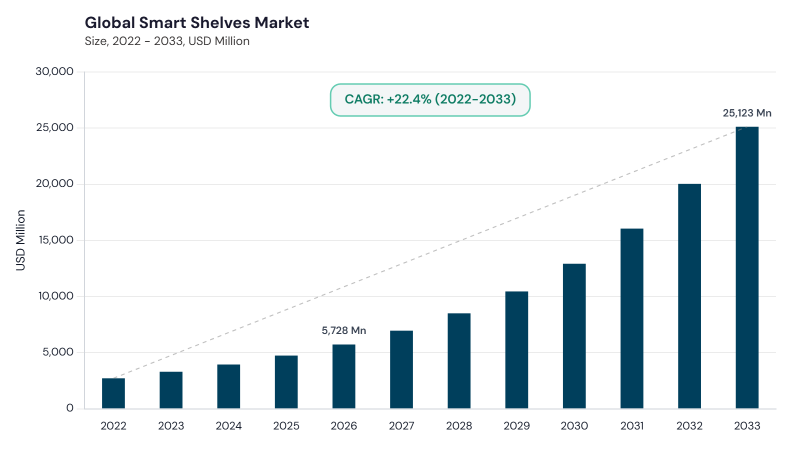
The Global Smart Shelves Market is expected to reach USD 25,122.7 million by 2033, growing at a CAGR of 23.5% during 2026 - 2033.
The Global Smart Shelves Market has evolved from early retail automation initiatives designed to improve inventory visibility and operational efficiency through sensor-based shelf monitoring systems. Initially, smart shelves primarily utilized weight sensors and basic electronic tracking technologies to detect stock levels and reduce manual inventory checks. Over time, these systems have advanced significantly through the integration of Internet of Things (IoT) connectivity, artificial intelligence (AI), cloud computing, RFID technology, computer vision, and advanced analytics platforms. Smart shelves have transformed from simple inventory management tools into intelligent retail infrastructure capable of supporting automated replenishment, dynamic pricing, personalized merchandising, and real-time customer engagement.
The market is witnessing robust growth driven by increasing retail digitalization, growing demand for real-time inventory visibility, rising labor cost pressures, and the expansion of automated store operations. Retailers are investing heavily in connected retail technologies to improve stock accuracy, reduce shrinkage, optimize shelf space utilization, and enhance shopper experiences. The growing adoption of AI-powered analytics, electronic shelf labeling (ESL), RFID-enabled inventory systems, and cloud-based retail management platforms continues to strengthen market demand globally.
The Smart Shelves Market is characterized by a moderately fragmented yet innovation-driven competitive landscape comprising electronic shelf label providers, RFID technology companies, IoT platform vendors, retail analytics specialists, and smart retail solution providers. Competition is primarily driven by technological innovation, sensor accuracy, AI capabilities, system interoperability, analytics sophistication, and deployment scalability. Market participants are actively investing in research and development to enhance inventory intelligence, dynamic pricing, computer vision analytics, and cloud-connected retail ecosystems. Strategic partnerships, ecosystem collaborations, product innovation, and geographic expansion remain key growth strategies adopted by leading companies.
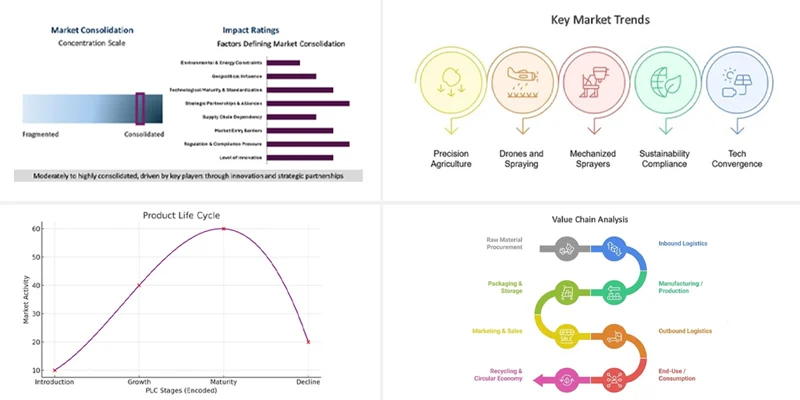

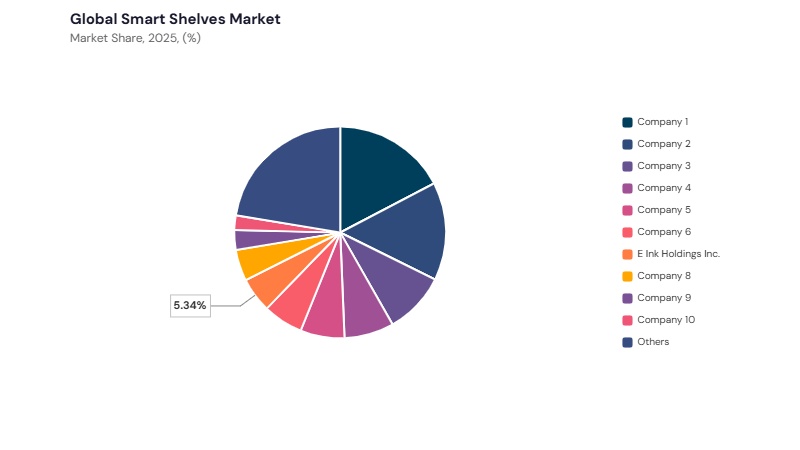
The Smart Shelves Market demonstrates a moderately concentrated competitive structure where leading technology vendors collectively account for a significant share of market revenue. The market is led by companies specializing in electronic shelf labels, RFID technologies, retail IoT infrastructure, and AI-powered analytics platforms. Market growth is increasingly driven by the convergence of AI, RFID, computer vision, IoT connectivity, and cloud analytics. Retailers are prioritizing integrated solutions that deliver inventory visibility, dynamic pricing, automated replenishment, planogram compliance, and enhanced customer engagement. The growing adoption of connected retail ecosystems continues to strengthen competition among global and regional market participants.
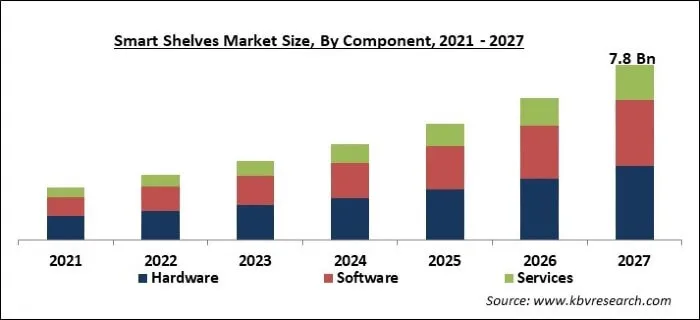
Based on Component, the market is segmented into Hardware, Software, and Services.
The Hardware market dominated the Global Smart Shelves Market by Component in 2025, and would continue to be a dominant market till 2033; thereby, achieving a market value of USD 13126.9 million by 2033, growing at a CAGR of 23.1 % during the forecast period. The Software market is expected to witness a CAGR of 24% during (2026 - 2033). The Services market is expected to witness a CAGR of 24% during (2026 - 2033).
Hardware accounted for the largest revenue share of 53.71% in 2025, supported by increasing deployment of RFID tags, sensors, cameras, communication modules, and electronic shelf labels that form the foundation of smart shelf infrastructure. Software represented 30.83% of the market, driven by growing demand for inventory analytics, AI-powered decision support systems, dynamic pricing platforms, and cloud-based retail management solutions. Services accounted for 15.46% of the market, supported by increasing demand for integration, deployment, consulting, maintenance, and managed services as retailers seek seamless implementation and optimization of smart shelf solutions.
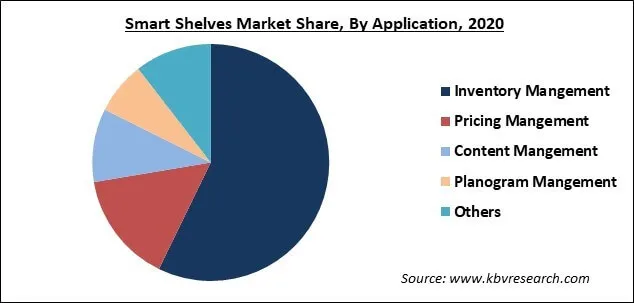
Based on Application, the market is segmented into Inventory Management, Planogram Management, Pricing Management, Content Management, and Other Applications. The Inventory Management market dominated the Global Smart Shelves Market by Application in 2025, and would continue to be a dominant market till 2033; thereby, achieving a market value of USD 9045.3 million by 2033, growing at a CAGR of 22.7 % during the forecast period. The Planogram Management market is expected to witness a CAGR of 23.2% during (2026 - 2033).
Inventory Management held the largest market share of 37.94% in 2025 due to growing retailer focus on minimizing stockouts, improving inventory accuracy, and enhancing replenishment efficiency. Planogram Management accounted for 21.32%, supported by increasing emphasis on merchandising effectiveness and shelf optimization. Pricing Management represented 16.78%, driven by adoption of electronic shelf labels and dynamic pricing strategies. Content Management accounted for 12.93%, reflecting growing demand for personalized customer engagement and digital shelf communication. Other Applications represented 11.04% of market revenue.
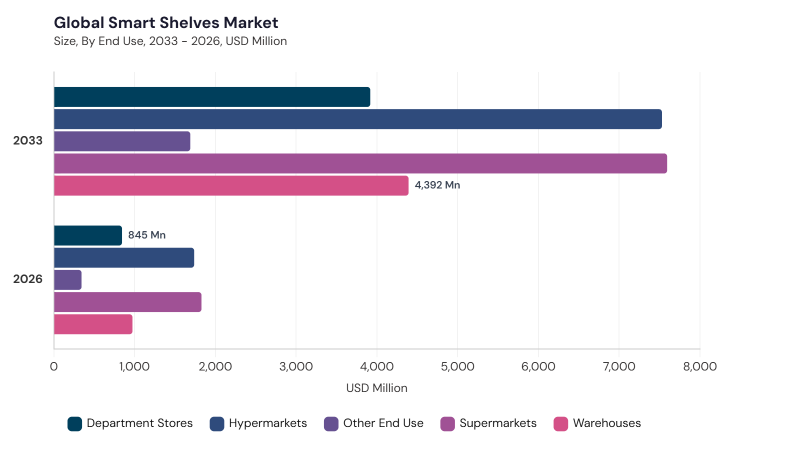
Based on End Use, the market is segmented into Supermarkets, Hypermarkets, Warehouses, Department Stores, and Other End Use. Supermarkets accounted for the largest market share of 32.16% in 2025 due to high-volume inventory management requirements and increasing adoption of real-time shelf monitoring systems. Hypermarkets followed with 30.39%, benefiting from large-scale inventory visibility and automated replenishment capabilities. Warehouses represented 16.94%, supported by growing demand for inventory accuracy and logistics optimization. Department Stores accounted for 14.64%, leveraging smart shelves for merchandising effectiveness and customer engagement. Other End Use segments contributed 5.88% of market revenue.
Free Valuable Insights: Smart Shelves Market Size to reach $25,122.70 Million by 2033
Region-wise, the Smart Shelves Market is analyzed across North America, Europe, Asia Pacific, and LAMEA. The North America market dominated the Global Smart Shelves Market by Region in 2025, and would continue to be a dominant market till 2033; thereby, achieving a market value of USD 8211.2 million by 2033, growing at a CAGR of 22.6 % during the forecast period. The Europe market is expected to witness a CAGR of 23.1% during (2026 - 2033).
North America accounted for the largest revenue share of 34.62% in 2025 due to strong retail digitalization initiatives, widespread adoption of IoT technologies, and significant investments in smart retail infrastructure. Europe represented 28.82% of market revenue, supported by extensive deployment of electronic shelf labels and retail automation technologies. Asia Pacific accounted for 27.86%, driven by rapid retail modernization, smart city initiatives, and increasing adoption of connected retail ecosystems. LAMEA contributed 8.71% of the market, supported by growing investments in retail transformation and inventory automation solutions.
Smart Shelves Market Coverage
| Report Attribute | Details |
|---|---|
| Market size value in 2026 | USD 5,727.56 Million |
| Market size forecast in 2033 | USD 25,122.70 Million |
| Base Year | 2025 |
| Historical Period | 2022 to 2024 |
| Forecast Period | 2026 to 2033 |
| Revenue Growth Rate | CAGR of 23.5% from 2026 to 2033 |
| Number of Pages | 596 |
| Tables | 720 |
| Report Coverage | Market Trends, Revenue Estimation and Forecast, Segmentation Analysis, Regional and Country Breakdown, Competitive Landscape, Market Share Analysis, Company Profiling, Companies Strategic Developments, SWOT Analysis, Product Life Cycle Analysis, Value Chain Analysis, Market Consolidation Analysis, Key Customer Criteria, COVID-19 Impact Analysis, and Winning Imperatives |
| Segments Covered | Component, Application, End Use, Region |
| Country Scope |
|
| Companies Included | VusionGroup, Avery Dennison Corporation, Trax Technology Solutions Pte Ltd., Honeywell International Inc., Huawei Technologies Co., Ltd., Samsung Electronics Co., Ltd., E Ink Holdings Inc., Intel Corporation, Lenovo PCCW Solutions Limited, and Happiest Minds Technologies Pvt. Ltd. |
By Component
By Application
By End Use
By Geography
Expected to reach USD 25,122.7 Million by 2033, growing at 23.5% CAGR during the forecast period (2026-2033).
Inventory Management leads, growing at a CAGR of 22.7% during the forecast period (2026-2033).
VusionGroup, Avery Dennison Corporation, Trax Technology Solutions Pte Ltd., Honeywell International Inc., Huawei Technologies Co.
North America dominates, projected to reach USD 8,211.2 Million by 2033, with a 22.6% CAGR during 2026-2033.
Integration of IoT and AI for real-time inventory management and rising demand for enhanced customer engagement.
North America is expected to achieve a market value of USD 8,211.2 Million by 2033.
Our team of dedicated experts can provide you with attractive expansion opportunities for your business.








 Unique Offerings