The sample copy of this report is available for access.
The Asia Pacific Smart Shelves Market is expected to reach USD 3,721.31 million by 2030, growing at a CAGR of 24.4% during 2026 - 2033.
The Asia Pacific Smart Shelves Market has emerged as one of the fastest-growing regional markets, supported by rapid retail modernization, increasing adoption of digital technologies, and expansion of organized retail formats. Initially, smart shelf deployments were centered around RFID-enabled inventory tracking systems designed to improve stock accuracy and reduce operational inefficiencies. Over time, advances in IoT connectivity, AI-powered analytics, sensor technologies, and cloud computing transformed smart shelves into intelligent retail platforms capable of real-time inventory monitoring, automated replenishment, dynamic pricing, and customer engagement. The region’s growing e-commerce ecosystem, rising consumer expectations for seamless shopping experiences, and strong investments in retail automation have accelerated adoption across supermarkets, hypermarkets, warehouses, and specialty retail stores.
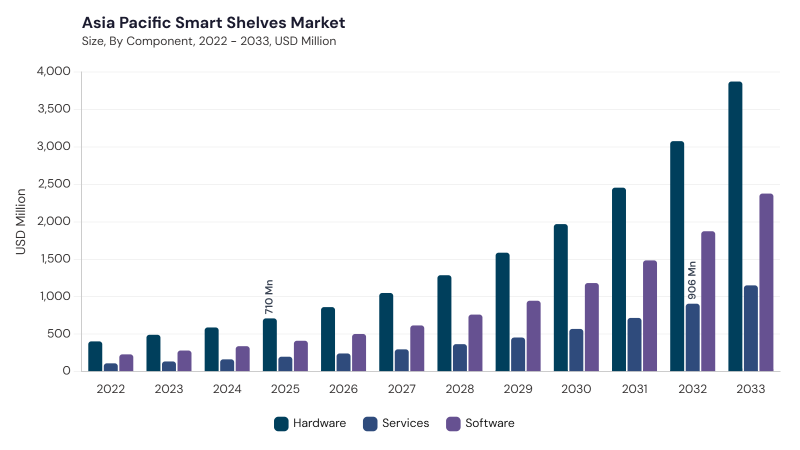
Based on Component, the market is segmented into Hardware, Software, and Services. Hardware accounts for the largest share of the Asia Pacific Smart Shelves Market due to widespread deployment of electronic shelf labels, RFID readers, sensors, cameras, digital displays, and IoT-enabled monitoring devices. Retailers increasingly invest in hardware infrastructure to improve inventory visibility and automate shelf-level operations. Software represents a significant growth segment, driven by increasing demand for inventory analytics, AI-powered forecasting, pricing automation, planogram compliance monitoring, and cloud-based retail management solutions. Services remain an essential component, including installation, integration, consulting, maintenance, employee training, and technical support services that ensure successful implementation and long-term optimization of smart shelf ecosystems.
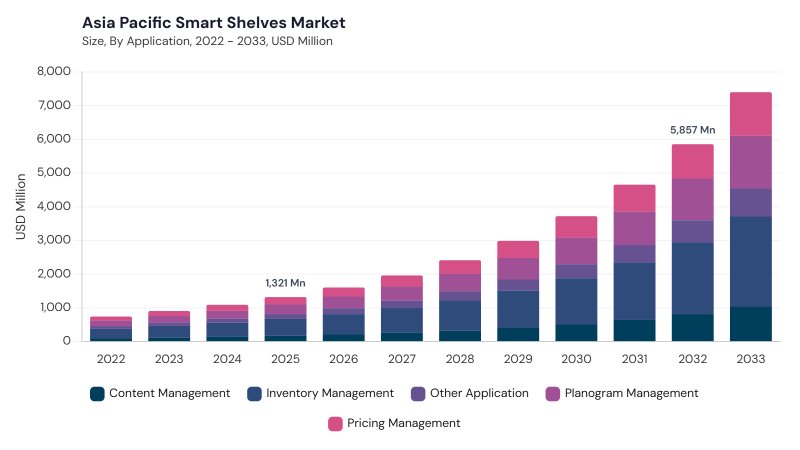
Based on Application, the market is segmented into Inventory Management, Planogram Management, Pricing Management, Content Management, and Other Applications. The Inventory Management market dominated the Asia Pacific Smart Shelves Market by Application in 2025, and would continue to be a dominant market till 2033; thereby, achieving a market value of USD 1,368.91million by 2030, growing at a CAGR of 23.6 % during the forecast period. The Planogram Management market is expected to witness a CAGR of 24.1% during (2026 - 2033).
Inventory Management holds the dominant position owing to increasing demand for real-time stock visibility, automated replenishment, and reduction of stockouts across high-volume retail environments. Planogram Management plays a critical role in merchandising optimization by ensuring proper product placement, shelf compliance, and promotional execution. Pricing Management continues to gain traction through the adoption of electronic shelf labels that support dynamic pricing and instant promotional updates.
Based on End Use, the market is segmented into Supermarkets, Hypermarkets, Warehouses, Department Stores, and Other End Use. The Supermarkets market dominated the Asia Pacific Smart Shelves Market by End Use in 2025, and would continue to be a dominant market till 2033; thereby, achieving a market value of USD 1,153.52 million by 2030, growing at a CAGR of 23.4 % during the forecast period. The Hypermarkets market is expected to witness a CAGR of 24.2% during (2026 - 2033). Additionally, The Warehouses market is expected to witness highest CAGR of 24.9% during (2026 - 2033).
Supermarkets represent the leading end-use segment due to high inventory turnover, extensive SKU management requirements, and the need for continuous shelf availability. Hypermarkets extensively utilize smart shelves to manage large product assortments, promotional activities, and pricing consistency across expansive retail spaces. Warehouses increasingly adopt smart shelf technologies to improve inventory accuracy, fulfillment efficiency, and storage visibility. Department stores leverage smart shelves to enhance merchandising effectiveness, improve customer experiences, and support digital retail initiatives.
Free Valuable Insights: Smart Shelves Market is Predicted to reach USD 25,122.70 Million billion by 2033, at a CAGR of 23.5%
Based on Country, the market is segmented into China, Japan, India, South Korea, Singapore, Malaysia, and Rest of Asia Pacific. The China and Japan led the Asia Pacific Smart Shelves Market by Country with a market share of 30.4% and 18.7% in 2025.The Singapore market is expected to witness a CAGR of 26.1% during throughout the forecast period.
China dominates the regional market due to extensive retail digitalization, large-scale deployment of AI-enabled retail technologies, and rapid growth of smart stores. Japan benefits from strong investments in retail automation and advanced inventory management solutions. India is experiencing significant growth driven by organized retail expansion, increasing adoption of IoT technologies, and modernization of retail infrastructure. South Korea continues to invest in intelligent retail environments supported by strong digital connectivity and innovation capabilities. Singapore and Malaysia are witnessing increased adoption of smart shelf technologies as part of broader smart retail transformation initiatives.

By Component
By Application
By End Use
By Country
Set to reach $3,721.31 Million by 2030, growing at 24.4% CAGR during 2026-2033.
China and Japan lead with a market share of 30.4% and 18.7% in 2025.
Inventory Management dominates, reaching $1,368.91 million by 2030, growing at 23.6% CAGR during 2026-2033.
Supermarkets reach $1,153.52 million by 2030, growing at 23.4% CAGR during 2026-2033.
Singapore is expected to witness a CAGR of 26.1% throughout the forecast period.
Planogram Management is expected to witness a CAGR of 24.1% during 2026-2033.
Our team of dedicated experts can provide you with attractive expansion opportunities for your business.




 Unique Offerings