The sample copy of this report is available for access.
The LAMEA Smart Shelves Market is expected to reach USD 981.73 million by 2029, growing at a CAGR of 25.4% during 2026 - 2033.
The LAMEA Smart Shelves Market has witnessed steady growth as retailers increasingly adopt digital technologies to improve inventory visibility, operational efficiency, and customer experiences. Initially deployed for basic inventory tracking through RFID and sensor technologies, smart shelves have evolved into intelligent retail solutions powered by IoT, AI, cloud computing, and real-time analytics. These systems help retailers automate stock monitoring, reduce stockouts, enable dynamic pricing, and optimize merchandising activities. Growing investments in retail modernization, warehouse automation, and omnichannel commerce across Latin America, the Middle East, and Africa continue to drive market expansion. Retailers are increasingly leveraging smart shelf technologies to improve productivity, reduce operational costs, and support data-driven decision-making.
Based on Component, the market is segmented into Hardware, Software, and Services. The Hardware market dominated the LAMEA Smart Shelves Market by Component in 2025, and would continue to be a dominant market till 2033; thereby, achieving a market value of USD 524.93 million by 2029, growing at a CAGR of 24.9 % during the forecast period. The Software market is expected to witness a CAGR of 25.9% during (2026 - 2033). The Services market is expected to witness a CAGR of 26.1% during (2026 - 2033).
Hardware accounts for the largest share due to extensive deployment of RFID readers, electronic shelf labels, sensors, cameras, digital displays, and IoT connectivity devices that enable real-time inventory monitoring. Software is gaining traction as retailers increasingly adopt analytics platforms, pricing management solutions, planogram compliance tools, and inventory optimization applications. Services remain essential for installation, integration, maintenance, consulting, employee training, and technical support, ensuring smooth implementation and efficient operation of smart shelf ecosystems.
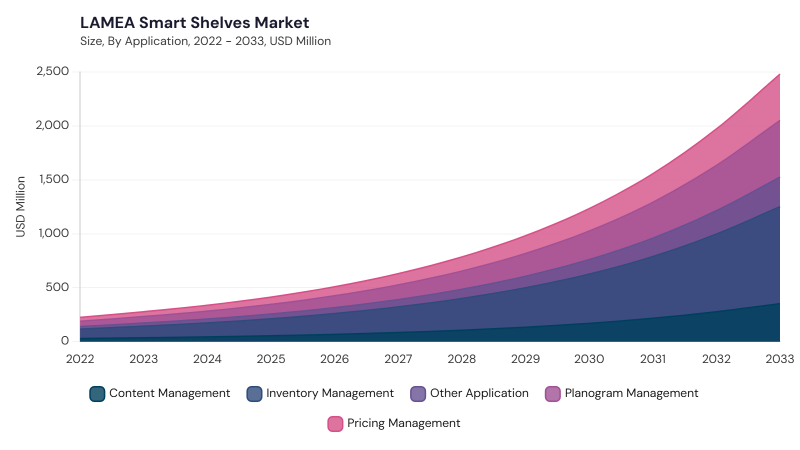
Based on Application, the market is segmented into Inventory Management, Planogram Management, Pricing Management, Content Management, and Other Applications. The Inventory Management market dominated the LAMEA Smart Shelves Market by Application in 2025, and would continue to be a dominant market till 2033; thereby, achieving a market value of USD 365.98 million by 2029, growing at a CAGR of 24.6 % during the forecast period. The Planogram Management market is expected to witness a CAGR of 25.1% during (2026 - 2033). The Other Application market is expected to witness a CAGR of 25.9% during (2026 - 2033).
Inventory Management dominates the market as retailers focus on improving stock visibility, minimizing stockouts, and automating replenishment processes. Planogram Management helps retailers optimize product placement and improve merchandising effectiveness. Pricing Management benefits from the increasing adoption of electronic shelf labels that support dynamic pricing and promotional updates. Content Management facilitates digital product information and customer engagement, while other applications include shelf analytics, shrinkage monitoring, and operational alerts.
Based on End Use, the market is segmented into Supermarkets, Hypermarkets, Warehouses, Department Stores, and Other End Use. Supermarkets hold the largest market share due to high inventory turnover, growing demand for real-time stock visibility, and the need for efficient replenishment systems. Hypermarkets utilize smart shelves to manage extensive product assortments and promotional campaigns. Warehouses increasingly adopt smart shelf technologies to improve inventory tracking, fulfillment accuracy, and operational efficiency. Department stores leverage these solutions to enhance merchandising, pricing management, and customer engagement. Other end users include pharmacies, convenience stores, specialty retailers, and electronics stores seeking greater inventory control and operational optimization.
Free Valuable Insights: Smart Shelves Market Size Worth USD 25,122.70 Million billion by 2033
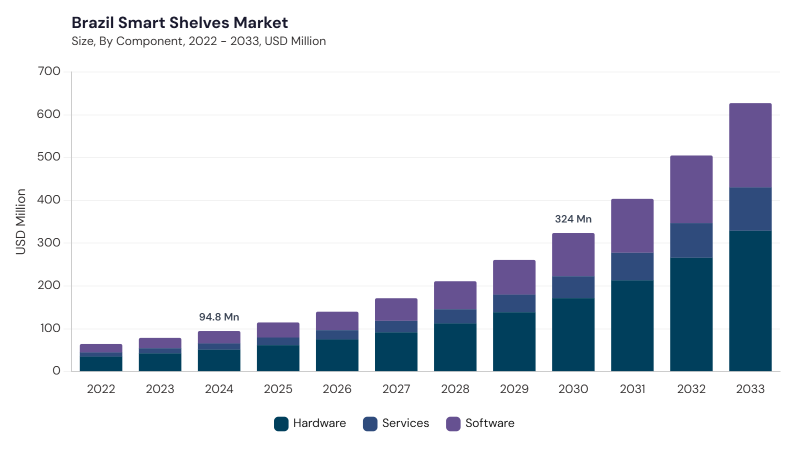
Based on Country, the market is segmented into Brazil, Argentina, UAE, Saudi Arabia, South Africa, Nigeria, and Rest of LAMEA. The Brazil and UAE led the LAMEA Smart Shelves Market by Country with a market share of 27.8% and 12.6% in 2025.The South Africa market is expected to witness a CAGR of 26.6% during throughout the forecast period.
Brazil leads the market due to increasing retail digitalization and adoption of AI-powered inventory management solutions. Argentina is witnessing steady growth supported by IoT-enabled retail modernization. The UAE and Saudi Arabia benefit from strong investments in smart retail technologies, digital transformation initiatives, and modern retail infrastructure. South Africa is expanding adoption across organized retail formats and large supermarket chains, while Nigeria is emerging as a promising market driven by growing retail infrastructure and automation needs. The Rest of LAMEA region offers significant growth opportunities through retail modernization, warehouse automation, and increasing deployment of connected store technologies.

By Component
By Application
By End Use
By Country
Set to reach $981.73 Million by 2029, growing at 25.4% CAGR during 2026-2033.
Brazil and UAE lead with market shares of 27.8% and 12.6% in 2025.
Rising demand for inventory management solutions, reaching $365.98 million by 2029 at 24.6% CAGR.
Hardware segment to achieve $524.93 million by 2029, growing at 24.9% CAGR during the forecast period.
South Africa market is expected to witness a CAGR of 26.6% throughout the forecast period.
Software market to witness a CAGR of 25.9% during 2026-2033.
Our team of dedicated experts can provide you with attractive expansion opportunities for your business.




 Unique Offerings