The sample copy of this report is available for access.
“Global Smart Fabrics Market to reach a market value of USD 31,912.01 Million by 2033 growing at a CAGR of 31.3%”
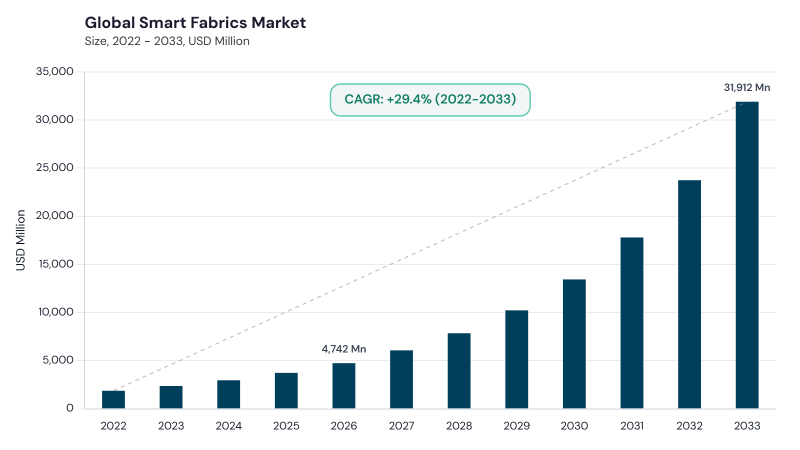
The Global Smart Fabrics Market is expected to reach USD 31.9 billion by 2033, growing at a CAGR of 31.3% during (2026 - 2033).
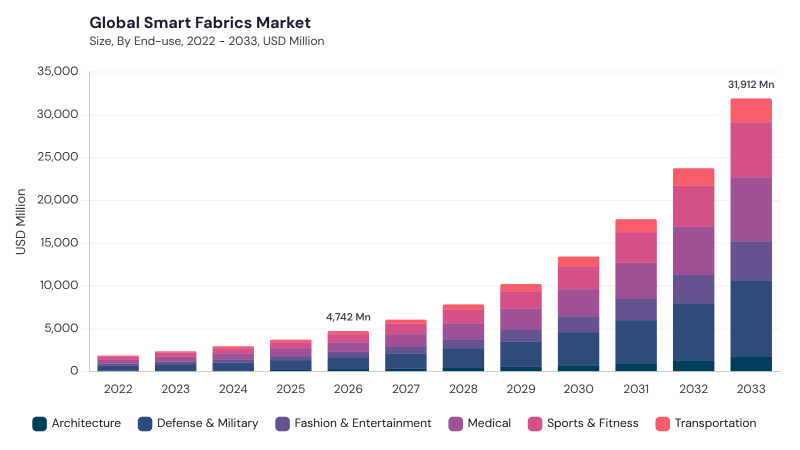
Growing adoption of smart, responsive, and connected textile solution across sports & fitness, healthcare, defense, automotive, fashion, industrial applications, and consumer electronics is surging the smart fabrics market. Market expansion is supported by conductive fibers, embedded sensors, energy-harvesting fabrics, temperature regulation, advancements in flexible electronics, and wearable technology adoption. Market emerged from early efforts to responsive materials, integrate electronics, actuators, and sensors into conventional textiles. With time, conductive fibers, miniaturized electronics, flexible sensors, nanotechnology, and polymer-based materials moved smart fabrics from experimental prototypes commercial products.
Smart fabrics market is experiencing growth as textiles largely evolve from passive materials into functional, connected, and data-generating platforms. Market demand is surging for fabrics that monitor vital signs, collect physiological data, regulate temperature, support energy generation, enhance comfort, and allow interactive user experiences. Sports, healthcare, defense, architecture, and temperature are adopting smart fabrics for wellness, safety, personalization, performance, and sustainability. Market growth is driven by IoT, AI, advanced coatings, digital textile printing, sensor-integrated fabric structures, and conductive polymers.
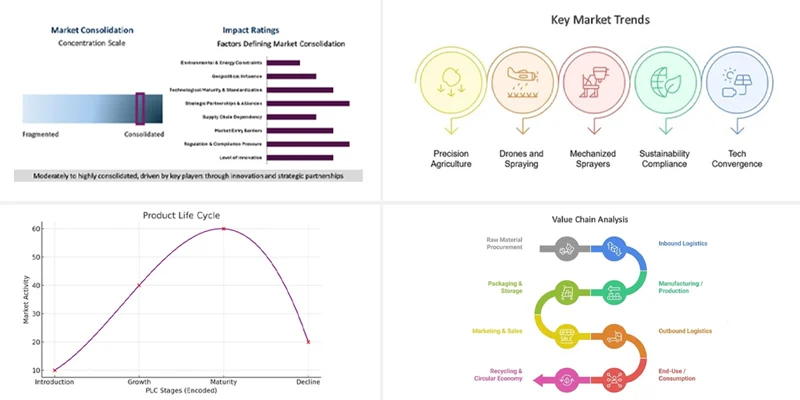
Smart fabrics market is innovation-driven and largely fragmented with competition driven by conductive-fabric specialists, functional textile manufacturers, smart-material companies, wearable technology developers, and conductive-fabric specialists. Market players compete through sensor accuracy, thermal responsiveness, user comfort, washability, conductivity, scalable production, data connectivity, and application-specific customization. Market competition further relies on medical-grade validation, AI-enabled textile intelligence, sustainable materials, durable e-textiles, integration with connected digital ecosystems, and energy-harvesting capabilities.

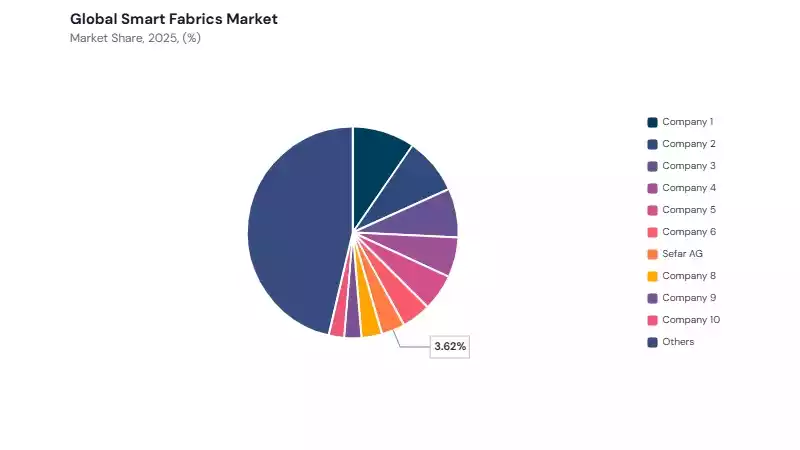
The global Smart Fabrics Market is highly fragmented, with the top ten companies collectively accounting for approximately 53.67% of the market and Others holding 46.33%. Outlast Technologies GmbH leads with 9.58%, followed by Schoeller Textil AG at 8.67% and Toray Industries, Inc. at 7.49%. Statex Produktions- und Vertriebs GmbH, Myant Corporation, Carré Technologies Inc., Sefar AG, Eeonyx Corporation, Sensoria Inc., and Pvilion, Inc. strengthen the competitive landscape through conductive textiles, biometric smart garments, thermoregulating fabrics, textile sensors, energy-generating fabrics, and connected textile platforms. Future competition will depend on sensor integration, conductivity, washability, thermal responsiveness, comfort, scalability, and digital ecosystem integration.
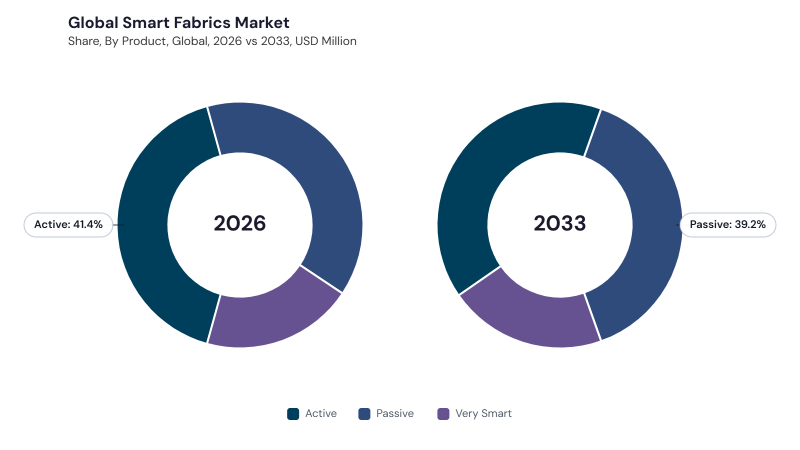
Based on Product, the market is segmented into Active, Passive, and Very Smart. The Active market dominated the Global Smart Fabrics Market by Product in 2025, and would continue to be a dominant market till 2033; thereby, achieving a market value of USD 12.7 billion by 2033, growing at a CAGR of 30.7 % during the forecast period. The Passive market is expected to witness a CAGR of 31.5% during (2026 - 2033). The Very Smart market is expected to witness a CAGR of 32.1% during (2026 - 2033).
Active smart fabrics lead the market due to their ability to sense and respond to physiological or environmental stimuli through embedded sensors, actuators, conductive fibers, and power-enabled components. Passive fabrics remain important because they provide monitoring, protection, thermal regulation, and material-level intelligence with lower integration complexity. Very Smart fabrics represent the most advanced segment, supported by AI, embedded computing, energy harvesting, and adaptive textile systems capable of sensing, processing, and responding autonomously.
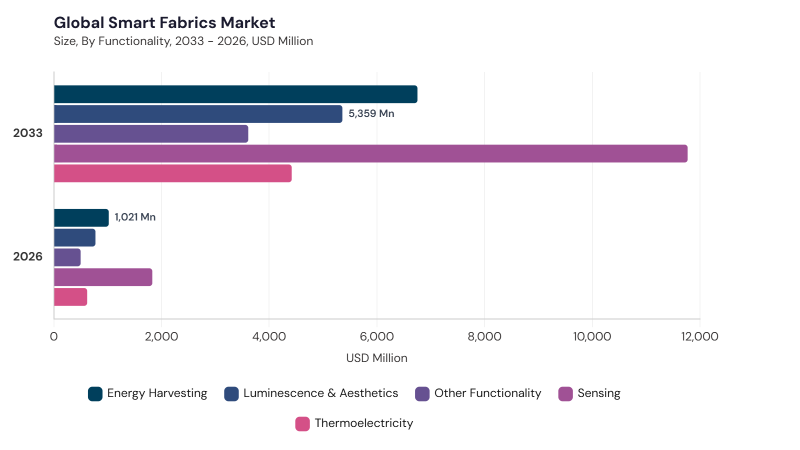
Based on Functionality, the market is segmented into Sensing, Energy Harvesting, Luminescence & Aesthetics, Thermoelectricity, and Other Functionality. The Sensing market dominated the Global Smart Fabrics Market by Functionality in 2025, and would continue to be a dominant market till 2033; thereby, achieving a market value of USD 11.7 billion by 2033, growing at a CAGR of 30.5 % during the forecast period. The Energy Harvesting market is expected to witness a CAGR of 31% during (2026 - 2033). Additionally, The Luminescence & Aesthetics market is expected to witness highest CAGR of 31.9% during (2026 - 2033).
Sensing dominates the market due to strong demand for textile-based monitoring of heart rate, respiration, movement, posture, pressure, temperature, and environmental conditions. Energy Harvesting is gaining traction as smart textiles increasingly require self-powered wearable systems. Luminescence & Aesthetics supports interactive fashion, illuminated garments, and visibility-enhancing textiles. Thermoelectricity is used in thermal comfort and body-heat conversion, while Other Functionality includes communication-enabled textiles, antimicrobial fabrics, adaptive protection, self-cleaning materials, and multifunctional textile interfaces.
Based on End-use, the market is segmented into Defense & Military, Medical, Sports & Fitness, Fashion & Entertainment, Transportation, and Architecture. The Defense & Military market dominated the Global Smart Fabrics Market by End-use in 2025, and would continue to be a dominant market till 2033; thereby, achieving a market value of USD 8.8 billion by 2033, growing at a CAGR of 30.2 % during the forecast period. The Medical market is expected to witness a CAGR of 31% during (2026 - 2033). Additionally, The Sports & Fitness market is expected to witness highest CAGR of 31.7% during (2026 - 2033).
Defense & Military leads the market due to demand for soldier monitoring, protection, communication, camouflage, thermal management, and lightweight wearable systems. Medical applications are expanding through continuous patient monitoring, rehabilitation garments, remote care, and sensor-integrated health textiles. Sports & Fitness benefits from biometric tracking, movement analysis, hydration monitoring, and connected training apparel. Fashion & Entertainment uses smart fabrics for interactive designs and illuminated clothing, while Transportation and Architecture adopt them for smart interiors, adaptive surfaces, thermal comfort, and responsive building materials.
Free Valuable Insights: Smart Fabrics Market Size to reach $31.9 Billion by 2033
Region-wise, the Smart Fabrics Market is analyzed across North America, Europe, Asia Pacific, and LAMEA.
In 2025, the North America led by smart fabrics market and is estimated to remain leading till 2033, by capturing a market value of 13.8 billion by 2033, expanding at a CAGR of 30.8% in the projection period. The Asia Pacific region is predicted to expand at a CAGR of 32.1% during 2026-2033. Moreover, the Europe market is anticipated to grow at a CAGR of 30.8% during the forecast period.
North America market is leading because of defense related research, advanced wearable technology development, investment in electronic textiles, and healthcare innovation. Europe is driven by wearable healthcare development, textile innovation, functional materials research, and sustainability initiatives. Asia Pacific is expanding through electronic manufacturing, and strong textile, surging wearable adoption, and advanced material investment. Moreover, LAMEA region is experiencing expansion through protective clothing, healthcare sports, and developing smart apparel applications.
| Report Attribute | Details |
|---|---|
| Market size value in 2026 | USD 4.7 billion |
| Market size forecast in 2033 | USD 31.9 billion |
| Base Year | 2025 |
| Historical Period | 2022 to 2024 |
| Forecast Period | 2026 to 2033 |
| Revenue Growth Rate | CAGR of 31.3% from 2026 to 2033 |
| Number of Pages | 679 |
| Tables | 750 |
| Report Coverage | Market Trends, Revenue Estimation and Forecast, Segmentation Analysis, Regional and Country Breakdown, Competitive Landscape, Market Share Analysis, Company Profiling, Companies Strategic Developments, SWOT Analysis, Product Life Cycle Analysis, Value Chain Analysis, Market Consolidation Analysis, Key Customer Criteria, Pandemic Impact Analysis, and Winning Imperatives |
| Segments Covered | Product, Functionality, End-use, Region |
| Country Scope |
|
| Companies Included | Outlast Technologies GmbH, Schoeller Textil AG, Toray Industries, Inc., Statex Produktions- und Vertriebs GmbH, Myant Corporation, Carré Technologies Inc., Sefar AG, Eeonyx Corporation, Sensoria Inc., and Pvilion, Inc. |
By Product
By Functionality
By End-use
By Geography
Expected to reach USD 31.9 billion by 2033, growing at 31.3% CAGR during 2026-2033.
Active smart fabrics lead, projected to achieve USD 12.7 billion by 2033.
Outlast Technologies GmbH, Schoeller Textil AG, Toray Industries, Inc., and Statex Produktions- und Vertriebs GmbH.
North America dominates, expected to reach USD 13.8 billion by 2033.
Wearable tech in healthcare, IoT-enabled functionalities, and adaptive textile technologies are key growth drivers.
Defense & Military leads, projected to reach USD 8.8 billion by 2033.
Our team of dedicated experts can provide you with attractive expansion opportunities for your business.








 Unique Offerings