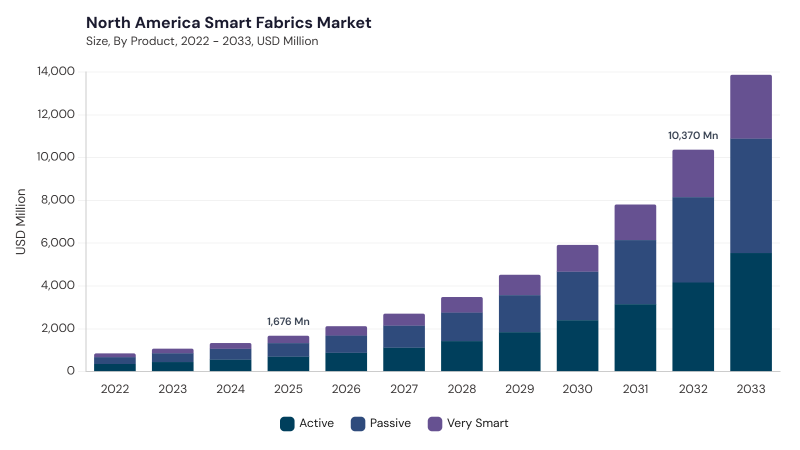
The North America Smart Fabrics Market is expected to reach USD 10.3 billion by 2032, growing at a CAGR of 30.8% during (2026 - 2033).
The North America Smart Fabrics Market evolved from early conductive fibers and sensor-integrated textiles developed mainly for military and aerospace applications into multifunctional fabrics capable of sensing, responding, and adapting to environmental and physiological conditions. Advances in nanotechnology, flexible electronics, miniaturized sensors, wireless communication, smart weaving, and 3D knitting improved durability, comfort, and functionality. This progression enabled expansion into healthcare, sportswear, fashion, automotive interiors, and other consumer-facing applications. The market now reflects a more mature ecosystem combining materials science, electronics, textile engineering, digital connectivity, and advanced manufacturing.
Advanced sensing, sustainability, AI integration, healthcare monitoring, and Industry 4.0 manufacturing are shaping current market development. Smart fabrics increasingly incorporate biometric sensors for heart rate, temperature, motion, and environmental monitoring, while AI-supported analytics enable predictive insights, adaptive comfort, and personalized user experiences. Manufacturers are also exploring biodegradable fibers, recyclable conductive materials, energy-efficient electronics, and circular design principles. IoT connectivity, energy harvesting, thermoelectric technologies, digital manufacturing, and collaborations among textile companies, technology developers, research institutions, healthcare organizations, and other industries are further expanding commercialization opportunities.
Based on Product, the market is segmented into Active, Passive, and Very Smart. The Active market dominated the North America Smart Fabrics Market by Product in 2025, and would continue to be a dominant market till 2033; thereby, achieving a market value of USD 4.1 billion by 2032, growing at a CAGR of 30.2 % during the forecast period. The Passive market is expected to witness a CAGR of 31% during (2026 - 2033). The Very Smart market is expected to witness a CAGR of 31.5% during (2026 - 2033).
Active smart fabrics both sense and respond to external or wearer-generated stimuli through heating, color changes, mechanical adjustment, haptic feedback, or other adaptive functions, making them relevant for performance apparel, military textiles, healthcare, and interactive clothing. Passive smart fabrics primarily detect and transmit information such as temperature, pressure, moisture, movement, or physiological data, offering simpler integration and lower design complexity for monitoring applications. Very Smart fabrics combine multi-modal sensing, embedded computing, wireless communication, and intelligent response capabilities, enabling autonomous interaction, predictive analysis, and advanced adaptive functionality in healthcare, defense, and emerging connected textile applications.
Based on Functionality, the market is segmented into Sensing, Energy Harvesting, Luminescence & Aesthetics, Thermoelectricity, and Other Functionality. The Sensing market dominated the North America Smart Fabrics Market by Functionality in 2025, and would continue to be a dominant market till 2033; thereby, achieving a market value of USD 3.8 billion by 2032, growing at a CAGR of 29.9 % during the forecast period. The Energy Harvesting market is expected to witness a CAGR of 30.4% during (2026 - 2033). Additionally, The Luminescence & Aesthetics market is expected to witness highest CAGR of 31.3% during (2026 - 2033).
Sensing fabrics enable continuous monitoring of physiological, environmental, and mechanical parameters across healthcare, fitness, defense, and workplace safety applications. Energy Harvesting fabrics convert movement, thermal gradients, or ambient energy into usable electricity, supporting self-powered wearables and reducing reliance on conventional batteries. Luminescence & Aesthetics incorporates light-emitting elements, color-changing materials, and interactive visual effects for fashion, entertainment, visibility, and experiential applications. Thermoelectricity supports body-heat conversion and thermal regulation for outdoor, medical, sports, and military garments. Other Functionality includes shape-memory textiles, antimicrobial or self-cleaning surfaces, communication-enabled fabrics, adaptive protection, embedded controls, and movement-assistance features.
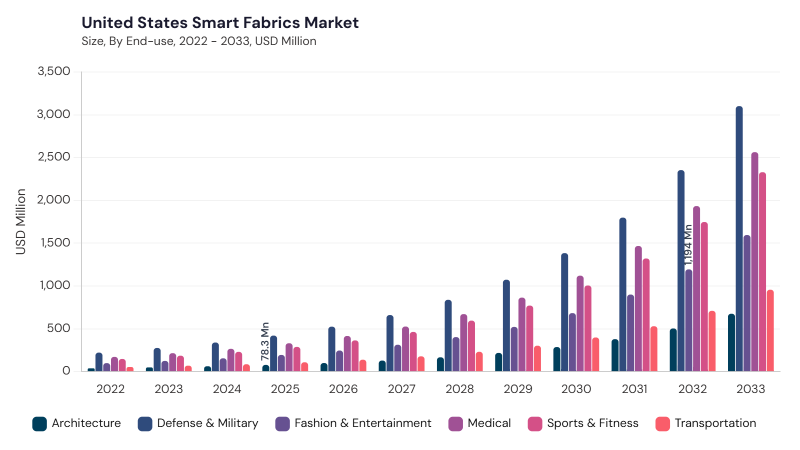
Based on End-use, the market is segmented into Defense & Military, Medical, Sports & Fitness, Fashion & Entertainment, Transportation, and Architecture. Defense & Military applications include physiological monitoring, adaptive thermal control, environmental sensing, communication support, smart camouflage, and protective wearable systems. Medical applications use biosensor-integrated fabrics for remote patient monitoring, rehabilitation, physiological tracking, therapeutic support, and continuous health assessment.
Sports & Fitness applications focus on performance analytics, movement monitoring, heart-rate tracking, hydration insights, and connected training apparel, while Fashion & Entertainment emphasizes programmable lighting, color-changing fabrics, interactive garments, and technology-led design. Transportation applications include intelligent seating, occupant monitoring, heating, pressure sensing, and responsive interiors across automotive and aerospace environments. Architecture uses smart fabrics for adaptive shading, environmental sensing, acoustic control, responsive interiors, and digitally integrated building surfaces.
Free Valuable Insights: The Global Smart Fabrics Market will hit USD 31.9 Billion billion by 2033, at a CAGR of 31.3%
Based on Country, the market is segmented into US, Canada, Mexico, and Rest of North America. The US market dominated the North America Smart Fabrics Market by Country in 2025, and would continue to be a dominant market till 2033; thereby, achieving a market value of USD 8.4 billion by 2032, growing at a CAGR of 30 % during the forecast period. The Canada market is expected to witness a CAGR of 34.8% during (2026 - 2033). Additionally, The Mexico market is expected to witness a CAGR of 33.5% during (2026 - 2033).
Across North America, smart fabric development is being shaped by sensor integration, sustainable materials, IoT connectivity, advanced manufacturing, healthcare wearables, and application-specific customization. The US emphasizes multifunctional activewear, health monitoring, connected textiles, sustainable materials, flexible electronics, and scalable manufacturing, while Canada focuses on biodegradable smart textiles, IoT-connected garments, adaptive functionality, AI-driven analytics, and localized manufacturing. Mexico is advancing sustainable and recycled smart materials, AI- and IoT-enabled textiles, localized supply chains, digitalized production, and cross-industry collaboration, whereas Rest of North America continues to develop biometric monitoring, eco-friendly functional fibers, flexible electronics, embedded sensing, localized production, and user-centric smart textile solutions.

By Product
By Functionality
By End-use
By Country
Set to reach $10.3 Billion by 2032, growing at 30.8% CAGR during 2026-2033.
The US leads with $8.4 billion by 2032, growing at 30% CAGR during the forecast period.
Rising demand for smart fabrics in sensing applications drives growth, reaching $3.8 billion by 2032.
Active segment will reach $4.1 billion by 2032, growing at 30.2% CAGR during 2026-2033.
Canada is expected to witness a CAGR of 34.8% during 2026-2033.
Luminescence & Aesthetics functionality is expected to witness the highest CAGR of 31.3% during 2026-2033.
Our team of dedicated experts can provide you with attractive expansion opportunities for your business.



 Unique Offerings