The sample copy of this report is available for access.
The LAMEA Smart Fabrics Market is expected to reach USD 722.2 million by 2029, growing at a CAGR of 33.9% during (2026 - 2033).
The LAMEA Smart Fabrics Market evolved from early sensor-integrated and conductive textiles developed primarily for military and healthcare applications into multifunctional fabrics combining advanced materials, embedded electronics, and digital connectivity. Progress in nanotechnology, flexible electronics, miniaturized sensors, energy harvesting, and wireless communication improved durability, washability, and practical usability. IoT integration further extended smart fabrics from experimental applications into sportswear, fashion, automotive interiors, industrial clothing, and healthcare monitoring. The market now combines materials science and digital technology with regional customization addressing varied climatic, economic, and end-user requirements.
Sustainability, wearable healthcare, advanced sensing, digital manufacturing, and localized customization are shaping current market development. Manufacturers are increasingly exploring biodegradable fibers, eco-friendly conductive materials, energy-efficient production, and circular design principles, while healthcare applications are expanding through continuous biometric monitoring and remote diagnostics. AI, IoT connectivity, additive manufacturing, digital printing, flexible electronics, and Industry 4.0 processes are enabling more adaptive and personalized textile solutions. Partnerships among textile manufacturers, technology providers, healthcare organizations, research institutions, and local producers are also strengthening commercialization across diverse LAMEA markets.
Based on Product, the market is segmented into Active, Passive, and Very Smart. The Active market dominated the LAMEA Smart Fabrics Market by Product in 2025, and would continue to be a dominant market till 2033; thereby, achieving a market value of USD 298.2 million by 2029, growing at a CAGR of 33.2 % during the forecast period. The Passive market is expected to witness a CAGR of 34.1% during (2026 - 2033). The Very Smart market is expected to witness a CAGR of 34.9% during (2026 - 2033).
Active smart fabrics integrate sensors, actuators, microcontrollers, and responsive materials that allow textiles to detect and react to physiological or environmental stimuli, supporting healthcare monitoring, sports performance, thermal management, and protective applications. Passive smart fabrics provide functional benefits such as monitoring, moisture management, UV protection, antimicrobial performance, and other material-level enhancements with comparatively simpler integration and lower complexity. Very Smart fabrics combine sensing, connectivity, embedded processing, energy management, and adaptive response capabilities, supporting emerging applications in defense, healthcare, automotive systems, and advanced connected wearables.
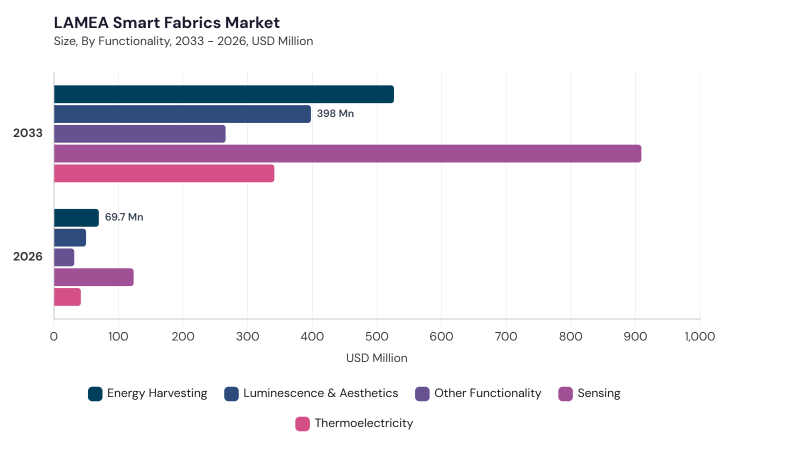
Based on Functionality, the market is segmented into Sensing, Energy Harvesting, Luminescence & Aesthetics, Thermoelectricity, and Other Functionality. The Sensing market dominated the LAMEA Smart Fabrics Market by Functionality in 2025, and would continue to be a dominant market till 2033; thereby, achieving a market value of USD 276.3 million by 2029, growing at a CAGR of 33 % during the forecast period. The Energy Harvesting market is expected to witness a CAGR of 33.5% during (2026 - 2033). Additionally, The Luminescence & Aesthetics market is expected to witness highest CAGR of 34.5% during (2026 - 2033).
Sensing fabrics monitor physiological, mechanical, and environmental parameters and support real-time data collection across medical, sports, industrial, and defense applications. Energy Harvesting fabrics convert solar, kinetic, or thermal energy into usable power, supporting autonomous wearable electronics and reducing dependence on conventional charging infrastructure. Luminescence & Aesthetics incorporates illuminated, color-changing, and interactive textile surfaces for fashion, entertainment, visibility, and safety applications. Thermoelectricity enables temperature regulation and body-heat utilization for climate-adaptive clothing, while Other Functionality includes antimicrobial coatings, shape-memory textiles, communication features, adaptive protection, moisture management, haptics, and multifunctional interactive surfaces.
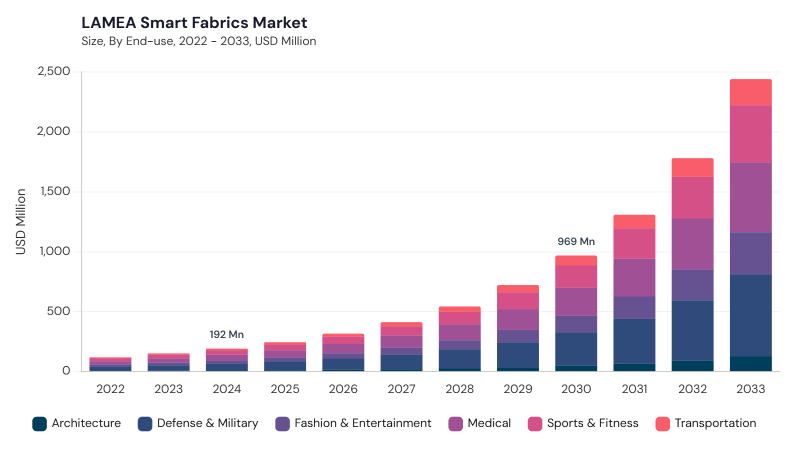
Based on End-use, the market is segmented into Defense & Military, Medical, Sports & Fitness, Fashion & Entertainment, Transportation, and Architecture. Defense & Military applications include physiological monitoring, adaptive camouflage, communication systems, environmental sensing, thermal management, and protective equipment. Medical applications use smart textiles for remote patient monitoring, rehabilitation, chronic disease management, continuous vital-sign observation, and home-based healthcare.
Sports & Fitness applies connected fabrics to performance analysis, motion tracking, heart-rate monitoring, and training optimization, while Fashion & Entertainment uses illuminated, interactive, and adaptive textiles for luxury, events, and technology-enabled apparel. Transportation applications include intelligent upholstery, passenger monitoring, thermal-control surfaces, and connected interiors, whereas Architecture uses smart fabrics in responsive shading, building interiors, acoustic systems, climate-adaptive structures, and smart-city projects.
Free Valuable Insights: Smart Fabrics Market Size Worth USD 31.9 Billion billion by 2033
Based on Country, the market is segmented into Brazil, Argentina, UAE, Saudi Arabia, South Africa, Nigeria, and Rest of LAMEA. The Brazil market dominated the LAMEA Smart Fabrics Market by Country in 2025, and would continue to be a dominant market till 2033; thereby, achieving a market value of USD 194.6 million by 2029, growing at a CAGR of 32.3 % during the forecast period. The Argentina market is expected to witness a CAGR of 36% during (2026 - 2033). Additionally, The UAE market is expected to witness a CAGR of 32.6% during (2026 - 2033).
Across LAMEA, smart fabric development is being shaped by sustainability, AI and IoT integration, wearable healthcare, localized manufacturing, advanced sensing, and digital textile production. Brazil emphasizes Industry 4.0 manufacturing, sustainable materials, sensor-integrated textiles, and collaborative innovation, while Argentina focuses on eco-friendly smart textiles, AI-enabled fabrics, localized production, digital printing, and flexible sensors. The UAE is advancing AI- and IoT-integrated textiles, climate-adaptive products, sustainable materials, advanced manufacturing, and wearable applications, whereas Saudi Arabia emphasizes smart manufacturing, biosensors, nanotechnology, energy-harvesting fabrics, localization, and healthcare and defense applications. South Africa focuses on industrial workwear, IoT-enabled monitoring, digital textile production, sustainability, and hybrid sensor-integrated fabrics, while Nigeria emphasizes IoT-enabled textiles, sustainable materials, localized design, healthcare applications, and collaboration between fashion and technology firms. Rest of LAMEA continues to develop sustainable smart materials, IoT-enabled fabrics, localized customization, flexible electronics, advanced manufacturing, and multifunctional textile applications.

By Product
By Functionality
By End-use
By Country
Set to reach $722.2 Million by 2029, growing at 33.9% CAGR during 2026-2033.
Brazil leads with a market value of $194.6 million by 2029, growing at a 32.3% CAGR during the forecast period.
The Active product segment will reach $298.2 million by 2029, growing at a 33.2% CAGR during 2026-2033.
The Passive segment is expected to grow at a 34.1% CAGR during 2026-2033.
The Argentina market is expected to witness a 36% CAGR during 2026-2033.
The Luminescence & Aesthetics segment is expected to witness the highest CAGR of 34.5% during 2026-2033.
Our team of dedicated experts can provide you with attractive expansion opportunities for your business.




 Unique Offerings