The sample copy of this report is available for access.
“Global Semiconductor Memory Market to reach a market value of USD 296,332.05 Million by 2033 growing at a CAGR of 11.3%”
The Global Semiconductor Memory Market is expected to reach USD 296.3 billion by 2033, growing at a CAGR of 11.3% during (2026 – 2033).
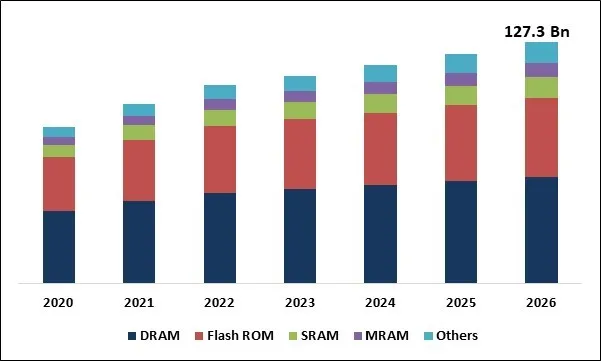
Semiconductor memory market is witnessing expansion driven by growing demand for AI workloads, high-speed data processing, edge devices, cloud computing, consumer electronics, connected vehicles, and telecommunication applications. Rising focus on faster data access, higher memory density, enhanced system performance, lower power consumption, and advanced memory architectures is further supporting market growth. Semiconductor memory market emerged in mid-20th century, when early electronic memory technologies were developed to support digital computing needs. Market evolved from early RAM technologies and magnetic core memory toward NAND flash, CMOS-based DRAM, and advanced non-volatile memory formats.
Semiconductor memory market is experiencing strong expansion as digital systems require more energy-efficient, faster, and denser memory for data-intensive workloads. High-performance computing, AI servers, connected vehicles, smartphones, cloud platforms, edge devices, and industrial automation are surging demand for NAND flash, DRAM, SRAM, HBM, and developing non-volatile memory technologies. Market growth is further driven by 3D NAND, advanced lithography, HBM stacking, embedded storage, localized fabrication investments, and secure memory.
Semiconductor memory market is technology-driven and largely consolidated with competition driven by NAND specialists, large integrated device manufacturers, specialty memory vendors, and DRAM suppliers. Market players compete through process-node migration, fabrication capacity, power efficiency, memory density, HBM capability, yield optimization, 3D NAND scaling, and product reliability, and long-term customer supply agreements. Market competition relies on HBM capacity, advanced packaging, AI-related memory demand, 3D stacking, manufacturing yields, supply-chain resilience, and access to advanced semiconductor equipment.
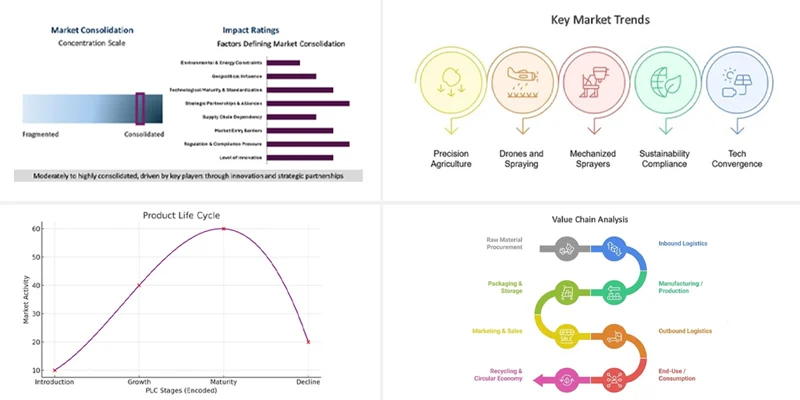

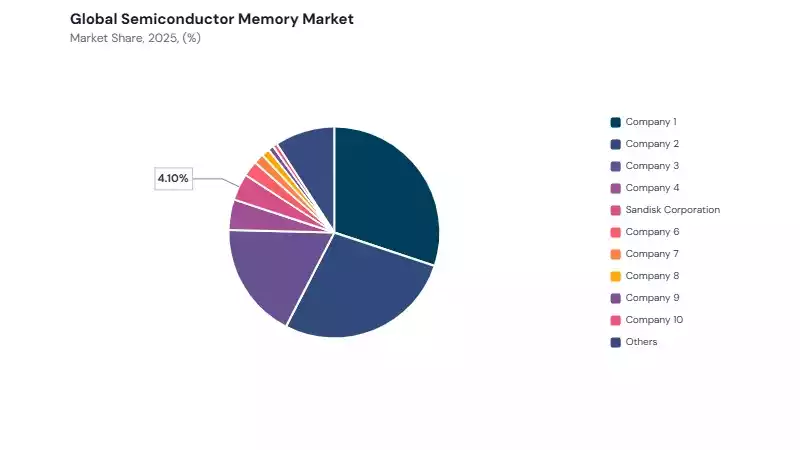
Semiconductor memory market is moderately consolidated with SK hyniz including Solidigm, Samsung Electronics, and Micron Technology forming the leading group tier across HBM, DRAM, NAND flash, server memory, mobile memory, and embedded storage. Winbond Electronics, Nanya Technology, and Macronix International Strengthen the mature-memory and specialty landscape. Market competition relies on AI-driven memory demand, HBM capacity, process technology, advanced packaging, manufacturing yields, supply agreements, and 3D NAND scaling.
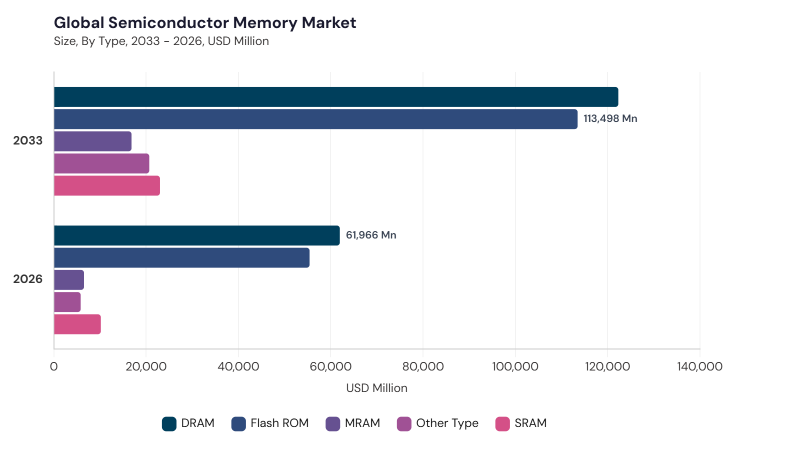
Based on Type, the market is segmented into DRAM, Flash ROM, SRAM, MRAM, and Other Type. The DRAM market dominated the Global Semiconductor Memory Market by Type in 2025, and would continue to be a dominant market till 2033; thereby, achieving a market value of USD 122.3 billion by 2033, growing at a CAGR of 10.2 % during the forecast period. The Flash ROM market is expected to witness a CAGR of 10.8% during (2026 - 2033). Additionally, The SRAM market is expected to witness highest CAGR of 12.3% during (2026 - 2033).
DRAM leads the market due to its broad use in personal computers, servers, smartphones, data centers, and high-performance computing systems requiring high-speed volatile memory. Flash ROM is strongly adopted for persistent storage across smartphones, solid-state drives, consumer electronics, and embedded devices. SRAM remains important for processor cache, networking equipment, and real-time computing applications. MRAM is gaining attention due to non-volatility, endurance, and low-power performance, while Other Type includes ReRAM, FeRAM, PCM, and specialized memory technologies for emerging computing needs.
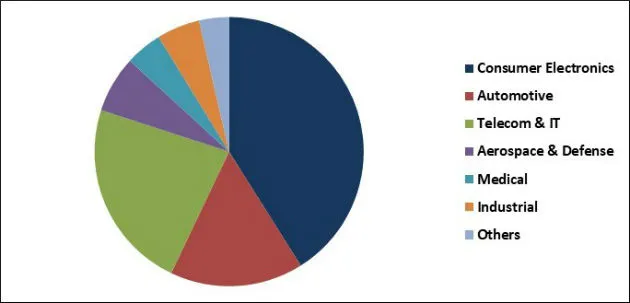
Based on Application, the market is segmented into Consumer Electronics, IT & Telecommunication, Automotive, Industrial, Aerospace & Defense, Medical, and Other Application. The Consumer Electronics market dominated the Global Semiconductor Memory Market by Application in 2025, and would continue to be a dominant market till 2033; thereby, achieving a market value of USD 91.0 billion by 2033, growing at a CAGR of 9.8 % during the forecast period. The IT & Telecommunication market is expected to witness a CAGR of 10.6% during (2026 - 2033). Additionally, The Automotive market is expected to witness highest CAGR of 11.8% during (2026 - 2033).
Consumer Electronics dominates the market due to high memory demand from smartphones, laptops, tablets, wearables, gaming devices, and smart home products. IT & Telecommunication is supported by cloud data centers, enterprise servers, 5G networks, AI infrastructure, and high-speed networking hardware. Automotive demand is increasing through ADAS, electric vehicles, infotainment, connected vehicle systems, and secure firmware storage. Industrial, aerospace, defense, medical, and other applications use semiconductor memory for automation, mission-critical systems, imaging devices, diagnostics, connected equipment, and specialized electronics.
Free Valuable Insights: Semiconductor Memory Market Size to reach $296.3 Billion by 2033
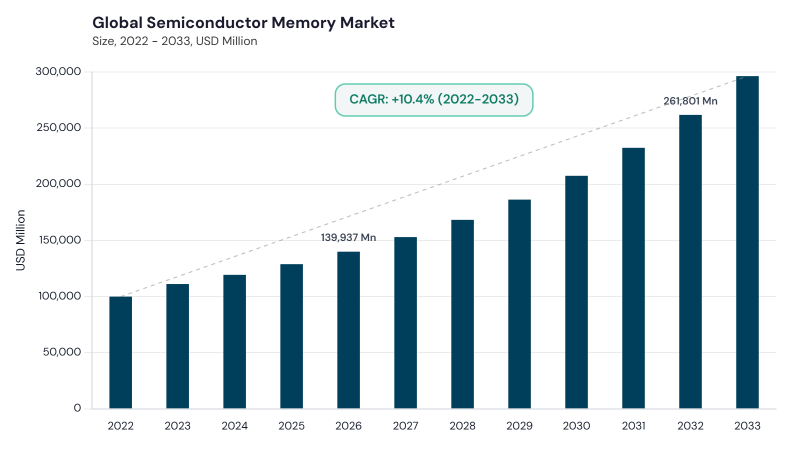
Region-wise, the Semiconductor Memory Market is analyzed across North America, Europe, Asia Pacific, and LAMEA.
In 2025, the Asia Pacific market led the semiconductor memory market and is estimated to be dominant till 2033, capturing a market value of USD 147.2 billion by 2033, expanding at a CAGR of 11.6%. The North America is predicted to grow at a CAGR of 10.5% during 2026-2033. Moreover, the Europe region is predicted to expand at a CAGR of 11% during the forecast period.
APAC region is expanding because of expanding semiconductor manufacturing capacity, memory fabrication investments, strong consumer electronics production, and demand for advanced devices. North America is driven by cloud infrastructure, semiconductor R&D, data centers, AI computing, domestic manufacturing initiatives and data centers. Europe benefits from industrial automation, automotive semiconductor demand, regional semiconductor capability-building programs, and digital infrastructure. LAMEA market is witnessing growth through consumer electronics demand, digital transformation, emerging technology investments, and IT infrastructure growth.
| Report Attribute | Details |
|---|---|
| Market size value in 2026 | USD 139.9 billion |
| Market size forecast in 2033 | USD 296.3 billion |
| Base Year | 2025 |
| Historical Period | 2022 to 2024 |
| Forecast Period | 2026 to 2033 |
| Revenue Growth Rate | CAGR of 11.3% from 2026 to 2033 |
| Number of Pages | 591 |
| Tables | 660 |
| Report Coverage | Market Trends, Revenue Estimation and Forecast, Segmentation Analysis, Regional and Country Breakdown, Competitive Landscape, Market Share Analysis, Company Profiling, Companies Strategic Developments, SWOT Analysis, Product Life Cycle Analysis, Value Chain Analysis, Market Consolidation Analysis, Key Customer Criteria, Pandemic Impact Analysis, and Winning Imperatives |
| Segments Covered | Type, Application, Region |
| Country Scope |
|
| Companies Included | Samsung Electronics Co., Ltd., SK hynix Inc., Micron Technology, Inc., Kioxia Holdings Corporation, Sandisk Corporation, ChangXin Memory Technologies, Yangtze Memory Technologies Co., Ltd., Nanya Technology Corporation, Winbond Electronics Corporation, and Macronix International Co., Ltd. |
By Type
By Application
By Geography
The semiconductor memory market is valued at USD 139.9 billion in 2026.
DRAM leads with a projected market value of USD 122.3 billion by 2033.
Samsung Electronics, SK hynix, and Micron Technology are the dominant companies.
Asia Pacific leads with a market value of USD 147.2 billion by 2033.
Advancements in semiconductor R&D and AI applications are key demand catalysts.
Consumer electronics leads with a market value of USD 91.0 billion by 2033.
Our team of dedicated experts can provide you with attractive expansion opportunities for your business.








 Unique Offerings