The sample copy of this report is available for access.
The Asia Pacific Semiconductor Memory Market is expected to reach USD 102.1 billion by 2030, growing at a CAGR of 11.6% during (2026 – 2033).
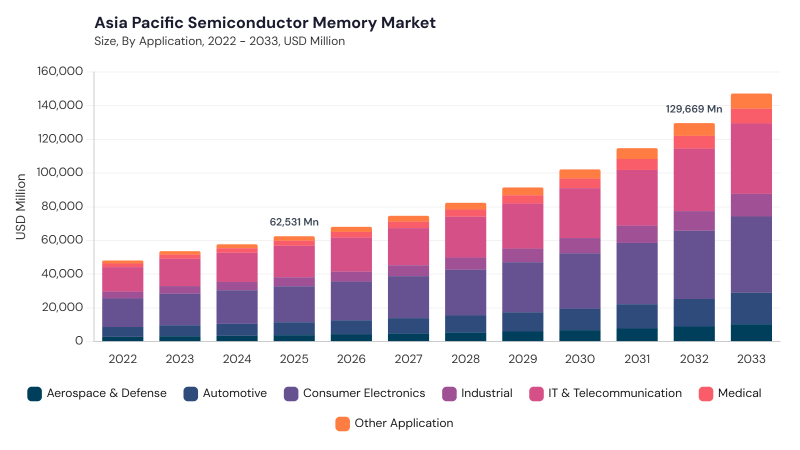
Semiconductor memory across Asia Pacific evolved from early DRAM and flash technologies into highly advanced memory architectures supporting AI, cloud computing, consumer electronics, automotive systems, and industrial applications. Japan and South Korea initially drove regional development, while Taiwan, China, India, and other markets strengthened design, fabrication, packaging, and testing capabilities. The shift from planar to 3D memory architectures improved density, speed, and energy efficiency. The market is now advancing toward HBM, MRAM, PCM, advanced DRAM, 3D NAND, and specialized memory solutions designed for high-performance and data-intensive computing.
AI integration, supply-chain localization, sustainable manufacturing, and next-generation memory technologies are shaping current market development. Growing AI, data center, edge, and 5G workloads are increasing demand for high-bandwidth, low-latency, and energy-efficient memory. Geopolitical pressures are encouraging regional production, supplier diversification, and stronger manufacturing resilience across major Asia Pacific economies. At the same time, greener fabrication processes, low-power memory architectures, advanced packaging, EUV lithography, and heterogeneous integration are becoming important competitive priorities across the regional semiconductor ecosystem.
Based on Type, the market is segmented into DRAM, Flash ROM, SRAM, MRAM, and Other Type. The DRAM market dominated the Asia Pacific Semiconductor Memory Market by Type in 2025, and would continue to be a dominant market till 2033; thereby, achieving a market value of USD 43.5 billion by 2030, growing at a CAGR of 10.5 % during the forecast period. The Flash ROM market is expected to witness a CAGR of 11.1% during (2026 - 2033). Additionally, The SRAM market is expected to witness highest CAGR of 12.7% during (2026 - 2033).
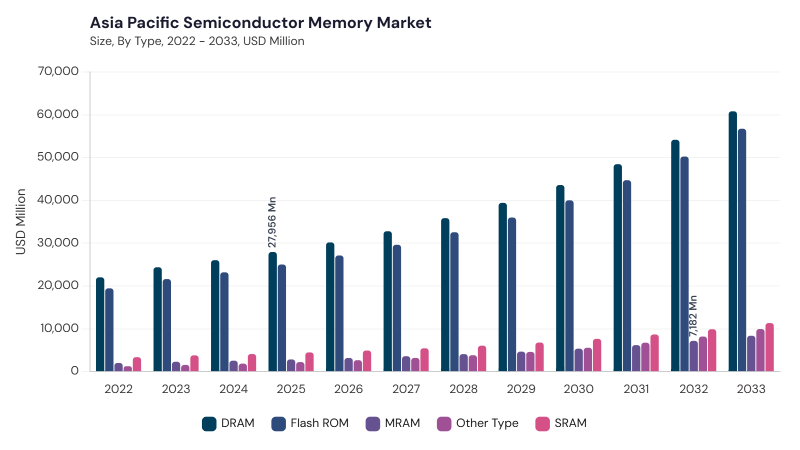
DRAM remains essential for servers, PCs, mobile devices, AI systems, and data centers requiring fast and scalable volatile memory. Flash ROM supports smartphones, SSDs, IoT devices, embedded electronics, automotive systems, and other non-volatile storage applications. SRAM is used extensively in processor caches, networking equipment, telecommunications, and latency-sensitive computing. MRAM is gaining adoption across automotive, industrial, aerospace, and embedded systems due to its endurance, speed, and low-power characteristics, while Other Type includes FRAM, EEPROM, PCM, ReRAM, and other emerging memory technologies.
Based on Application, the market is segmented into Consumer Electronics, IT & Telecommunication, Automotive, Industrial, Aerospace & Defense, Medical, and Other Application. Consumer Electronics relies on DRAM and flash memory for storage, multimedia processing, AI functionality, and connectivity. IT & Telecommunication requires high-capacity and high-speed memory for cloud data centers, AI infrastructure, enterprise networks, 5G, and edge computing.
Automotive demand is expanding through EVs, ADAS, connected cars, and infotainment, while Industrial applications include robotics, factory automation, IoT, and smart manufacturing. Aerospace & Defense requires secure and reliable memory, Medical uses memory in diagnostic and monitoring equipment, and Other Application includes energy, education, banking, smart agriculture, and smart city systems.
Free Valuable Insights: Semiconductor Memory Market is Predicted to reach USD 296.3 Billion billion by 2033, at a CAGR of 11.3%
Based on Country, the market is segmented into China, Japan, India, South Korea, Singapore, Taiwan, and Rest of Asia Pacific. The China market dominated the Asia Pacific Semiconductor Memory Market by Country in 2025, and would continue to be a dominant market till 2033; thereby, achieving a market value of USD 27.0 billion by 2030, growing at a CAGR of 9.6 % during the forecast period. The Japan market is expected to witness a CAGR of 10.7% during (2026 - 2033). Additionally, The India market is expected to witness a CAGR of 13.3% during (2026 - 2033).
Across Asia Pacific, semiconductor memory development is being shaped by AI demand, advanced manufacturing, localization, and supply-chain resilience. China is strengthening domestic DRAM, NAND, storage-class memory, fabrication equipment, and semiconductor self-sufficiency, while Japan is advancing EUV-based production, specialized memory, government-supported manufacturing, and high-performance architectures. India is expanding local fabrication, packaging, advanced memory development, and semiconductor supply chains, whereas South Korea remains focused on HBM, AI-optimized memory, advanced packaging, and large-scale manufacturing investment. Singapore is strengthening design, testing, MRAM, 3D NAND, and resilient supply chains, while Taiwan is progressing through DDR5, LPDDR5, specialty Flash, customized AI memory, advanced DRAM, and flexible foundry capabilities. Rest of Asia Pacific continues to expand HBM, ferroelectric memory, localized fabrication, EUV adoption, and advanced stacking technologies.

By Type
By Application
By Country
Set to reach $102.1 Billion by 2030, growing at 11.6% CAGR during 2026-2033.
China leads with $27.0 billion by 2030, growing at a CAGR of 9.6% during the forecast period.
Rising enterprise cloud adoption and AI-driven workloads are the main catalysts.
DRAM segment will reach $43.5 billion by 2030, growing at a CAGR of 10.5% during the forecast period.
India is expected to witness a CAGR of 13.3% during 2026-2033.
The SRAM segment is expected to witness the highest CAGR of 12.7% during 2026-2033.
Our team of dedicated experts can provide you with attractive expansion opportunities for your business.




 Unique Offerings