The sample copy of this report is available for access.
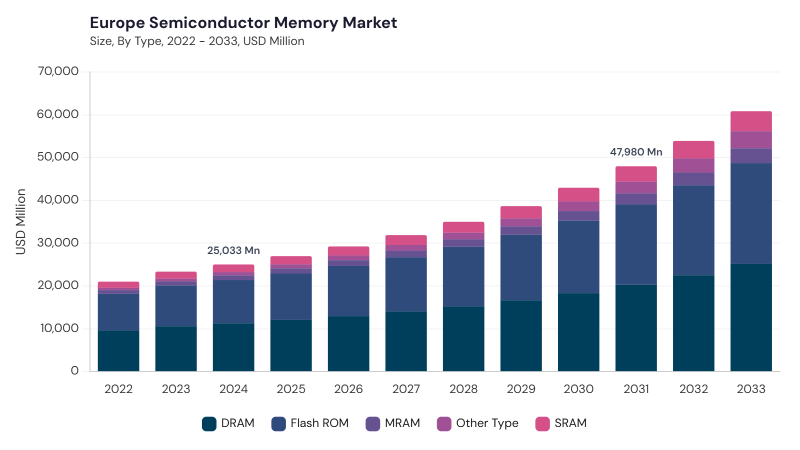
The Europe Semiconductor Memory Market is expected to reach USD 47.9 billion by 2031, growing at a CAGR of 11% during (2026 – 2033).
Semiconductor memory in Europe evolved from foundational DRAM and SRAM technologies toward specialized volatile and non-volatile architectures supporting AI, edge computing, automotive, and industrial systems. Improvements in microelectronics, packaging, materials, and heterogeneous integration expanded performance, density, and energy efficiency. The market gradually moved beyond commodity memory toward chiplet-based, integrated, and application-specific solutions. Regional policies supporting technological sovereignty, reshoring, advanced packaging, and sustainable manufacturing are now strengthening Europe’s role across research, design, fabrication, and post-fab innovation.
Chiplet integration, sustainable manufacturing, supply-chain localization, and next-generation memory technologies are shaping current market development. Heterogeneous architectures are enabling memory components to work more efficiently with logic devices for AI and data-intensive workloads. Sustainability requirements are encouraging low-power memory designs and resource-efficient manufacturing, while geopolitical pressures are strengthening domestic fabrication and packaging initiatives. At the same time, MRAM, ReRAM, high-bandwidth memory, advanced DRAM, and 3D integration are expanding technology options across Europe’s semiconductor ecosystem.
Based on Type, the market is segmented into DRAM, Flash ROM, SRAM, MRAM, and Other Type. The DRAM market dominated the Europe Semiconductor Memory Market by Type in 2025, and would continue to be a dominant market till 2033; thereby, achieving a market value of USD 20.2 billion by 2031, growing at a CAGR of 9.9 % during the forecast period. The Flash ROM market is expected to witness a CAGR of 10.5% during (2026 - 2033). Additionally, The SRAM market is expected to witness highest CAGR of 12% during (2026 - 2033).
DRAM remains central to servers, computing systems, AI platforms, and automotive electronics requiring high-speed volatile memory. Flash ROM supports SSDs, embedded electronics, smartphones, industrial systems, and persistent data storage applications. SRAM is widely used in processor caches, telecommunications, networking, and latency-sensitive systems, while MRAM is expanding across automotive, industrial IoT, aerospace, and embedded applications due to its durability and low-power characteristics. Other Type includes FRAM, EEPROM, PCM, ReRAM, and other specialized memory technologies serving medical, industrial, research, and emerging computing applications.
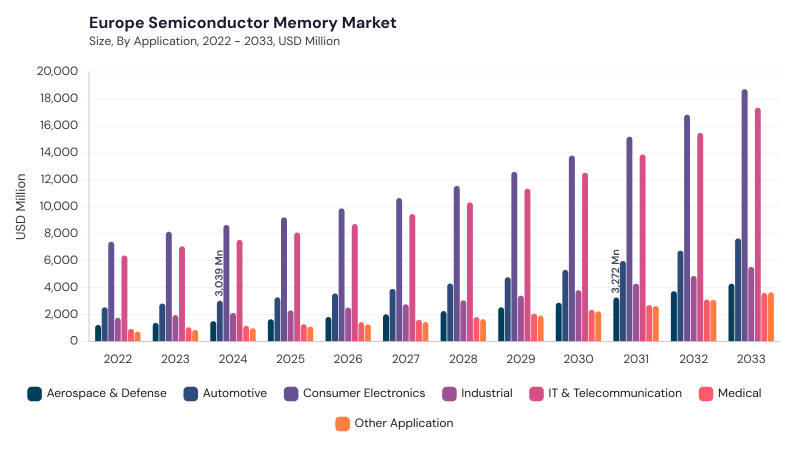
Based on Application, the market is segmented into Consumer Electronics, IT & Telecommunication, Automotive, Industrial, Aerospace & Defense, Medical, and Other Application. Consumer Electronics relies heavily on DRAM and flash memory for high-speed processing, multimedia, storage, and connected-device functionality. IT & Telecommunication requires scalable memory for cloud computing, data centers, 5G infrastructure, servers, and edge systems.
Automotive demand is strengthening through EVs, ADAS, connected vehicles, and infotainment, while Industrial uses memory in robotics, automation, IoT, and smart manufacturing. Aerospace & Defense requires secure and reliable memory for avionics and mission systems, Medical uses memory across diagnostics and monitoring devices, and Other Application includes energy, finance, education, smart grids, and infrastructure.
Free Valuable Insights: The Worldwide Semiconductor Memory Market is projected to reach USD 296.3 Billion billion by 2033, at a CAGR of 11.3%
Based on Country, the market is segmented into Germany, UK, France, Russia, Spain, Italy, and Rest of Europe. The Germany market dominated the Europe Semiconductor Memory Market by Country in 2025, and would continue to be a dominant market till 2033; thereby, achieving a market value of USD 10.2 billion by 2031, growing at a CAGR of 9.6 % during the forecast period. The UK market is expected to witness a CAGR of 9.8% during (2026 - 2033). Additionally, The France market is expected to witness a CAGR of 11.9% during (2026 - 2033).
Across Europe, semiconductor memory development is increasingly shaped by AI, localization, sustainability, advanced packaging, and supply-chain resilience. Germany is advancing HBM, AI-oriented memory, advanced testing, local fabrication, and next-generation architectures, while the UK emphasizes 3D-stacked memory, emerging non-volatile technologies, research collaboration, and localized production. France is strengthening AI-focused memory, advanced packaging, domestic manufacturing, and European ecosystem partnerships, whereas Russia is focusing on semiconductor sovereignty, localized lithography, chiplet designs, and domestic memory production. Spain is developing embedded memory, AI-enabled design, sustainable manufacturing, and regional innovation clusters, while Italy emphasizes automotive-grade memory, AI-assisted development, localization, and process automation. Rest of Europe continues to progress through 3D NAND, HBM, specialized memory, regional fabrication, low-power technologies, and collaborative semiconductor initiatives.

By Type
By Application
By Country
Set to reach $47.9 Billion by 2031, growing at 11% CAGR during 2026-2033.
Germany leads with $10.2 billion by 2031, growing at a CAGR of 9.6% during the forecast period.
Rising demand for DRAM, projected to reach $20.2 billion by 2031, drives growth.
DRAM segment reaches $20.2 billion by 2031, with a CAGR of 9.9% during the forecast period.
The UK market is expected to witness a CAGR of 9.8% during 2026-2033.
The SRAM market is expected to witness the highest CAGR of 12% during 2026-2033.
Our team of dedicated experts can provide you with attractive expansion opportunities for your business.




 Unique Offerings