“Global Seatbelt Material Market to reach a market value of 1.98 Billion by 2032 growing at a CAGR of 4.7%”
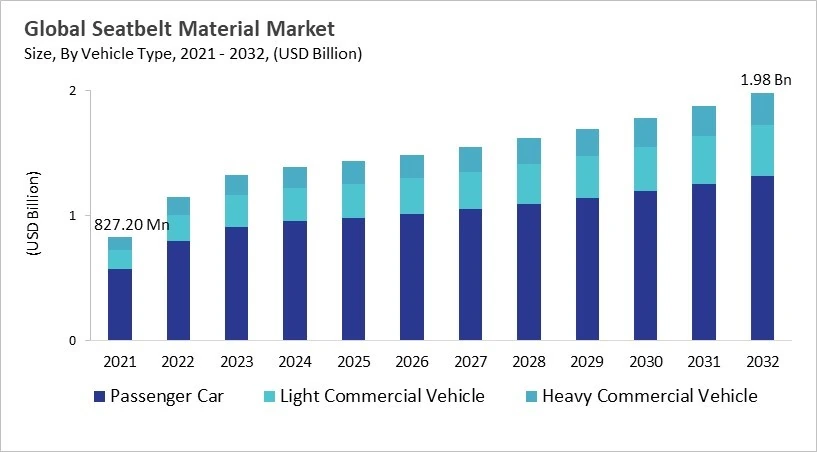
The Global Seatbelt Material Market size is estimated at $1.43 billion in 2025 and is expected to reach $1.98 billion by 2032, rising at a market growth of 4.7% CAGR during the forecast period (2025-2032). The growth of the Global Seatbelt Material Market is driven by increasing vehicle production, stricter automotive safety regulations, and rising consumer awareness regarding passenger safety. Additionally, advancements in high-strength polyester fibers and lightweight materials are improving seatbelt durability and performance, supporting steady demand from automotive manufacturers during the forecast period.
The seatbelt material market evolved with the development of automotive safety systems, when rising awareness of occupant protection led to the adoption of seatbelts. Early materials majorly consisted of strong textile fibers like polyester and nylon, valued for their ability and durability to withstand collision forces. With safety regulations becoming more stringent, manufacturers have advanced material technologies to enhance strength, fire resistance, and flexibility. Innovations in coatings, weaving techniques, and polymer processing improved both comfort and safety performance, while advancements in metal components further strengthened overall system reliability. The market has developed into a highly regulated and technologically advanced industry focused on compliance, manufacturability, and performance.
The seatbelt material market is shaped by elements including geographic diversification, sustainability, and geographic diversification. Manufacturers are largely developing recyclable and eco-friendly materials to meet consumer demand and environmental regulations. The integration of sensors and conductive elements into seatbelts is raising the requirement for multifunctional materials that maintain safety while allowing advanced features. Moreover, the expansion of automotive production in developing nations is creating demand for materials tailored to varied regulatory and climatic conditions. Key market players are investing in forming strategic partnerships, innovations, and expanding regional production capabilities, with the aim of leading the market.

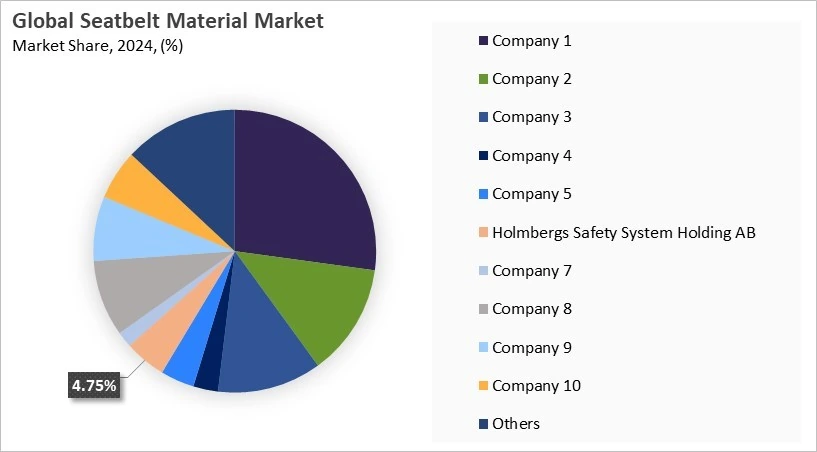
The leading players in the market are competing with diverse innovative offerings to remain competitive in the market. The above illustration shows the percentage of revenue shared by some of the leading companies in the market. The leading players of the market are adopting various strategies in order to cater demand coming from the different industries. The key developmental strategies in the market are Acquisitions, and Partnerships & Collaborations.
Before COVID-19, the seatbelt material market operated steadily, supported by automotive production and strict safety regulations. The pandemic disrupted supply chains due to lockdowns, labor shortages, and reduced production of fibers and fabrics used in seatbelts. Automotive plant shutdowns also reduced vehicle sales, temporarily lowering demand. However, companies increasingly adopted digital tools for supply chain management and remote collaboration. Growing consumer preference for personal vehicles later supported demand for automotive safety features. Manufacturers also explored innovative materials, including antimicrobial fabrics. As restrictions eased, the market gradually recovered with renewed automotive production, stronger supply chain strategies, and increased focus on sustainable and high-performance seatbelt materials. Thus, the COVID-19 pandemic had a negative impact on the Seatbelt Material Market, accelerating innovation while disrupting traditional operations.
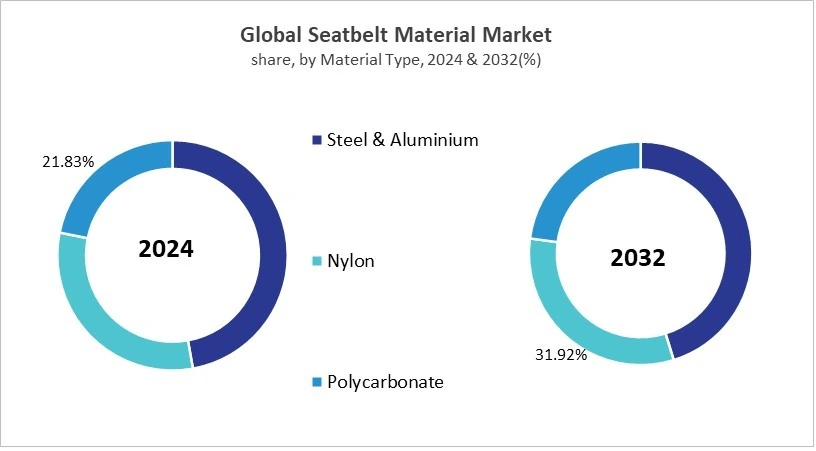
By Material Type, the Seatbelt Material Market is analyzed across Steel & Aluminium, Nylon, and Polycarbonate. The Nylon segment witnessed 31.01% revenue share in the Seatbelt Material Market. Nylon is widely used in seatbelt webbing due to its excellent tensile strength, flexibility, and resistance to wear and tear. Its ability to absorb impact energy and provide comfort to passengers makes it a preferred material for seatbelt straps. Increasing demand for high-performance synthetic fibers, along with advancements in material engineering to improve durability and safety standards, continues to drive the adoption of nylon in modern seatbelt systems.
Based on Vehicle Type, the Seatbelt Material Market is analyzed across Passenger Car, Light Commercial Vehicle, and Heavy Commercial Vehicle. The Light Commercial Vehicle segment witnessed 18.90% revenue share in the Seatbelt Material Market. The growth of this segment is supported by the expanding logistics and e-commerce sectors, which are driving the demand for light commercial vehicles globally. These vehicles are increasingly being equipped with improved safety systems to comply with regulatory standards and ensure driver protection.
Free Valuable Insights: Seatbelt Material Market Size to reach $1.98 by 2032
Region-wise, the Seatbelt Material Market is analyzed across North America, Europe, Asia Pacific, and LAMEA. The North America segment recorded 26.22% revenue share in the Seatbelt Material Market. The seatbelt material market is expected to expand at a steady rate in the North America and Europe regions. The market is supported by high technological advancement and strong regulatory oversight. The regional market is supported by strict safety standards like FMVSS regulations and a well-established automotive manufacturing base in Canada and the US. The region prioritizes innovation in high-performance materials, including aramid fibers, advanced polyester blends, especially for electric vehicles. Furthermore, Europe seatbelt material market is anticipated to grow with a noticeable market share. The market is driven by environmental frameworks, like Euro NCAP standards, and the EU General Safety Regulation, which encourage manufacturers toward lightweight, sustainable, and recyclable materials. Both North America and Europe region are widely adopting eco-friendly innovations and smart seatbelt technologies, with a strong focus on sustainability, compliance, and high-value vehicle segments.
In the Asia Pacific and LAMEA regions, the seatbelt material market is projected to capture a prominent share during the forecast period. This is owing to massive automotive production in nations like Japan, China, India, and South Korea, alongside increasing vehicle ownership and supportive government policies for electric vehicles. The region further benefits from expanding EV adoption and cost-efficient manufacturing. Additionally, LAMEA’s seatbelt material market is estimated to experience substantial growth. The market is driven by rising vehicle production, enhanced safety regulations, and urbanization. Developing nations in this region are proactively integrating advanced seatbelt technologies and materials, thereby offering lucrative opportunities for market expansion as automotive industries continue to grow.
| Report Attribute | Details |
|---|---|
| Market size value in 2025 | USD 1.43 Billion |
| Market size forecast in 2032 | USD 1.98 Billion |
| Base Year | 2024 |
| Historical period | 2021 to 2023 |
| Forecast Period | 2025 to 2032 |
| Revenue Growth Rate | CAGR of 4.7% from 2025 to 2032 |
| Number of Pages | 483 |
| Tables | 365 |
| Report Coverage | Market Trends, Revenue Estimation and Forecast, Segmentation Analysis, Regional and Country Breakdown, Market Share Analysis, Porter’s 5 Forces Analysis, Company Profiling, Companies Strategic Developments, SWOT Analysis, Winning Imperatives |
| Segments Covered | Material Type, Vehicle Type, Component, Region |
| Country Scope |
|
| Companies Included | Autoliv, Inc., Joyson Safety Systems Aschaffenburg GmbH, ZF Friedrichshafen AG, Yanfeng International Automotive Technology Co. Ltd., GWR Safety Systems, Holmbergs Safety System Holding AB, Robert Bosch GmbH, Tokai Rika Co., Ltd., Ashimori Industry Co., Ltd. and Continental AG |
By Material Type
By Vehicle Type
By Component
By Geography
Valued at USD 1.43 billion in 2025, growing at 4.7% CAGR during 2025-2032 to reach USD 1.98 billion by 2032.
Steel & Aluminium leads the market, achieving a market value of $896 million by 2032.
Autoliv Inc., Joyson Safety Systems Aschaffenburg GmbH, ZF Friedrichshafen AG, and Yanfeng International Automotive Technology Co. Ltd. dominate the space.
Asia Pacific dominates with $762.2 million by 2032. Europe grows at 4% CAGR during 2025-2032.
Enhanced regulatory frameworks, growing automotive production, and increasing focus on passenger safety innovation push market expansion.
Retractor segment leads, growing at 4.2% CAGR during the forecast period due to its critical safety role.
Our team of dedicated experts can provide you with attractive expansion opportunities for your business.






 Unique Offerings