The Asia Pacific Seatbelt Material Market is expected to reach $644.70 million by 2031 and would witness market growth of 5.1% CAGR during the forecast period (2025-2032).
The China market dominated the Asia Pacific Seatbelt Material Market by Country in 2024, and would continue to be a dominant market till 2032; thereby, achieving a market value of $286.6 million by 2032. The Japan market is showcasing a CAGR of 4.1% during (2025 - 2032). Additionally, The India market would register a CAGR of 6.1% during (2025 - 2032). The China and India led the Asia Pacific Seatbelt Material Market by Country with a market share of 41.5% and 13.7% in 2024. The Malaysia market is expected to witness a CAGR of 8.5% during throughout the forecast period.
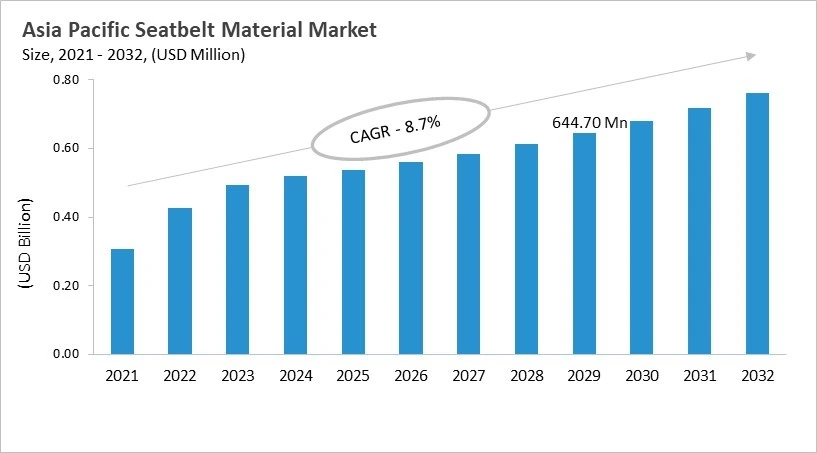
The Asia Pacific Seatbelt Material Market emerged during the late 20th century with the introduction of mandatory seatbelt regulations across major automotive-producing countries. Early seatbelt materials mainly consisted of basic woven nylon fabrics designed to meet minimum safety standards. Over time, advancements in polymer science and weaving technologies led to the development of stronger, lighter, and more durable synthetic fibers with improved abrasion resistance and elasticity. Increasing automotive production, stricter safety regulations, and the rising adoption of premium and smart seatbelt systems have further driven the demand for advanced seatbelt materials. Additionally, the growth of electric and autonomous vehicles is encouraging innovations in materials that meet evolving safety requirements and enhance passenger comfort.
Currently, the market is shaped by trends such as the adoption of sustainable and recyclable materials, the development of high-performance functional fibers, and the strengthening of regional manufacturing supply chains across Asia Pacific. Leading companies emphasize research and development, strategic partnerships with automotive manufacturers, and expansion into emerging automotive hubs like China, India, and Southeast Asia. Competition remains strong between global suppliers and regional manufacturers, where innovation, product quality, and cost efficiency play crucial roles. While global players leverage strong R&D capabilities and advanced technologies, regional firms benefit from localized production and cost advantages, creating a dynamic and competitive market environment.
Based on Material Type, the market is segmented into Steel & Aluminium, Nylon, and Polycarbonate. With a compound annual growth rate (CAGR) of 3.2% over the projection period, the Steel & Aluminium Market, dominate the China Seatbelt Material Market by Material Type in 2024 and would be a prominent market until 2032. The Polycarbonate market is expected to witness a CAGR of 4.4% during (2025 - 2032).
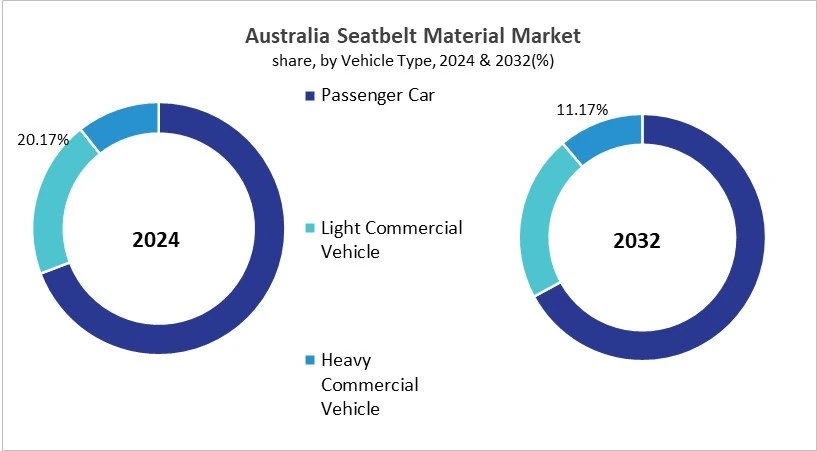
Based on Vehicle Type, the market is segmented into Passenger Car, Light Commercial Vehicle, and Heavy Commercial Vehicle. The Passenger Car market segment dominated the Australia Seatbelt Material Market by Vehicle Type is expected to grow at a CAGR of 7.3 % during the forecast period thereby continuing its dominance until 2032. Also, The Heavy Commercial Vehicle market is anticipated to grow as a CAGR of 8.4 % during the forecast period during (2025 - 2032).
Free Valuable Insights: Seatbelt Material Market is Predicted to reach USD 1.98 billion by 2032, at a CAGR of 4.7%
The China seatbelt material market developed alongside the rapid growth of the country’s automotive industry in the late 20th century, initially relying on traditional polyester webbing produced through imports or technology transfer from Western manufacturers. Over time, improvements in polymer chemistry and textile engineering enabled local producers to enhance durability, strength, and comfort of seatbelt materials. The integration of advanced safety technologies such as motorized pretensioning seatbelts further drove the need for materials with precise elasticity and high durability. Currently, the market is influenced by stricter safety regulations, the growth of electric and autonomous vehicles, and increasing adoption of smart textiles integrated with sensors. Sustainability initiatives are also encouraging the use of bio-based and recycled fibers in manufacturing. Leading companies focus on R&D investments, strategic collaborations with automotive OEMs, and localized production to strengthen supply chains. Competition remains intense, balancing technological innovation with cost efficiency as regional manufacturers leverage pricing advantages while global firms rely on advanced material technologies and large-scale R&D capabilities.

By Material Type
By Vehicle Type
By Component
By Country
Market will reach $644.70 million by 2031, growing at 5.1% CAGR during 2025-2032.
China dominates with 41.5% market share in 2024 and will reach $286.6 million by 2032.
Increasing vehicle production and stricter automotive safety regulations across the region fuel demand.
Steel & aluminium dominates China's market and will grow at 3.2% CAGR during 2025-2032.
India holds 13.7% market share in 2024 and will grow at 6.1% CAGR during 2025-2032.
Japan's market grows at 4.1% CAGR during 2025-2032, slower than India but steady.
Our team of dedicated experts can provide you with attractive expansion opportunities for your business.




 Unique Offerings