The Latin America, Middle East and Africa Seatbelt Material Market is expected to reach $126.10 million by 2028 and would witness market growth of 5.9% CAGR during the forecast period (2025-2032).
The Brazil market dominated the LAMEA Seatbelt Material Market by Country in 2024, and would continue to be a dominant market till 2032; thereby, achieving a market value of $37.9 million by 2032. The Argentina market is registering a CAGR of 6.5% during (2025 - 2032). Additionally, The UAE market would showcase a CAGR of 3.6% during (2025 - 2032). The Brazil and Saudi Arabia led the LAMEA Seatbelt Material Market by Country with a market share of 25.8% and 9.4% in 2024. The Nigeria market is expected to witness a CAGR of 7.6% during throughout the forecast period.
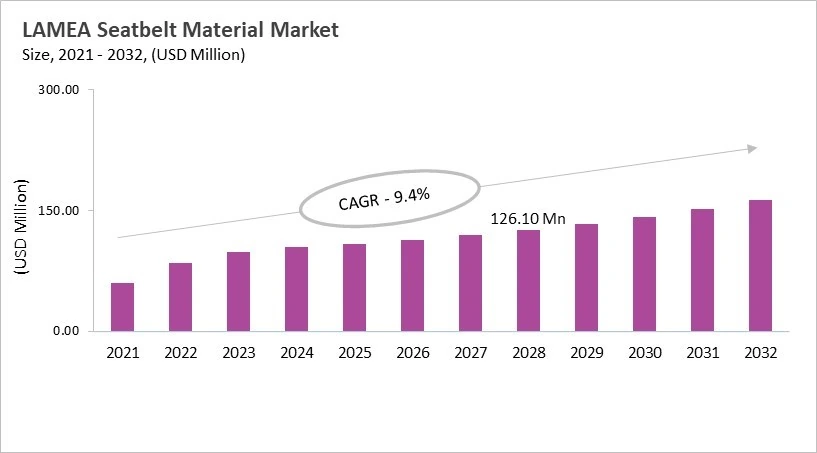
The LAMEA seatbelt material market developed alongside the expansion of the automotive industry across Latin America, the Middle East, and Africa, where increasing vehicle production and safety regulations created demand for reliable seatbelt components. Initially, the market relied on conventional woven polyester materials adapted from global technologies to meet basic safety standards. Over time, advancements in polymers and high-tensile threads enabled manufacturers to produce materials capable of withstanding harsh regional conditions such as heat, humidity, and sand exposure. Stricter regulatory standards further accelerated the shift toward advanced composites with features like fire retardants, UV stabilizers, and abrasion-resistant coatings. Today, the market reflects a more advanced stage where high-performance and regulation-compliant materials dominate production.
Currently, the market is shaped by trends such as the adoption of sustainable and eco-friendly materials, the integration of smart textiles with sensors for enhanced safety monitoring, and the increasing localization of production to reduce import dependency. Leading companies focus on innovation, R&D investments, strategic partnerships with automotive OEMs, and regional manufacturing expansion to address diverse market needs. The competitive landscape includes both global suppliers and regional manufacturers, where differentiation is based on material performance, technological innovation, and cost efficiency. While global players leverage advanced technology and large-scale capabilities, regional firms benefit from local market knowledge and customization advantages, creating a dynamic and evolving market environment.
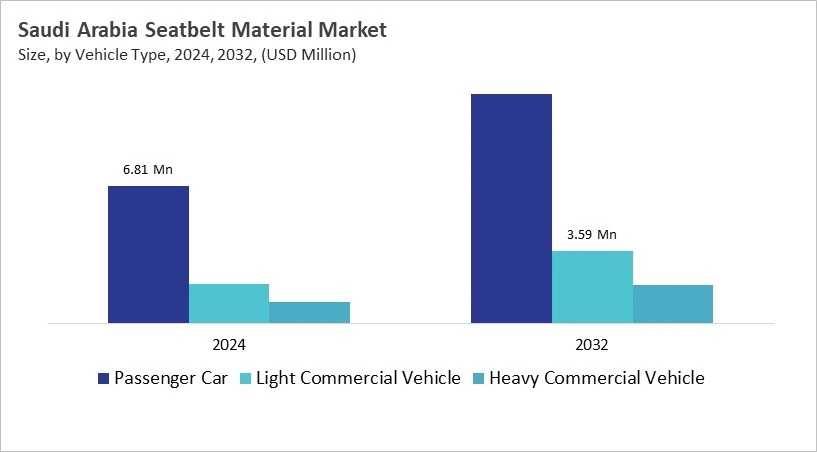
Based on Vehicle Type, the market is segmented into Passenger Car, Light Commercial Vehicle, and Heavy Commercial Vehicle. With a compound annual growth rate (CAGR) of 6.8% over the projection period, the Passenger Car Market, dominate the Saudi Arabia Seatbelt Material Market by Vehicle Type in 2024 and would be a prominent market until 2032. The Light Commercial Vehicle market is expected to witness a CAGR of 8.3% during (2025 - 2032).
Based on Material Type, the market is segmented into Steel & Aluminium, Nylon, and Polycarbonate. The Steel & Aluminium market segment dominated the South Africa Seatbelt Material Market by Material Type is expected to grow at a CAGR of 6.6 % during the forecast period thereby continuing its dominance until 2032. Also, The Polycarbonate market is anticipated to grow as a CAGR of 7.9 % during the forecast period during (2025 - 2032).
Free Valuable Insights: Seatbelt Material Market Size Worth USD 1.98 billion by 2032
The Brazil Seatbelt Material Market developed alongside global automotive safety initiatives, initially focusing on durable textile materials that met basic Brazilian safety standards. Over time, advancements in material science and stricter regulations led to the adoption of high-tensile synthetic fibers such as polyester and nylon, improving strength and durability. The integration of technologies like pre-tensioners and force limiters further increased the demand for materials capable of performing under dynamic stress conditions. Currently, the market is influenced by trends including sustainability initiatives, integration of seatbelt systems with electronic safety networks, and increasing customization to suit regional climate and vehicle requirements. Leading companies emphasize innovation in lightweight, high-strength textile composites and collaborate with automotive OEMs to integrate advanced safety features. Expansion through localized manufacturing and investment in automated production technologies also strengthens supply chains. Competition remains dynamic between global technology-driven suppliers and regional cost-focused manufacturers, balancing innovation, regulatory compliance, and cost efficiency.

By Material Type
By Vehicle Type
By Component
By Country
Market will reach $126.10 million by 2028, growing at 5.9% CAGR during 2025-2032.
Brazil dominates with $37.9 million expected by 2032. Saudi Arabia follows with 9.4% market share in 2024.
Expanding automotive manufacturing and stricter vehicle safety regulations across Latin America and Middle East regions fuel demand.
Steel & Aluminium segment dominated the market in 2024 due to durability requirements.
UAE market grows at 3.6% CAGR during 2025-2032, reflecting steady automotive sector expansion.
Our team of dedicated experts can provide you with attractive expansion opportunities for your business.




 Unique Offerings