“Global Satellite Transponder Market to reach a market value of 19.79 Billion by 2032 growing at a CAGR of 4.4%”
The Global Satellite Transponder Market size is estimated at $14.66 billion in 2025 and is expected to reach $19.79 billion by 2032, rising at a market growth of 4.4% CAGR during the forecast period (2025-2032). Growth is supported by rising demand for satellite-based broadcasting, expanding broadband connectivity in remote regions, increasing deployment of high-throughput satellites, and growing government and defense communication needs. Additionally, expanding direct-to-home services, mobility connectivity for aviation and maritime sectors, and technological upgrades in satellite capacity contribute to market expansion through 2032.
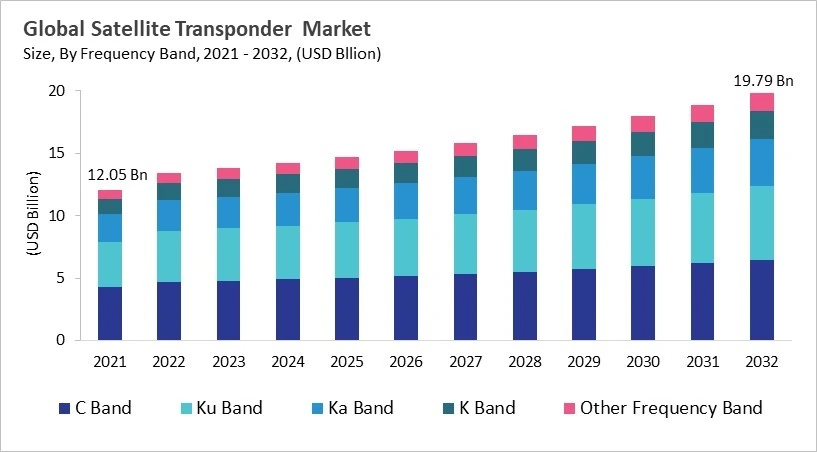
Satellite transponders are crucial components of communication satellites that receive signals from Earth, amplify them and shift their frequency, and retransmit them back to ground receivers. This process allows long-distance transmission of broadband data, television broadcasts, and voice communications through space-based infrastructure, especially in regions where terrestrial networks are not available. The evolution of satellite transponders began with early satellite communication milestones like the launch of Telstar-1, which supported the feasibility of transatlantic television transmission. Satellites in geostationary orbit expanded global communication capabilities, driven by regulatory coordination from enterprises like the International Telecommunication Union.
The satellite transponders market has developed significantly because of the increasing demand for broadband connectivity and advancements in satellite technology. Advanced frequency bands and high throughput satellites have largely surged data capacity, allowing high-speed connectivity for maritime operations, aviation, data-intensive digital services, and maritime operations. The deployment of medium Earth orbit and low Earth orbit satellite constellations has further reduced signal latency and enhanced coverage, accelerating the role of satellite networks in global digital infrastructure. Satellite transponders are largely integrated with terrestrial communication systems to support applications like Internet of Things (IoT) connectivity, 5G backhaul, and emergency communication.

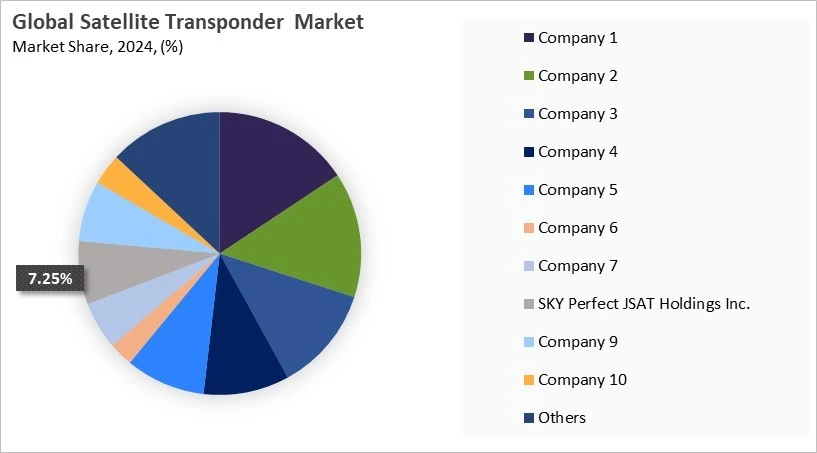
The leading players in the market are competing with diverse innovative offerings to remain competitive in the market. The above illustration shows the percentage of revenue shared by some of the leading companies in the market. The leading players of the market are adopting various strategies in order to cater demand coming from the different industries. The key developmental strategies in the market are Acquisitions, and Partnerships & Collaborations.
During the first phase of the COVID-19 pandemic, the Satellite Transponder Market was only slightly affected because global supply chains were disrupted and satellite manufacturing and launch schedules were pushed back. Lockdowns and travel bans made it harder to get the parts needed to build satellites and slowed down production. Several planned satellite launches were put off because launch facilities and logistics operations were having trouble working. The pandemic also had an effect on investment decisions in fields like telecommunications and broadcasting, which slowed the demand for new satellite capacity by a small amount. Some satellite operators put off plans to grow because of uncertainty in the economy and lower advertising revenues in the broadcasting industry. But as the pandemic went on, the market slowly got back to normal. The continued use of satellite services was supported by the growing need for reliable communication, remote access, and digital broadcasting during lockdowns. Because of this, supply chains got back on track and satellite launches started up again, which helped the market get back to normal. Thus, the COVID-19 pandemic had a mild negative impact on the market.
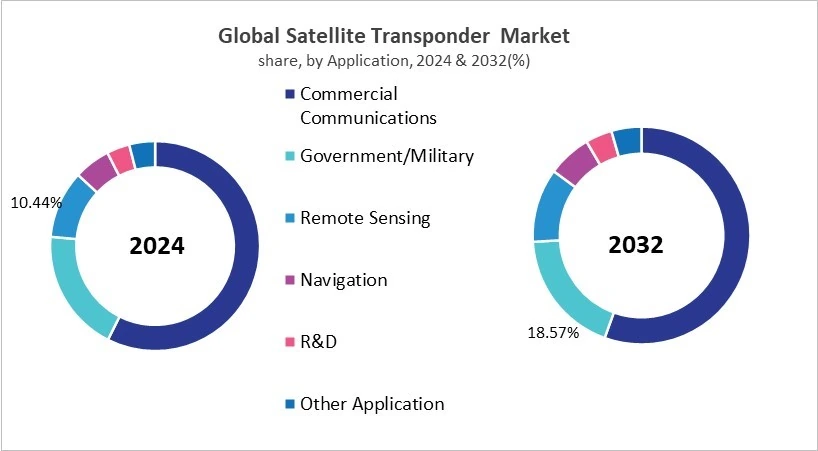
On the basis of application, the satellite transponder market is classified into commercial communications, government/military, remote sensing, navigation, R&D, and other application. The government/military segment recorded 19% revenue share in the satellite transponder market in 2024. This is reflecting the strategic importance of secure and resilient satellite communication systems. Governments worldwide depend on satellite transponders for defense communications, border security coordination, disaster response, and secure data transmission. Satellite infrastructure ensures operational continuity during emergencies or terrestrial network disruptions.
By service, the satellite transponder market is divided into leasing, maintenance & support, and other service. The maintenance & support segment recorded 17% revenue share in the satellite transponder market in 2024. Satellite operators require continuous monitoring, technical diagnostics, software updates, and ground station management to maintain optimal transponder performance. As satellite fleets incorporate advanced technologies and high-throughput capabilities, professional maintenance services become critical to minimizing downtime and preserving signal quality.
Free Valuable Insights: Satellite Transponder Market Size to reach $19.79 by 2032
Region-wise, the satellite transponder market is analyzed across North America, Europe, Asia Pacific, and LAMEA. The North America segment recorded 40% revenue share in the satellite transponder market in 2024. In the North America and Europe regions, the satellite transponders market is projected to capture prominent growth. This is because of significant investments in space technology, strong satellited communication infrastructure, and the presence of major satellite operators like Telesat, SES, and Intelsat. Further, the region is experiencing growth because of high demand for satellite-based broadcasting, activation communication, broadband connectivity, and defense applications. Expansion of satellite broadband services in rural regions, rising deployment of high-throughput satellites, and increasing adoption of satellite-based IoT and government communication networks are some of the elements accelerating market expansion. Moreover, the European satellite transponders market is predicted to capture significant growth. The market is driven by well-established regulatory frameworks, strong aerospace capabilities, and investments in satellite communication infrastructure. Nations including Germany, France, and UK are largely contributing substantially to government communication programs, media broadcasting services, and advanced space initiatives led by enterprises like the European Space Agency.
The satellite transponders market is estimated to experience substantial growth in the Asia Pacific and LAMEA. The market is growing because of rising satellite launches, expanding telecommunications infrastructure, and increasing demand for broadband connectivity in remote areas. Regional nations like Japan, South Korea, China, and India are largely investing in space exploration programs, satellite communication systems, and low-Earth-orbit satellite constellations to support data intensive applications and enhance digital connectivity. The expansion of enterprise communication networks, direct-to-home television services, and aviation connectivity is leading to market expansion. Furthermore, the LAMEA satellite transponders market is expected to expand at a steady pace. This is due to the need for a reliable communication infrastructure across underserved areas. Also, in Latin America, the demand is supported by rural broadcasting and broadband services. The Middle East and Africa widely rely on satellite communication for disaster management, telecom backhaul, and defense communication.
| Report Attribute | Details |
|---|---|
| Market size value in 2025 | USD 14.66 Billion |
| Market size forecast in 2032 | USD 19.79 Billion |
| Base Year | 2024 |
| Historical period | 2021 to 2023 |
| Forecast Period | 2025 to 2032 |
| Revenue Growth Rate | CAGR of 4.4% from 2025 to 2032 |
| Number of Pages | 625 |
| Tables | 505 |
| Report Coverage | Market Trends, Revenue Estimation and Forecast, Segmentation Analysis, Regional and Country Breakdown, Competitive Landscape, Market Share Analysis, Porter’s 5 Forces Analysis, Company Profiling, Companies Strategic Developments, SWOT Analysis, Winning Imperatives |
| Segments Covered | Frequency Band, Application, Service, Satellite Platform, Region |
| Country Scope |
|
| Companies Included | Intelsat S.A., SES S.A., EUTELSAT COMMUNICATIONS SA, Telesat Corporation, EchoStar Corporation, Thaicom Public Company Limited, Singtel (Temasek Holdings (Private) Limited), SKY Perfect JSAT Holdings Inc., Viasat, Inc. and Asia Satellite Telecommunications Co. Ltd. |
By Frequency Band
By Application
By Service
By Satellite Platform
By Geography
Valued at USD 14.66 billion in 2025, reaching USD 19.79 billion by 2032 at 4.4% CAGR during 2025-2032.
C Band dominates, projected to achieve a market value of $6.44 billion by 2032.
Intelsat S.A., SES S.A., EUTELSAT COMMUNICATIONS SA, Telesat Corporation, and EchoStar Corporation hold dominant positions.
North America leads at $7,612.5 million by 2032; Asia Pacific grows at 5% CAGR during 2025-2032.
Rising demand for satellite broadband connectivity, DTH television expansion, and high-throughput satellite technologies fuel growth.
Leasing leads the service segment, achieving a market value of $14.72 billion by 2032.
Our team of dedicated experts can provide you with attractive expansion opportunities for your business.








 Unique Offerings