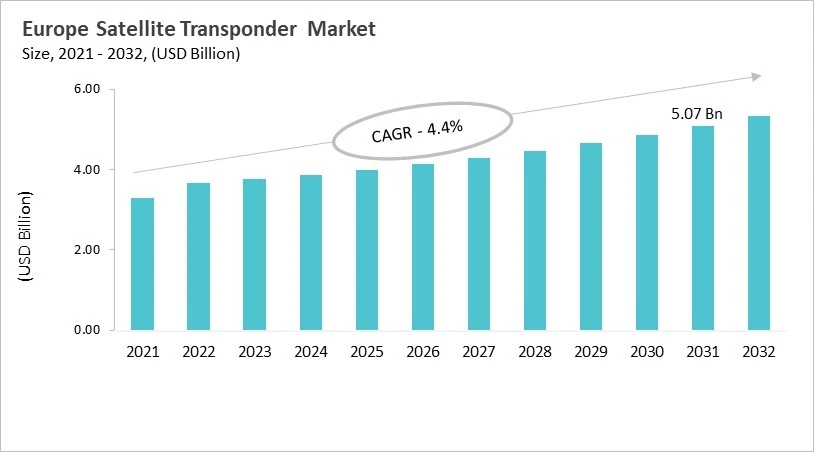
The Europe Satellite Transponder Market is expected to reach $5.07 billion by 2031 and would witness market growth of 4.2% CAGR during the forecast period (2025-2032).
The Germany market dominated the Europe Satellite Transponder Market by Country in 2024, and would continue to be a dominant market till 2032; thereby, achieving a market value of $1,004.1 million by 2032. The UK market is exhibiting a CAGR of 3.2% during (2025 - 2032). Additionally, The France market would experience a CAGR of 4.9% during (2025 - 2032). The Germany and UK led the Europe Satellite Transponder Market by Country with a market share of 21.1% and 18% in 2024.The Italy market is expected to witness a CAGR of 5.7% during throughout the forecast period.
Communication satellites need satellite transponders to work. These devices receive signals from Earth, make them stronger, and send them back to ground stations. They support important services in Europe, such as government networks, broadband internet, television broadcasting, and aviation communication. The satellite transponder ecosystem in Europe started to grow in the 1960s and 1970s when Europe first got involved in global satellite communication projects. Regional operators like Eutelsat helped build up satellite communication infrastructure across the continent over time. This made it possible for direct-to-home TV services and large-scale broadcasting to grow in the 1990s. High-throughput satellites (HTS) were developed in the 2000s and 2010s. They increased bandwidth capacity and made high-speed broadband services possible.
Today, the European satellite transponder ecosystem is still changing because there is more demand for broadband access in rural and underserved areas, and it is also being used more in aviation, maritime, and business communication. To support things like 5G backhaul and IoT connectivity, satellite networks are also being connected to land-based telecom networks. Top companies like Eutelsat, SES, Inmarsat, and Telesat are putting money into next-generation satellites, adding to their fleets, and teaming up with telecom companies and government agencies. Established satellite operators still have strong market positions even though competition is growing and technology is getting better. This is because they have a lot of infrastructure and knowledge, which means that satellite transponders are still very important to Europe's digital communication system.
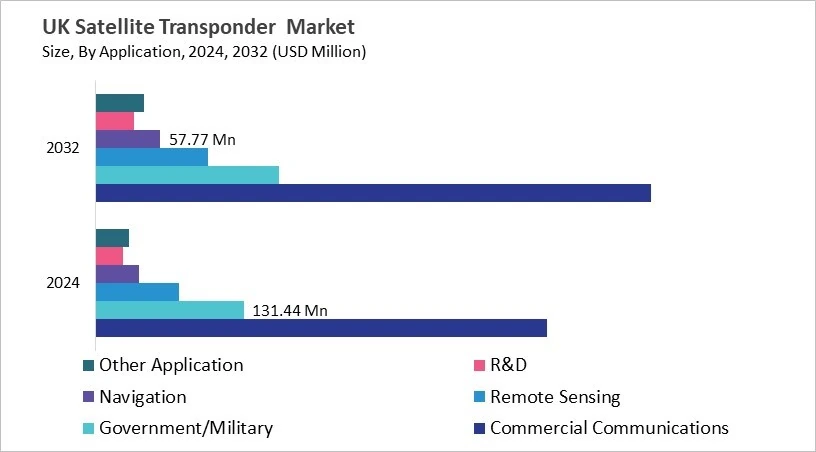
Based on Application, the market is segmented into Commercial Communications, Government/Military, Remote Sensing, Navigation, R&D, and Other Application. Among various UK Satellite Transponder Market by Application; The Commercial Communications market achieved a market size of USD $399.7 Million in 2024 and is expected to grow at a CAGR of 2.7 % during the forecast period. The Navigation market is predicted to experience a CAGR of 5.1% throughout the forecast period from (2025 - 2032).
Based on Service, the market is segmented into Leasing, Maintenance & Support, and Other Service. With a compound annual growth rate (CAGR) of 4.5% over the projection period, the Leasing Market, dominate the France Satellite Transponder Market by Service in 2024 and would be a prominent market until 2032. The Maintenance & Support market is expected to witness a CAGR of 5.2% during (2025 - 2032).
Free Valuable Insights: The Worldwide Satellite Transponder Market is projected to reach USD 19.79 billion by 2032, at a CAGR of 4.4%
Germany plays a big role in Europe's satellite communications ecosystem. This is because it has a strong telecommunications infrastructure, advanced aerospace capabilities, and is actively involved in European space programs. Satellite transponders are very important for making broadcasting, broadband internet, government communication networks, and defense operations possible. Germany's space industry works closely with the European Space Agency (ESA) to help make new satellite technologies. The Federal Network Agency (Bundesnetzagentur) oversees the regulatory framework. It is also in charge of spectrum allocation and satellite communication licensing. People want satellite transponders because they need strong communication networks, safe government communications, and connections for industries like aviation, maritime operations, and disaster response. Technological progress, such as multi-orbit satellite constellations and programs like the EU's IRIS² program, is likely to make high-capacity satellite systems more popular. SES and Eutelsat are two of the biggest players in the competitive landscape. They provide satellite capacity for broadcasting, telecom, and business connectivity across Europe.

By Frequency Band
By Application
By Service
By Satellite Platform
By Country
Market will reach $5.07 billion by 2031, growing at 4.2% CAGR during 2025-2032.
Germany leads the market and will reach $1,004.1 million by 2032. UK holds 18% market share in 2024.
France market grows at 4.9% CAGR during 2025-2032.
Italy market will witness 5.7% CAGR during the forecast period.
UK commercial communications reached $399.7 million in 2024, growing at 2.7% CAGR during 2025-2032.
Our team of dedicated experts can provide you with attractive expansion opportunities for your business.




 Unique Offerings