According to a new report, published by KBV research, The Global Satellite Transponder Market size is expected to reach $19.79 billion by 2032, rising at a market growth of 4.4% CAGR during the forecast period.
Satellite transponders are core components of communication satellites that receive signals transmitted from Earth, amplify them, change their frequency, and retransmit them back to ground receivers. This process allows information such as television broadcasts, broadband data, and voice communications to travel across long distances through space-based infrastructure.
The C Band segment is leading the Global Satellite Transponder Market by Frequency Band in 2024; thereby, achieving a market value of $6.44 billion by 2032. C band frequencies are widely used for television broadcasting, fixed satellite services, and telecommunications backhaul, particularly in regions with high rainfall where signal stability is critical. Their resistance to rain attenuation makes them suitable for ensuring consistent signal transmission in tropical and high-humidity environments.
The Commercial Communications segment is generating maximum revenue share in the Global Satellite Transponder Market by Application in 2024, growing at a CAGR of 3.9 % during the forecast period. Satellite transponders are extensively used for television broadcasting, direct-to-home services, broadband connectivity, telecommunications backhaul, and enterprise networking worldwide. Media companies, telecom operators, and internet service providers rely on satellite capacity to deliver content and connectivity across urban, rural, and remote regions.
The Leasing segment led the Global Satellite Transponder Market by Service in 2024; thereby, achieving a market value of $14.72 billion by 2032. This reflecting its dominant role in enabling broadcasters, telecom operators, enterprises, and government agencies to access satellite capacity without owning space assets. Leasing provides flexibility, scalability, and reduced capital expenditure, allowing service providers to adjust bandwidth requirements based on evolving communication demands. Media companies rely heavily on leased transponders for television broadcasting and content distribution, while telecom operators utilize leased capacity for broadband backhaul and rural connectivity.
The Geostationary Earth Orbit Satellites (GEO) segment is generating maximum revenue share in the Global Satellite Transponder Market by Satellite Platform in 2024, and would continue to be a dominant market till 2032, growing at a CAGR of 4 % during the forecast period. Positioned approximately 36,000 kilometers above the equator, GEO satellites provide continuous coverage over specific geographic regions, making them highly suitable for television distribution, telecommunications backhaul, enterprise connectivity, and government communications. Their ability to support stable, high-capacity transponders across broad territories has made them a foundational component of global satellite communication infrastructure.
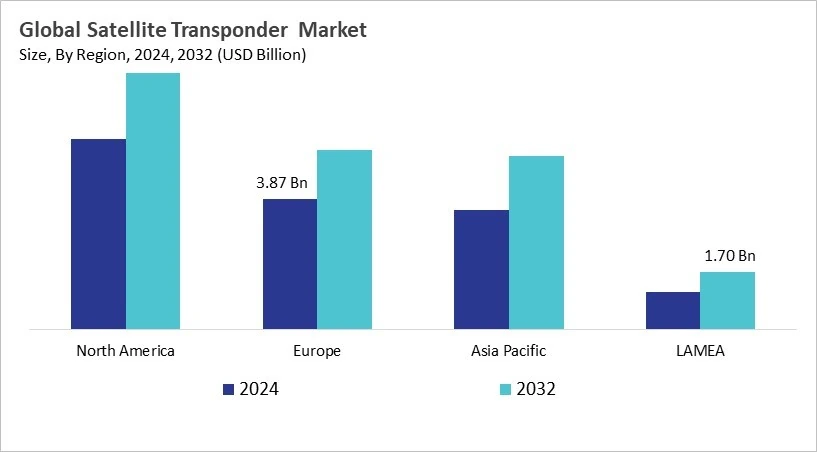
The North America region dominated the Global Satellite Transponder Market by Region in 2024, and would continue to be a dominant market till 2032; thereby, achieving a market value of $7,612.5 million by 2032. The Asia Pacific region is experiencing a CAGR of 5% during (2025 - 2032). Additionally, The Europe region would showcase a CAGR of 4.2% during (2025 - 2032).
By Frequency Band
By Application
By Service
By Satellite Platform
By Geography

 Unique Offerings

