The sample copy of this report is available for access.
“Global Recreational Vehicle Market to reach a market value of USD 70,052.69 Million by 2033 growing at a CAGR of 4.2%”
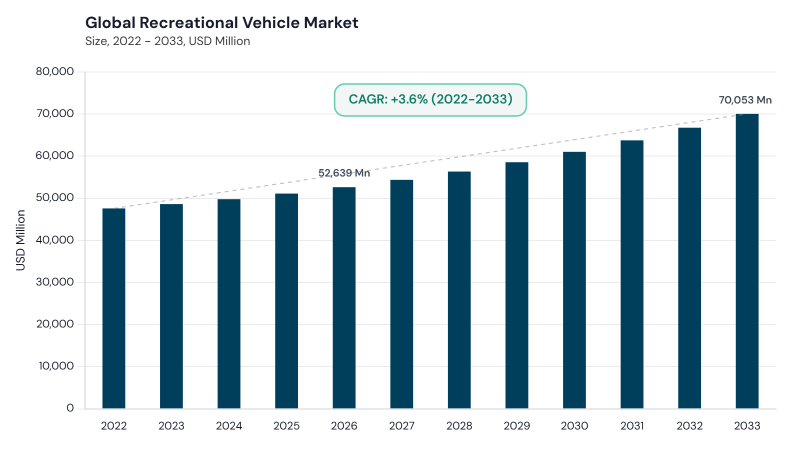
The Global Recreational Vehicle Market is expected to reach USD 70.0 billion by 2033, growing at a CAGR of 4.2% during (2026 - 2033).
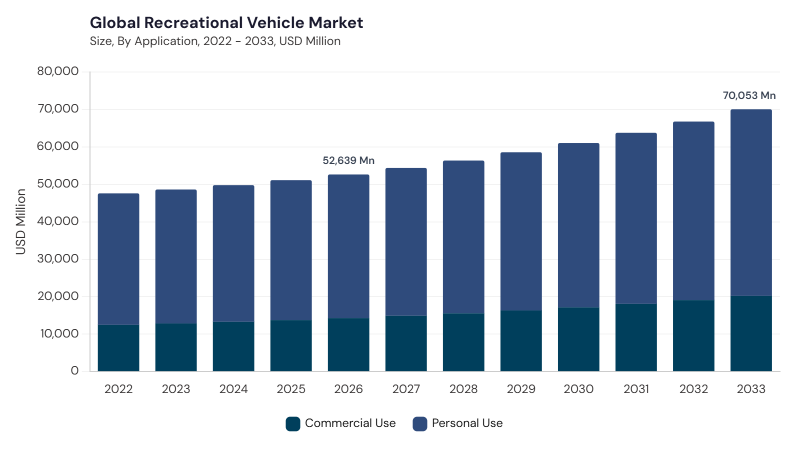
Growing demand for flexible travel, outdoor recreation, road-based tourism, self-contained accommodation, and personalized leisure experiences is driving the Recreational Vehicle Market across families, adventure travelers, retirees, younger consumers, rental operators, tourism businesses, and outdoor hospitality providers. Growth is further strengthened by expanding RV parks and campground infrastructure, remote and hybrid work trends, domestic tourism, lightweight materials, fuel-efficient and electric powertrains, smart connectivity, solar systems, energy storage, safety features, and space-efficient interior designs.
Increasing outdoor recreation, domestic tourism, remote work flexibility, and consumer interest in flexible travel are strengthening market growth. Consumers increasingly view RVs as mobile living spaces that combine transport, accommodation, work capability, entertainment, and off-grid convenience. Rental, sharing, subscription, and peer-to-peer platforms are also widening market access among users who prefer flexible usage over full ownership. At the same time, manufacturers are advancing lightweight construction, solar integration, lithium battery systems, smart controls, modular interiors, and electric or hybrid propulsion to improve comfort, efficiency, sustainability, and long-distance usability.
The competitive environment is brand-portfolio-driven and moderately consolidated, led by large RV groups, European caravan specialists, motorhome manufacturers, premium towable companies, and niche innovators. THOR Industries, Forest River, Trigano, and Winnebago hold strong positions through broad product coverage, dealer relationships, scale, and multi-brand strategies. Knaus Tabbert, Rapido Group, REV Group, Hobby, Brinkley RV, and Alliance RV strengthen the market through European specialization, motorized RV expertise, premium towables, camper vans, and customer-informed design. Future competition will depend on electrification, off-grid capability, lightweight materials, financing accessibility, digital customer journeys, service networks, and product formats suited to younger, remote-working, and experience-driven consumers.
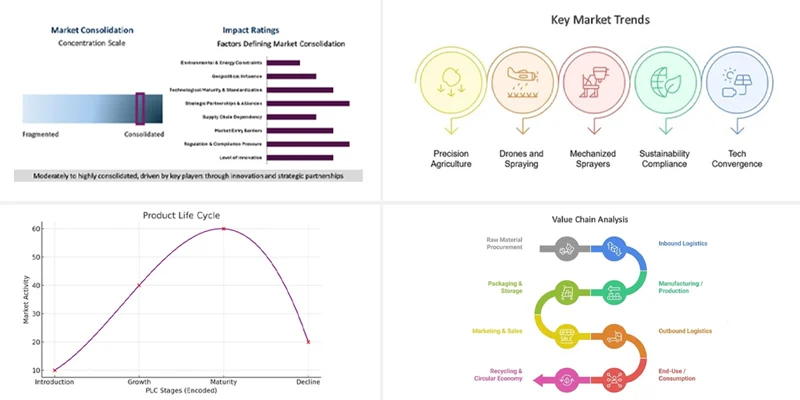

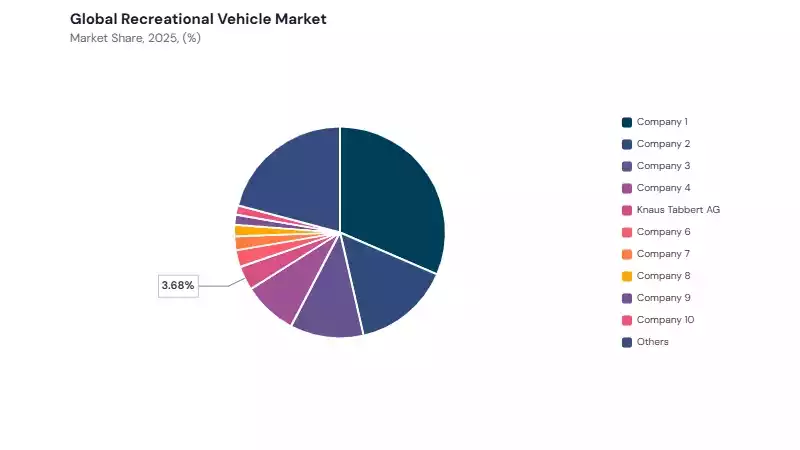
The global Recreational Vehicle Market reflects a moderately consolidated and portfolio-led competitive structure, where large manufacturers benefit from brand breadth, dealer networks, manufacturing scale, procurement strength, and exposure to both motorized and towable RV formats. THOR Industries leads through its broad family of RV brands across North America and Europe, while Forest River maintains a strong position through diversified towable and motorized recreational vehicles. Trigano and Knaus Tabbert strengthen the European competitive base through caravans, camper vans, and motorhomes, while Winnebago, Rapido Group, REV Group, Hobby, Brinkley RV, and Alliance RV compete through premium motorhomes, towables, camper vans, customer-informed designs, and regional specialization.
Based on Propulsion Type, the market is segmented into Non-motorized and Motorized. The Non-motorized market dominated the Global Recreational Vehicle Market by Propulsion Type in 2025, and would continue to be a dominant market till 2033; thereby, achieving a market value of USD 48.7 billion by 2033, growing at a CAGR of 3.9 % during the forecast period. The Motorized market is expected to witness a CAGR of 4.8% during (2026 - 2033).
Non-motorized recreational vehicles include travel trailers, caravans, camper trailers, fifth wheels, and other towable units that rely on an external towing vehicle. This segment benefits from affordability, ownership flexibility, lower maintenance needs, broad configurations, and the ability to separate transport from accommodation. Motorized recreational vehicles include motorhomes, camper vans, and other self-propelled units that integrate mobility with living functions. Demand in this segment is shaped by onboard comfort, self-contained travel, driver-assistance systems, powertrain efficiency, connectivity, and gradual development of electric and hybrid alternatives.
Based on Application, the market is segmented into Personal Use and Commercial Use. The Personal Use market dominated the Global Recreational Vehicle Market by Application in 2025, and would continue to be a dominant market till 2033; thereby, achieving a market value of USD 49.8 billion by 2033, growing at a CAGR of 3.8 % during the forecast period. The Commercial Use market is expected to witness a CAGR of 5.1% during (2026 - 2033).
Personal Use represents individual and family purchases for leisure travel, camping, road trips, seasonal getaways, remote work travel, and outdoor lifestyle experiences. Consumers in this segment value comfort, reliability, customization, off-grid readiness, connectivity, and flexible interior layouts. Commercial Use includes RV rental fleets, tourism operators, mobile hospitality services, event-support vehicles, mobile offices, and specialized travel businesses. Commercial adoption is supported by shared mobility models, fleet-management tools, peer-to-peer rental platforms, tourism demand, and the ability to offer RV access without requiring full ownership.
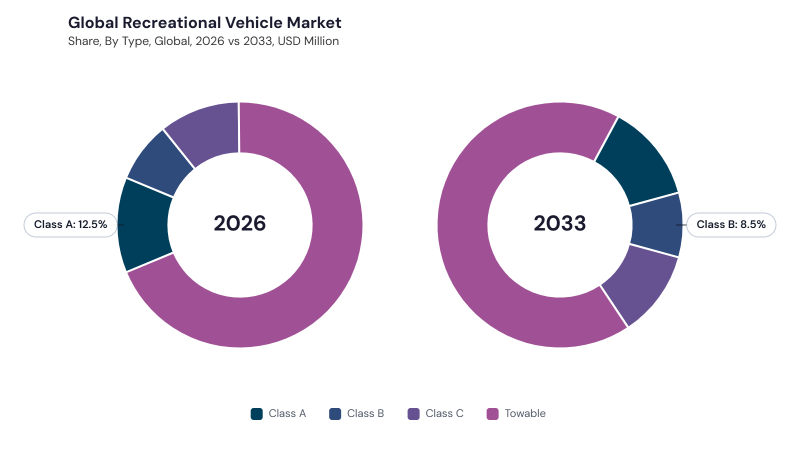
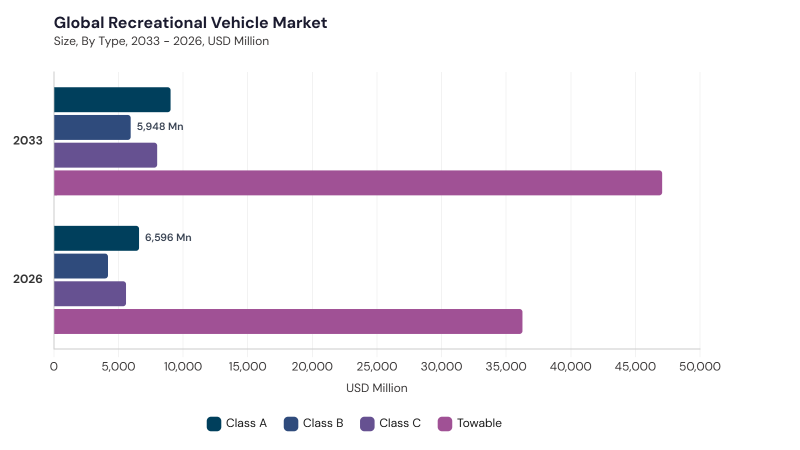
Based on Type, the market is segmented into Towable, Class A, Class C, and Class B. The Towable market dominated the Global Recreational Vehicle Market by Type in 2025, and would continue to be a dominant market till 2033; thereby, achieving a market value of USD 47.0 billion by 2033, growing at a CAGR of 3.8 % during the forecast period. The Class A market is expected to witness a CAGR of 4.6% during (2026 - 2033). Additionally, The Class C market is expected to witness highest CAGR of 5.3% during (2026 - 2033).
Towable RVs include travel trailers, fifth wheels, camper trailers, and related units that appeal to buyers seeking affordability, flexibility, detachable transport, and wide configuration choices. Class A motorhomes represent larger premium RVs with spacious interiors, high-end amenities, and suitability for extended travel or full-time use. Class C motorhomes offer a practical balance of living space, drivability, sleeping capacity, and family-oriented usability. Class B motorhomes, commonly known as camper vans, serve consumers seeking compact size, easier maneuverability, lower operating requirements, and flexible short-trip or adventure-focused travel.
Free Valuable Insights: Recreational Vehicle Market Size to reach $70.0 Billion by 2033
Region-wise, the Recreational Vehicle Market is analyzed across North America, Europe, Asia Pacific, and LAMEA. The North America market dominated the Global Recreational Vehicle Market by Region in 2025, and would continue to be a dominant market till 2033; thereby, achieving a market value of USD 36.5 billion by 2033, growing at a CAGR of 3.7 % during the forecast period. The Europe market is expected to witness a CAGR of 3.7% during (2026 - 2033). Additionally, The Asia Pacific market is expected to witness a CAGR of 5.4% during (2026 - 2033).
North America remains the leading regional market due to strong camping culture, broad campground infrastructure, high pickup and SUV ownership, extensive dealer networks, and sustained demand for domestic road-based vacations. Europe benefits from established caravan and motorhome usage, cross-border leisure travel, developed camping infrastructure, and rising sustainability-focused product innovation. Asia Pacific is expanding through outdoor tourism, rising disposable incomes, camping culture development, and growing interest in alternative leisure accommodation. LAMEA is developing gradually as road tourism, adventure travel, rental activity, and outdoor hospitality models gain traction, although infrastructure and affordability continue to influence adoption.
| Report Attribute | Details |
|---|---|
| Market size value in 2026 | USD 52.6 billion |
| Market size forecast in 2033 | USD 70.0 billion |
| Base Year | 2025 |
| Historical Period | 2022 to 2024 |
| Forecast Period | 2026 to 2033 |
| Revenue Growth Rate | CAGR of 4.2% from 2026 to 2033 |
| Number of Pages | 202 |
| Tables | 570 |
| Report Coverage | Market Trends, Revenue Estimation and Forecast, Segmentation Analysis, Regional and Country Breakdown, Competitive Landscape, Market Share Analysis, Company Profiling, Companies Strategic Developments, SWOT Analysis, Product Life Cycle Analysis, Value Chain Analysis, Market Consolidation Analysis, Key Customer Criteria, Pandemic Impact Analysis, and Winning Imperatives |
| Segments Covered | Propulsion Type, Application, Type, and Geography |
| Country Scope |
|
| Companies Included | THOR Industries; Forest River; Trigano; Winnebago Industries; Knaus Tabbert; Rapido Group; REV Group; Hobby; Brinkley RV; Alliance RV |
By Propulsion Type
By Application
By Type
By Geography
The market is expected to reach USD 70.0 billion by 2033, growing at 4.2% CAGR during 2026-2033.
Non-motorized segment leads with a projected market value of USD 48.7 billion by 2033.
THOR Industries, Forest River, Trigano, Winnebago Industries, Knaus Tabbert, Rapido Group, REV Group, Hobby, Brinkley RV, Alliance RV.
North America leads with a market value of USD 36.5 billion by 2033.
Advanced technologies, electrification, and lifestyle mobility expansion drive the market.
Personal Use segment is projected to reach USD 49.8 billion by 2033.
Our team of dedicated experts can provide you with attractive expansion opportunities for your business.








 Unique Offerings