The sample copy of this report is available for access.
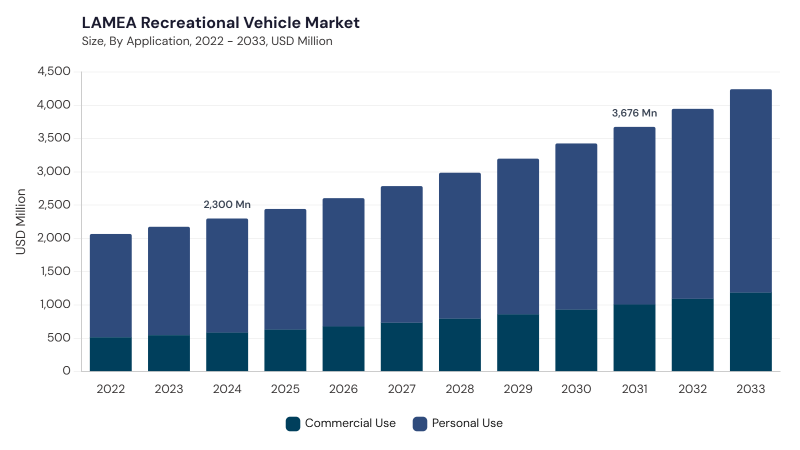
The LAMEA Recreational Vehicle Market is expected to reach USD 3198.6 million by 2029, growing at a CAGR of 7.2% during (2026 - 2033).
The LAMEA Recreational Vehicle Market evolved from a niche segment centered on basic camping trailers and imported leisure vehicles into a more diversified mobility market serving tourism, adventure travel, and lifestyle applications. Rising domestic tourism, improving road connectivity, higher disposable incomes in selected markets, and growing interest in outdoor recreation gradually broadened adoption. Product development progressed through improved chassis systems, efficient powertrains, enhanced onboard amenities, and greater regional customization. More recently, hybrid and electric propulsion, lightweight materials, digital connectivity, smart vehicle systems, and localized assembly have strengthened product sophistication and market relevance.
Eco-friendly technologies, digitalization, regional customization, and tourism infrastructure development are shaping current market development across LAMEA. Manufacturers are increasingly integrating hybrid and electric drivetrains, solar power, IoT-enabled controls, GPS navigation, telematics, predictive maintenance, and energy-management systems to improve efficiency and user experience. Customization is gaining importance as vehicles are adapted to regional climates, terrain, road conditions, and consumer preferences. At the same time, high ownership costs, import duties, uneven road infrastructure, fragmented regulations, limited service networks, charging constraints, and differences in tourism infrastructure continue to influence adoption across the region.
Based on Propulsion Type, the market is segmented into Non-motorized and Motorized. The Non-motorized market dominated the LAMEA Recreational Vehicle Market by Propulsion Type in 2025, and would continue to be a dominant market till 2033; thereby, achieving a market value of USD 2282.6 million by 2029, growing at a CAGR of 6.9 % during the forecast period. The Motorized market is expected to witness a CAGR of 8% during (2026 - 2033).
Non-motorized RVs include caravans, travel trailers, and camper trailers that allow consumers to use a separate towing vehicle and benefit from comparatively straightforward mechanical structures and flexible ownership. Lightweight construction, improved structural materials, aerodynamic designs, and enhanced interiors are improving usability. Motorized RVs include motorhomes and campervans that combine transportation and accommodation in one platform and support premium road tourism, long-distance travel, and self-contained leisure experiences. Demand is increasingly influenced by smart technologies, alternative powertrains, digital connectivity, comfort features, and growing rental activity, although cost and infrastructure limitations remain important considerations.
Based on Application, the market is segmented into Personal Use and Commercial Use. The Personal Use market dominated the LAMEA Recreational Vehicle Market by Application in 2025, and would continue to be a dominant market till 2033; thereby, achieving a market value of USD 2339.4 million by 2029, growing at a CAGR of 6.8 % during the forecast period. The Commercial Use market is expected to witness a CAGR of 8.3% during (2026 - 2033).
Personal Use includes privately owned motorhomes, campervans, and caravans used for vacations, road trips, outdoor recreation, weekend travel, and extended touring. Consumers increasingly value self-sufficiency, smart features, solar systems, durable construction, flexible interiors, and connectivity. Commercial Use includes RV rentals, tourism fleets, hospitality applications, mobile retail, event-support vehicles, traveling exhibitions, and other revenue-generating activities. Commercial operators emphasize utilization efficiency, durability, fleet management, telematics, regulatory compliance, maintenance support, and adaptable vehicle configurations suited to varied business models.
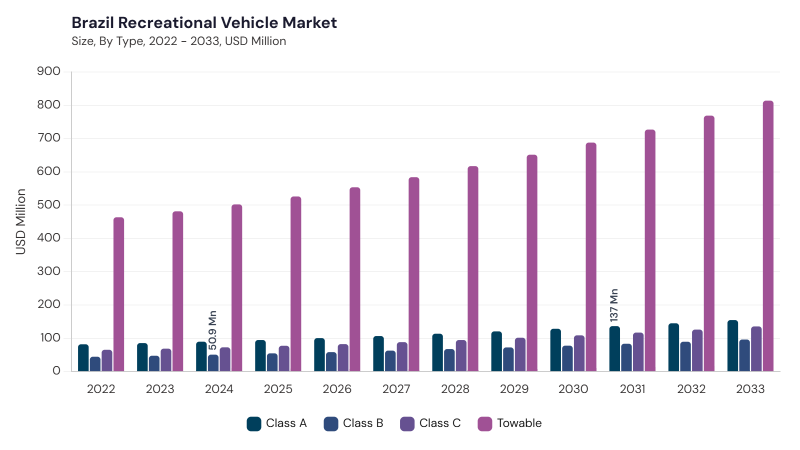
Based on Type, the market is segmented into Towable, Class A, Class C, and Class B. Towable RVs include travel trailers, fifth wheels, and pop-up campers and appeal strongly to price-conscious families and recreational travelers seeking flexibility and comparatively lower acquisition costs. Class A motorhomes serve affluent consumers and premium travelers seeking spacious interiors, extensive amenities, and long-duration travel capabilities.
Class C motorhomes offer a balance of accommodation capacity, maneuverability, and practicality, supporting family travel and rental applications. Class B campervans emphasize compact dimensions, easier parking, fuel efficiency, modular layouts, and mobility, supporting growing demand among younger users, couples, digital nomads, and short-trip travelers.
Free Valuable Insights: Recreational Vehicle Market Size Worth USD 70.0 Billion billion by 2033
Based on Country, the market is segmented into Brazil, Argentina, UAE, Saudi Arabia, South Africa, Nigeria, and Rest of LAMEA. The Brazil market dominated the LAMEA Recreational Vehicle Market by Country in 2025, and would continue to be a dominant market till 2033; thereby, achieving a market value of USD 946.7 million by 2029, growing at a CAGR of 6.1 % during the forecast period. The Argentina market is expected to witness a CAGR of 7.8% during (2026 - 2033). Additionally, The UAE market is expected to witness a CAGR of 6% during (2026 - 2033).
Across LAMEA, RV adoption is being shaped by domestic tourism, sustainability, digital connectivity, localized manufacturing, and infrastructure development. Brazil emphasizes eco-friendly technologies, connected vehicles, local manufacturing, and customization, while Argentina focuses on solar integration, smart systems, rental and subscription models, and region-specific designs. The UAE is advancing electric and hybrid RVs, climate-adaptive interiors, rental platforms, smart fleet systems, and localized services, whereas Saudi Arabia emphasizes Vision 2030-supported tourism, smart connectivity, solar-powered solutions, localization, and advanced safety features. South Africa focuses on rugged off-grid RVs, solar technologies, smart systems, and localized service networks, while Nigeria emphasizes modular designs, solar and hybrid energy, digital booking, telematics, and locally adapted vehicles. Rest of LAMEA continues to develop energy-efficient RVs, smart technologies, modular products, regional manufacturing, and localized recreational mobility solutions.

By Propulsion Type
By Application
By Type
By Country
Set to reach $3198.6 Million by 2029, growing at 7.2% CAGR during 2026-2033.
Brazil leads with $946.7 million by 2029, growing at 6.1% CAGR during the forecast period.
The Non-motorized segment will achieve $2282.6 million by 2029, growing at 6.9% CAGR during 2026-2033.
Personal Use segment will reach $2339.4 million by 2029, growing at 6.8% CAGR during 2026-2033.
Argentina market is expected to witness a CAGR of 7.8% during 2026-2033.
Motorized segment is expected to witness a CAGR of 8% during 2026-2033.
Our team of dedicated experts can provide you with attractive expansion opportunities for your business.




 Unique Offerings