The sample copy of this report is available for access.
The North America Recreational Vehicle Market is expected to reach USD 34.9 billion by 2032, growing at a CAGR of 3.7% during (2026 - 2033).
The North America Recreational Vehicle Market evolved from early passenger-vehicle conversions and basic camper trailers into specialized motorhomes and towable units offering integrated living, utility, and recreational capabilities. Expansion of highways, campgrounds, and post-war leisure travel broadened RV adoption, while advances in manufacturing introduced lightweight materials, improved chassis systems, modern safety features, and more sophisticated interiors. Recent development increasingly emphasizes digital connectivity, energy-efficient systems, electrification, and flexible access models such as subscriptions and rentals. This progression has transformed RVs from basic mobile shelters into technologically advanced living and travel platforms serving diverse recreational lifestyles.
Electrification, smart connectivity, flexible ownership, lightweight materials, and changing travel lifestyles are shaping current market development. Manufacturers are increasingly integrating hybrid and electric powertrains, solar systems, IoT-enabled appliances, advanced navigation, telematics, predictive maintenance, and connected vehicle functions to enhance efficiency and user experience. Subscription services, peer-to-peer rentals, and digital booking platforms are reducing ownership barriers, while remote work and experiential travel are broadening the consumer base. At the same time, emissions regulations, vehicle acquisition costs, charging infrastructure, service-network availability, supply chain resilience, and regional manufacturing strategies continue to influence product development and market accessibility.
Based on Propulsion Type, the market is segmented into Non-motorized and Motorized. The Non-motorized market dominated the North America Recreational Vehicle Market by Propulsion Type in 2025, and would continue to be a dominant market till 2033; thereby, achieving a market value of USD 24.3 billion by 2032, growing at a CAGR of 3.4 % during the forecast period. The Motorized market is expected to witness a CAGR of 4.3% during (2026 - 2033).
Non-motorized RVs include travel trailers, fifth wheels, camper trailers, and other towable units that allow consumers to separate recreational accommodation from everyday transportation. Product development increasingly emphasizes lightweight construction, aerodynamics, efficient floorplans, durability, connectivity, and compatibility with evolving tow-vehicle technologies. Motorized RVs include motorhomes and camper vans that combine transportation and living functions in a self-contained platform. Demand is supported by road-trip travel, premium touring, digital connectivity, energy management, driver-assistance features, and growing development of hybrid and electric propulsion technologies.
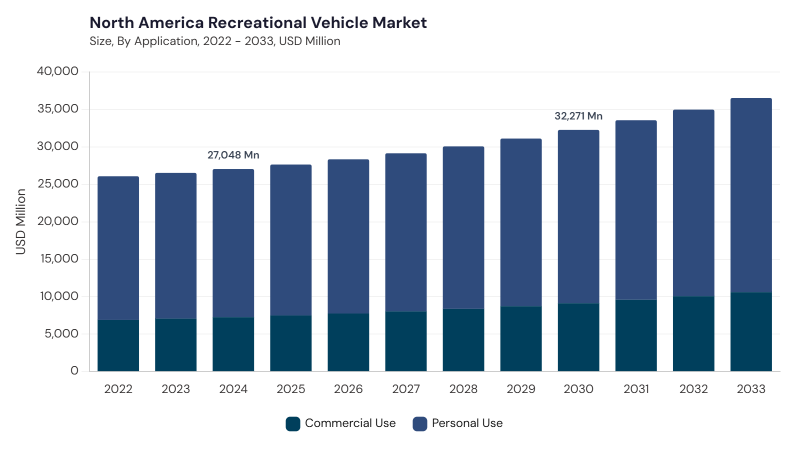
Based on Application, the market is segmented into Personal Use and Commercial Use. The Personal Use market dominated the North America Recreational Vehicle Market by Application in 2025, and would continue to be a dominant market till 2033; thereby, achieving a market value of USD 24.9 billion by 2032, growing at a CAGR of 3.3 % during the forecast period. The Commercial Use market is expected to witness a CAGR of 4.6% during (2026 - 2033).
Personal Use includes RV ownership for leisure travel, camping, extended road trips, remote working, seasonal travel, and lifestyle mobility, with demand increasingly influenced by customization, smart features, solar energy, and connected technologies. Commercial Use includes rental fleets, tourism services, mobile offices, event-support vehicles, mobile healthcare, disaster response, entertainment applications, and other specialized operations. Commercial operators prioritize durability, telematics, fleet management, regulatory compliance, maintenance efficiency, and flexible utilization while increasingly evaluating electric and hybrid RV platforms to improve operational sustainability.
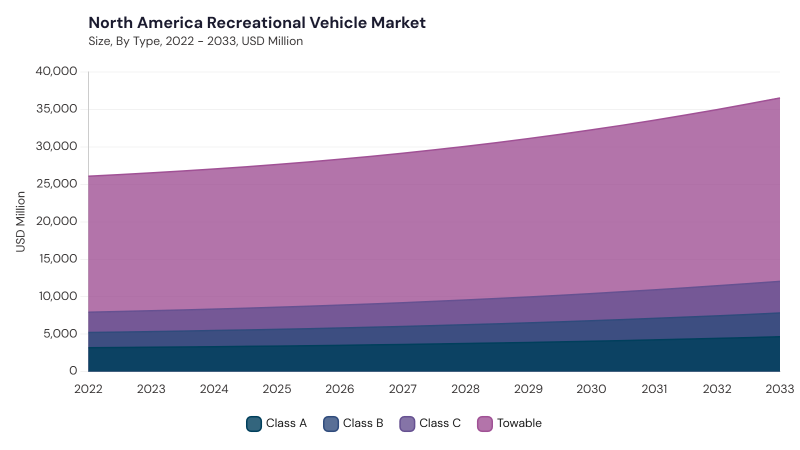
Based on Type, the market is segmented into Towable, Class A, Class C, and Class B. Towable RVs range from compact travel trailers to large fifth-wheel units and appeal to consumers seeking flexibility, affordability, and customizable layouts. Class A motorhomes target premium and long-duration travelers through spacious interiors, extensive amenities, advanced technology, and self-contained living environments.
Class C motorhomes offer a balance of living space, maneuverability, and affordability, supporting family travel and rental applications. Class B motorhomes emphasize compact dimensions, easier driving, fuel efficiency, modular interiors, and van-based adventure travel, making them increasingly relevant among younger travelers, couples, digital nomads, and urban users.
Free Valuable Insights: The Global Recreational Vehicle Market will hit USD 70.0 Billion billion by 2033, at a CAGR of 4.2%
Based on Country, the market is segmented into US, Canada, Mexico, and Rest of North America. The US market dominated the North America Recreational Vehicle Market by Country in 2025, and would continue to be a dominant market till 2033; thereby, achieving a market value of USD 27.9 billion by 2032, growing at a CAGR of 3.1 % during the forecast period. The Canada market is expected to witness a CAGR of 6.1% during (2026 - 2033). Additionally, The Mexico market is expected to witness a CAGR of 6.3% during (2026 - 2033).
Across North America, RV adoption is being shaped by electrification, smart technology, sustainable materials, flexible ownership models, and changing leisure preferences. The US emphasizes electric and hybrid RV development, connected vehicle systems, remote-work-compatible layouts, lightweight materials, and digital ownership experiences, while Canada focuses on pre-owned RV demand, smart home features, solar integration, sustainable design, and region-specific vehicle configurations. Mexico is advancing energy-efficient RVs, smart connectivity, localized manufacturing, nearshoring, lightweight materials, and tailored product development, whereas Rest of North America emphasizes electric powertrains, subscription services, connected vehicles, predictive maintenance, and localized offerings suited to diverse regulatory and consumer requirements.

By Propulsion Type
By Application
By Type
By Country
Set to reach $34.9 Billion by 2032, growing at 3.7% CAGR during 2026-2033.
The US leads with $27.9 billion by 2032, growing at 3.1% CAGR during 2026-2033.
Rising personal use, reaching $24.9 billion by 2032 at 3.3% CAGR during 2026-2033.
Non-motorized segment hits $24.3 billion by 2032, growing at 3.4% CAGR during 2026-2033.
Canada's market is expected to grow at a 6.1% CAGR during 2026-2033.
The Motorized segment is expected to witness a 4.3% CAGR during 2026-2033.
Our team of dedicated experts can provide you with attractive expansion opportunities for your business.




 Unique Offerings