The sample copy of this report is available for access.
“Global Plant Phenotyping Equipment Market to reach a market value of USD 596.75 Million by 2033 growing at a CAGR of 9.8%”
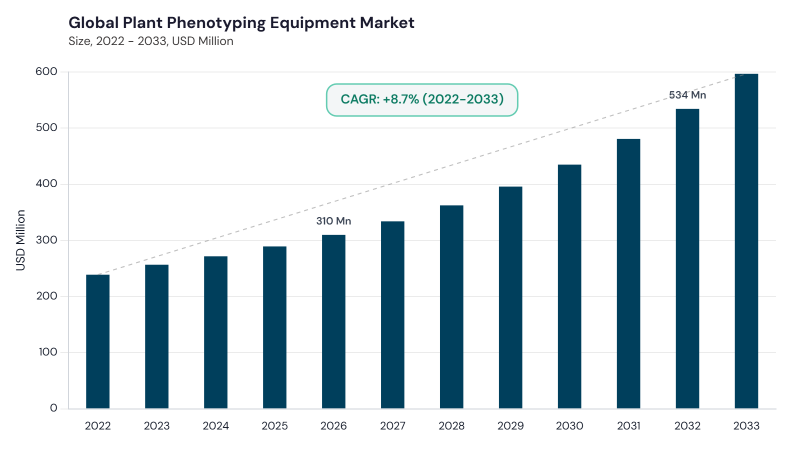
The Global Plant Phenotyping Equipment Market is expected to reach USD 596.7 million by 2033, growing at a CAGR of 9.8% during (2026 - 2033).
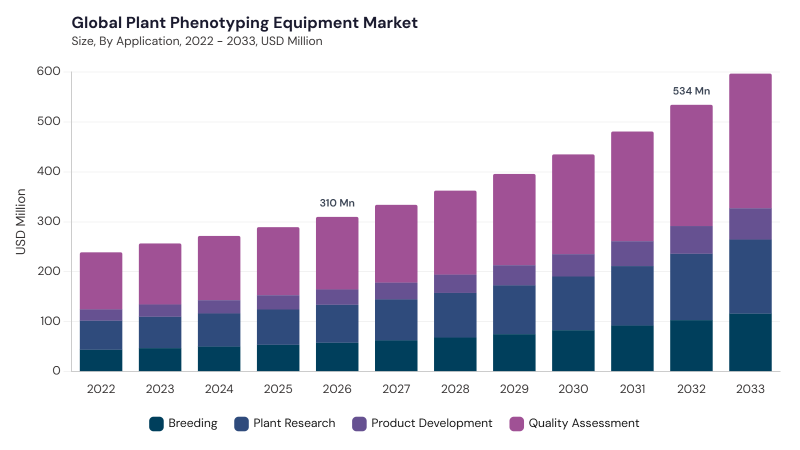
Growing need for precision agriculture, advanced crop research, data-driven plant breeding, faster trait analysis, accurate growth monitoring, stress detection, and improved crop productivity is driving the Plant Phenotyping Equipment Market. Adoption is increasing across agricultural research institutes, universities, seed companies, biotechnology firms, and commercial farming operations. Growth is further strengthened by rising investment in agricultural biotechnology, climate-resilient crop development, digital farming, AI integration, multispectral and hyperspectral imaging, robotics, automated data collection, portable field systems, and scalable phenotyping platforms.
Growth in the Plant Phenotyping Equipment Market is driven by the rising need to improve crop yields, shorten breeding cycles, develop climate-resilient varieties, and understand plant responses to drought, heat, salinity, pests, disease, nutrient variation, and environmental stress. Automated phenotyping equipment enables researchers to collect consistent, non-destructive, and high-frequency measurements across large plant populations, reducing the limitations of manual observation. AI-enabled image analysis, sensor fusion, 3D imaging, hyperspectral sensing, thermal cameras, fluorescence analysis, automated root measurement, drones, and field platforms are expanding the accuracy and scope of plant research.
The competitive environment is research-infrastructure-driven and moderately fragmented, with dedicated phenotyping platform manufacturers, plant-imaging specialists, controlled-environment providers, automation integrators, portable scientific-instrument companies, and regional engineering suppliers competing across the market. Nynomic AG and Photon Systems Instruments hold leading positions through integrated hardware-software platforms, imaging, spectroscopy, sensor integration, and high-throughput systems. Phenospex, Heinz Walz, Conviron, WPS, Qubit Systems, SMO, Delta, and PhenoVation strengthen the market through 3D plant scanning, fluorescence imaging, controlled growth environments, robotic handling, gas-exchange measurement, portable plant instruments, and specialized automation.
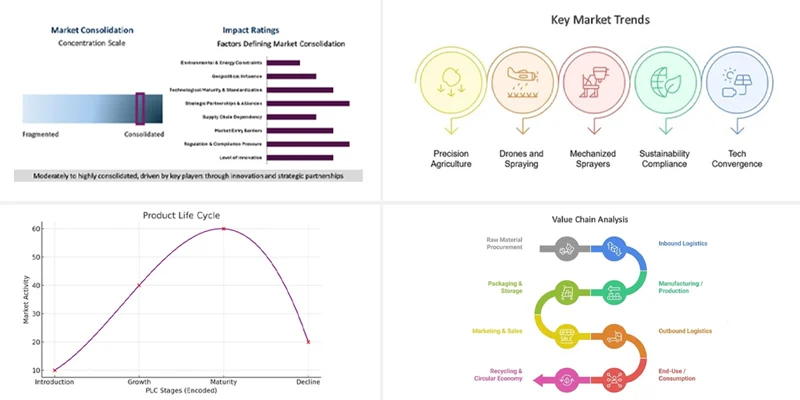

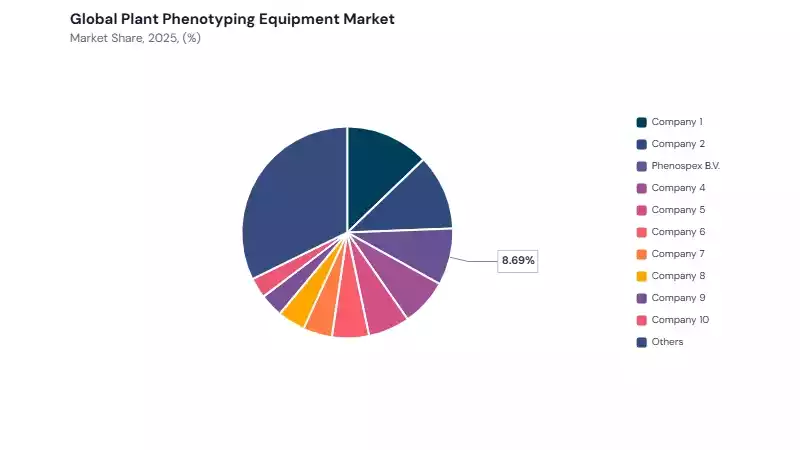
The global Plant Phenotyping Equipment Market reflects a moderately fragmented and research-infrastructure-led competitive landscape, with leadership distributed across automated phenotyping platform providers, imaging specialists, plant physiology instrument companies, controlled-environment suppliers, and robotic automation firms. Nynomic AG leads the market through imaging, spectroscopy, sensor integration, and complete hardware-software platforms, while Photon Systems Instruments maintains a strong second position through PlantScreen systems, robotic platforms, compact laboratory units, greenhouse systems, root phenotyping, and field research equipment. Phenospex B.V. holds a strong third position through 3D scanning, multispectral sensing, and non-destructive trait measurement. Heinz Walz, Conviron, WPS, Qubit Systems, SMO, Delta, and PhenoVation add depth through fluorescence systems, plant-growth chambers, plant-handling automation, gas-exchange measurement, portable instruments, and integrated imaging platforms.
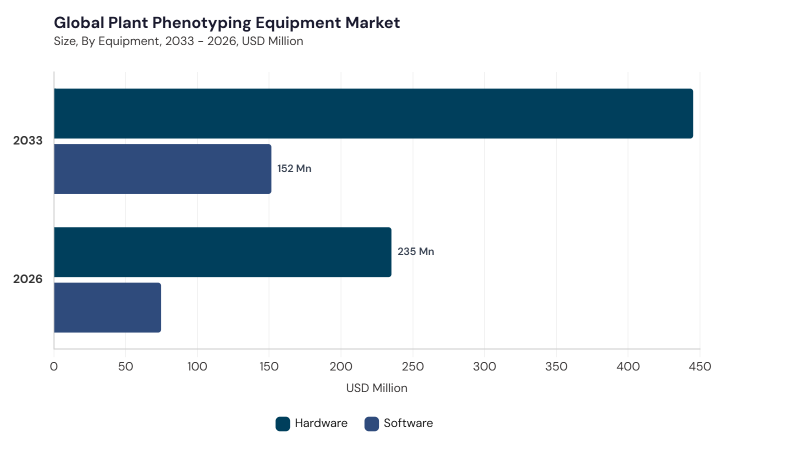
Based on Equipment, the market is segmented into Hardware and Software. The Hardware market dominated the Global Plant Phenotyping Equipment Market by Equipment in 2025, and would continue to be a dominant market till 2033; thereby, achieving a market value of USD 445.2 million by 2033, growing at a CAGR of 9.6 % during the forecast period. The Software market is expected to witness a CAGR of 10.6% during (2026 - 2033).
Hardware remains the leading equipment category because plant phenotyping depends heavily on imaging devices, sensors, cameras, spectroscopy equipment, drones, robotic platforms, scanners, automated measurement systems, and data-acquisition technologies. These systems enable researchers to capture plant morphology, physiology, biochemical traits, stress responses, disease characteristics, biomass, yield potential, and environmental interactions across laboratory, greenhouse, and field conditions. Software is gaining importance as phenotyping generates large and complex datasets that require image analysis, trait extraction, statistical interpretation, visualization, and integration with genotypic and environmental data. AI, machine learning, cloud-based analytics, and interoperable platforms are strengthening the role of software in converting raw plant measurements into actionable research insights.
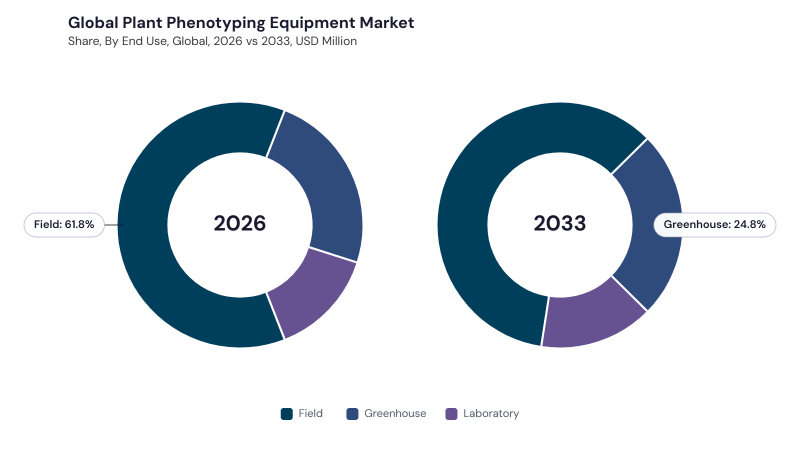
Based on End Use, the market is segmented into Field, Greenhouse, and Laboratory. The Field market dominated the Global Plant Phenotyping Equipment Market by End Use in 2025, and would continue to be a dominant market till 2033; thereby, achieving a market value of USD 358.9 million by 2033, growing at a CAGR of 9.4 % during the forecast period. The Greenhouse market is expected to witness a CAGR of 10.3% during (2026 - 2033). Additionally, The Laboratory market is expected to witness highest CAGR of 10.8% during (2026 - 2033).
Field remains the dominant end-use segment as researchers and breeders increasingly evaluate crops under real agricultural conditions rather than relying only on controlled environments. Field phenotyping uses drones, UAVs, mobile sensors, ground vehicles, proximal sensing, imaging platforms, and environmental monitoring to assess crop growth, canopy structure, stress tolerance, biomass, nutrient status, disease symptoms, and yield-related traits. Greenhouse phenotyping supports controlled-environment experimentation by allowing precise management of light, humidity, temperature, water, and nutrients while using automated imaging and sensor systems. Laboratory phenotyping serves detailed physiological, biochemical, genetic, and cellular investigations using specialized instruments such as fluorescence analyzers, gas-exchange systems, microscopy tools, spectroscopy, and controlled experimental platforms.
Based on Application, the market is segmented into Quality Assessment, Plant Research, Breeding, and Product Development. The Quality Assessment market dominated the Global Plant Phenotyping Equipment Market by Application in 2025, and would continue to be a dominant market till 2033; thereby, achieving a market value of USD 269.7 million by 2033, growing at a CAGR of 9.2 % during the forecast period. The Plant Research market is expected to witness a CAGR of 10.1% during (2026 - 2033). Additionally, The Breeding market is expected to witness highest CAGR of 10.5% during (2026 - 2033).
Quality Assessment remains the leading application as phenotyping equipment is widely used to evaluate plant health, morphology, crop quality, vigor, maturity, stress tolerance, nutrient status, disease symptoms, and yield characteristics. Plant Research is supported by academic, institutional, and commercial studies focused on plant physiology, genetics, genotype-environment interactions, stress responses, photosynthetic performance, and climate adaptation. Breeding applications are expanding as high-throughput phenotyping helps breeders screen large plant populations, identify desirable traits, shorten selection cycles, and support genomic-assisted breeding. Product Development uses phenotyping data to validate new seed varieties, crop protection products, biological inputs, fertilizers, growth enhancers, and precision-agriculture solutions before broader commercialization.
Free Valuable Insights: Plant Phenotyping Equipment Market Size to reach $596.7 Million by 2033
Region-wise, the Plant Phenotyping Equipment Market is analyzed across North America, Europe, Asia Pacific, and LAMEA. The North America market dominated the Global Plant Phenotyping Equipment Market by Region in 2025, and would continue to be a dominant market till 2033; thereby, achieving a market value of USD 227.6 million by 2033, growing at a CAGR of 9.1 % during the forecast period. The Asia Pacific market is expected to witness a CAGR of 10.6% during (2026 - 2033). Additionally, The Europe market is expected to witness a CAGR of 9.3% during (2026 - 2033).
North America leads the global market due to strong agricultural biotechnology investment, precision agriculture adoption, advanced crop research infrastructure, university and research-center activity, seed company involvement, and early adoption of AI-enabled phenotyping platforms. Asia Pacific is expanding through rising agricultural modernization, crop genetics programs, food security needs, digital agriculture, climate-resilient crop development, and research activity across China, Japan, India, South Korea, Singapore, and Malaysia. Europe benefits from strong plant-science research, sustainability priorities, high-throughput phenotyping infrastructure, data standardization, and climate-resilient breeding initiatives. LAMEA is developing through agricultural modernization, crop resilience needs, greenhouse and field-based phenotyping adoption, research partnerships, and growing demand for scalable tools across Brazil, Argentina, UAE, Saudi Arabia, South Africa, and Nigeria.
| Report Attribute | Details |
|---|---|
| Market size value in 2026 | USD 309.8 million |
| Market size forecast in 2033 | USD 596.7 million |
| Base Year | 2025 |
| Historical Period | 2022 to 2024 |
| Forecast Period | 2026 to 2033 |
| Revenue Growth Rate | CAGR of 9.8% from 2026 to 2033 |
| Number of Pages | 490 |
| Tables | 390 |
| Report Coverage | Market Trends, Revenue Estimation and Forecast, Segmentation Analysis, Regional and Country Breakdown, Competitive Landscape, Market Share Analysis, Company Profiling, Companies Strategic Developments, SWOT Analysis, Product Life Cycle Analysis, Value Chain Analysis, Market Consolidation Analysis, Key Customer Criteria, Pandemic Impact Analysis, and Winning Imperatives |
| Segments Covered | Equipment, End Use, Application, and Geography |
| Country Scope |
|
| Companies Included | Nynomic AG; Photon Systems Instruments; Phenospex B.V.; Heinz Walz GmbH; Conviron; WPS B.V.; Qubit Systems Inc.; SMO B.V.; Delta-T Devices; PhenoVation B.V. |
By Equipment
By End Use
By Application
By Geography
Expected to reach USD 596.7 million by 2033, growing at 9.8% CAGR during the forecast period (2026-2033).
Field and large-scale phenotyping solutions are expanding to address real-world agricultural challenges.
Nynomic AG, Photon Systems Instruments, Phenospex B.V., Heinz Walz GmbH, Conviron, WPS B.V., Qubit Systems Inc., SMO B.V., Delta-T Devices, PhenoVation B.V.
Asia Pacific shows promising growth with advancements in high-throughput phenotyping technologies.
Advancement and integration of high-throughput phenotyping technologies and AI in phenotyping drive growth.
The market is projected to grow at 9.8% CAGR during the forecast period (2026-2033).
Our team of dedicated experts can provide you with attractive expansion opportunities for your business.








 Unique Offerings