The sample copy of this report is available for access.
The LAMEA Plant Phenotyping Equipment Market is expected to reach USD 29.1 million by 2029, growing at a CAGR of 12.2% during (2026 - 2033).
The LAMEA Plant Phenotyping Equipment Market evolved from manual and low-throughput assessment of plant traits toward advanced, automated systems capable of precise and non-destructive crop analysis. Progress in hyperspectral, thermal, and fluorescence imaging, remote sensing, automation, and computational analysis substantially improved measurement of plant growth, biomass, stress responses, and disease characteristics. Integration of machine learning further enhanced interpretation of complex phenotypic data across the region’s diverse agroecological conditions. Current development increasingly combines multi-sensor hardware, AI-enabled analytics, cloud-based platforms, portable equipment, and scalable phenotyping systems to support crop breeding, precision agriculture, stress-tolerance research, and sustainable production.
AI-enabled phenotyping, high-throughput automation, advanced spectral imaging, localized solutions, and sustainability-oriented crop research are shaping current market development. Agricultural research institutions, breeding programs, universities, and agribusinesses increasingly use drones, portable sensors, automated platforms, remote imaging, cloud analytics, and machine-learning tools to evaluate plants under arid, semi-arid, tropical, and other demanding environments. Growing emphasis on water efficiency, heat and drought tolerance, crop resilience, public-private research programs, and precision agriculture is broadening adoption. However, high capital and operating costs, inadequate infrastructure, limited technical expertise, fragmented standards, interoperability constraints, complex data management, and varying regional investment capacity continue to affect deployment.
Based on Equipment, the market is segmented into Hardware and Software. The Hardware market dominated the LAMEA Plant Phenotyping Equipment Market by Equipment in 2025, and would continue to be a dominant market till 2033; thereby, achieving a market value of USD 22.1 million by 2029, growing at a CAGR of 11.9 % during the forecast period. The Software market is expected to witness a CAGR of 13.1% during (2026 - 2033).
Hardware includes cameras, imaging systems, sensors, drones, portable measurement devices, automated platforms, and environmental monitoring equipment used to capture plant morphology, physiological characteristics, stress responses, disease indicators, and environmental interactions. These systems are particularly relevant for assessing crops under water scarcity, heat, salinity, and variable soil conditions. Software supports image processing, trait classification, data visualization, experiment management, predictive analytics, and integration of phenotypic observations. Increasing use of AI, machine learning, cloud computing, and centralized research databases is strengthening software’s ability to convert complex datasets into actionable crop-development insights.
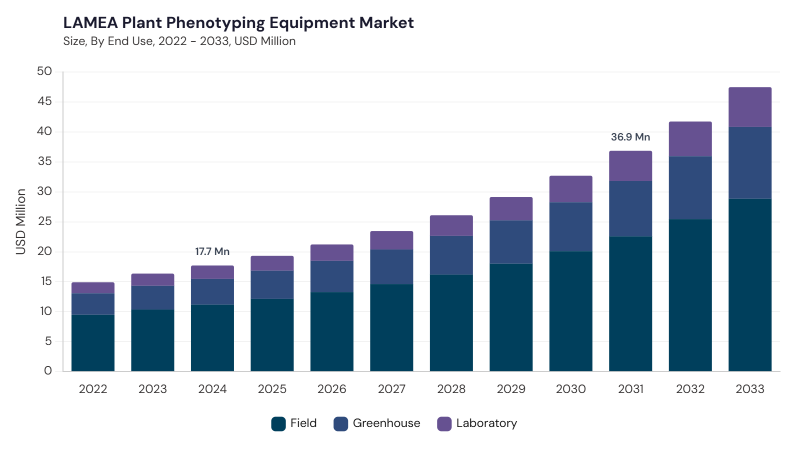
Based on End Use, the market is segmented into Field, Greenhouse, and Laboratory. The Field market dominated the LAMEA Plant Phenotyping Equipment Market by End Use in 2025, and would continue to be a dominant market till 2033; thereby, achieving a market value of USD 18.0 million by 2029, growing at a CAGR of 11.7 % during the forecast period. The Greenhouse market is expected to witness a CAGR of 12.7% during (2026 - 2033). Additionally, The Laboratory market is expected to witness highest CAGR of 13.5% during (2026 - 2033).
Field phenotyping uses UAV-mounted sensors, remote sensing, portable imaging platforms, and ground-based equipment to assess crop health, canopy development, water stress, environmental responses, and yield characteristics under natural conditions. Greenhouse phenotyping provides controlled environments for examining plant responses to temperature, humidity, light, water availability, heat, and other stresses through automated imaging, sensors, and robotic technologies. Laboratory phenotyping supports detailed physiological, biochemical, cellular, and genetic studies using microscopy, spectroscopy, imaging systems, and other specialized analytical tools. Together, these settings connect detailed biological investigation with controlled stress assessment and real-world crop performance.
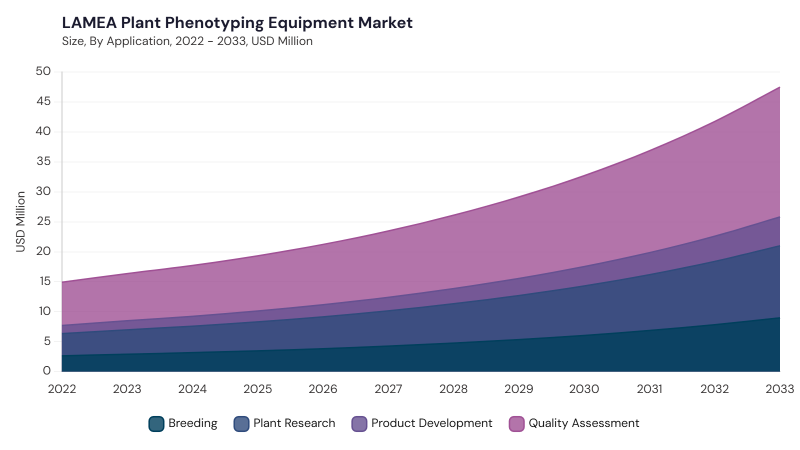
Based on Application, the market is segmented into Quality Assessment, Plant Research, Breeding, and Product Development. Quality Assessment applies imaging systems, hyperspectral technologies, multisensor platforms, and automated analysis to evaluate plant height, biomass, chlorophyll content, seed quality, stress indicators, and crop consistency. Plant Research supports investigation of plant growth, drought response, heat tolerance, soil salinity, nutrient efficiency, disease behavior, and environmental adaptation across controlled and field environments.
Breeding uses high-throughput imaging, spectral sensors, drones, and automated analytics to identify varieties with improved yield potential, disease resistance, heat tolerance, and resilience to water limitations. Product Development applies phenotypic evaluation to locally adapted seeds, biostimulants, fertilizers, crop-protection solutions, biological inputs, and other agricultural technologies before broader commercial deployment.
Free Valuable Insights: Plant Phenotyping Equipment Market Size Worth USD 596.7 Million billion by 2033
Based on Country, the market is segmented into Brazil, Argentina, UAE, Saudi Arabia, South Africa, Nigeria, and Rest of LAMEA. The Brazil market dominated the LAMEA Plant Phenotyping Equipment Market by Country in 2025, and would continue to be a dominant market till 2033; thereby, achieving a market value of USD 8.9 million by 2029, growing at a CAGR of 11 % during the forecast period. The Argentina market is expected to witness a CAGR of 12.8% during (2026 - 2033). Additionally, The UAE market is expected to witness a CAGR of 10.5% during (2026 - 2033).
Across LAMEA, plant phenotyping adoption is being shaped by climate resilience, automation, AI, spectral imaging, localized crop research, and increasing demand for resource-efficient agriculture. Brazil emphasizes multispectral and 3D imaging, high-throughput automation, localized platforms, and integration of phenotypic, genotypic, and environmental information, while Argentina focuses on robotic field systems, multi-sensor fusion, AI analytics, and modular equipment adapted to local crops and economic conditions. The UAE is advancing autonomous platforms, hyperspectral and thermal imaging, AI-based stress detection, and solutions suited to controlled agriculture and arid environments, whereas Saudi Arabia emphasizes 3D vision, AI-enabled analysis, genome-linked phenotyping, and systems adapted to drought and limited arable land. South Africa focuses on high-throughput phenotyping, UAV sensing, climate-smart agriculture, data analytics, and localized crop-resilience research, while Nigeria emphasizes affordable portable devices, multi-sensor platforms, AI-assisted analysis, and solutions tailored to staple crops and resource-constrained research environments. Rest of LAMEA continues to develop modular equipment, remote sensing, cloud-enabled analytics, stress-detection technologies, and scalable phenotyping platforms adapted to diverse agricultural and infrastructure conditions.

By Equipment
By End Use
By Application
By Country
Set to reach $29.1 Million by 2029, growing at 12.2% CAGR during 2026-2033.
Brazil dominates with a market value of $8.9 million by 2029, growing at 11% CAGR during 2026-2033.
Hardware segment leads, reaching $22.1 million by 2029, at 11.9% CAGR during 2026-2033.
Software segment expected to grow at 13.1% CAGR during 2026-2033.
The UAE market is expected to witness a CAGR of 10.5% during 2026-2033.
Field segment to reach $18.0 million by 2029, growing at 11.7% CAGR during 2026-2033.
Our team of dedicated experts can provide you with attractive expansion opportunities for your business.




 Unique Offerings