
The North America Payment Orchestration Platform Market is expected to reach USD 4.0 billion by 2032, growing at a CAGR of 23.6% during (2026 - 2033).
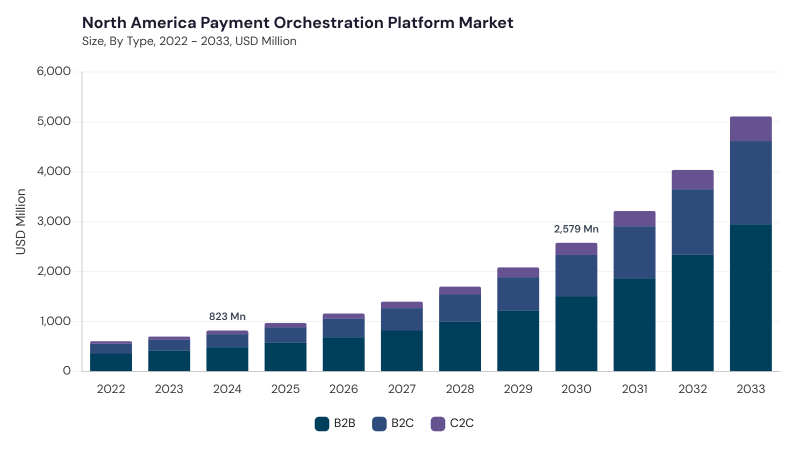
The North America Payment Orchestration Platform Market originated from the growing complexity of digital payment ecosystems, where merchants needed a unified layer to manage multiple gateways, acquirers, processors, and alternative payment methods. Early platforms focused on aggregating payment channels to simplify transaction routing and reconciliation, while later advancements added rule-based routing, fraud mitigation, analytics, real-time monitoring, multi-currency processing, and compliance support. The market has since evolved from basic gateway aggregation into a sophisticated orchestration layer that improves payment success rates, operational agility, and customer experience.
Current market growth is shaped by real-time payments, AI-driven routing, fraud prevention, regulatory compliance, and omnichannel commerce. Platforms are increasingly using machine learning to optimize payment paths, reduce transaction failures, detect fraud, and improve approval rates. At the same time, merchants are prioritizing tokenization, encryption, identity verification, unified dashboards, cross-border payment support, and modular API-first architectures as payment ecosystems become more complex, regulated, and customer-experience driven.
Based on Type, the market is segmented into B2B, B2C, and C2C. The B2B market dominated the North America Payment Orchestration Platform Market by Type in 2025, and would continue to be a dominant market till 2033; thereby, achieving a market value of USD 2.3 billion by 2032, growing at a CAGR of 23.2 % during the forecast period. The B2C market is expected to witness a CAGR of 24% during (2026 - 2033). The C2C market is expected to witness a CAGR of 24.5% during (2026 - 2033).
B2B remains central as enterprises use orchestration platforms to connect processors and acquirers, automate routing, optimize transaction costs, improve treasury visibility, consolidate reporting, and simplify reconciliation across business units and geographies. B2C maintains a substantial presence through e-commerce, retail, subscription services, travel, entertainment, and omnichannel merchants that require flexible checkout, wallet support, alternative payment options, and higher authorization performance. C2C holds a smaller but developing role as marketplaces, creator platforms, gig-economy networks, peer-to-peer payment applications, and resale platforms require payout management, refunds, payment-method support, and processor connectivity.
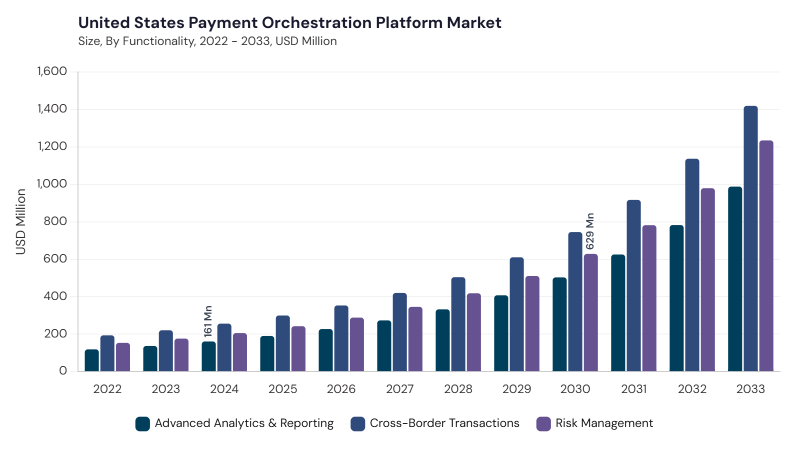
Based on Functionality, the market is segmented into Cross-Border Transactions, Risk Management, and Advanced Analytics & Reporting. Cross-Border Transactions remain important as merchants use orchestration platforms to manage multi-currency payments, local payment methods, dynamic currency conversion, regulatory compliance, settlement, and reconciliation across international commerce flows.
Risk Management maintains a substantial role through fraud detection, authentication, chargeback mitigation, real-time risk scoring, device fingerprinting, behavioral analytics, and third-party fraud tool integration. Advanced Analytics & Reporting holds a smaller but growing position as merchants seek dashboards, payment-performance visibility, transaction intelligence, authorization-rate tracking, failure analysis, predictive analytics, and automated reporting to optimize payment strategies.
Based on End-use, the market is segmented into BFSI, E-commerce, Travel & Hospitality, Healthcare, and Other End-use. BFSI relies on orchestration platforms to connect multiple payment rails, improve transaction reliability, strengthen compliance, manage fraud risk, and support real-time payment modernization. E-commerce holds a substantial position as online retailers, marketplaces, and subscription businesses use orchestration to support wallets, BNPL, multi-currency checkout, fraud controls, and higher payment acceptance.
Travel & Hospitality maintains a considerable presence due to booking complexity, refunds, chargebacks, multi-currency transactions, and international customer payment preferences. Healthcare adoption is supported by patient payments, billing workflows, co-pays, deductibles, refunds, EHR integration, and secure compliant payment handling. Other End-use includes education, utilities, government services, non-profits, digital services, and other sectors adopting centralized payment infrastructure for collections, reporting, reconciliation, and secure transaction processing.
Free Valuable Insights: The Global Payment Orchestration Platform Market will hit USD 14.9 Billion billion by 2033, at a CAGR of 24.2%
Based on Country, the market is segmented into US, Canada, Mexico, and Rest of North America. The US market dominated the North America Payment Orchestration Platform Market by Country in 2025, and would continue to be a dominant market till 2033; thereby, achieving a market value of USD 2.8 billion by 2032, growing at a CAGR of 22.7 % during the forecast period. The Canada market is expected to witness a CAGR of 26.1% during (2026 - 2033). Additionally, The Mexico market is expected to witness a CAGR of 24.9% during (2026 - 2033).
The US is driven by omnichannel payment acceptance, AI-powered routing, embedded fraud prevention, regulatory compliance, and modular API-based platforms, while Canada is supported by real-time payments, AI-led risk management, omnichannel integration, open banking readiness, and compliance-sensitive orchestration. Mexico is shaped by fraud prevention, multi-currency and cross-border payments, Open Banking APIs, SPEI instant transfers, OXXO cash payments, and local fintech partnerships, whereas Rest of North America reflects AI-driven fraud management, cross-border and multi-currency transactions, real-time payments, scalable APIs, tokenization, and payment security.
By Country
Set to reach $4.0 Billion by 2032, growing at 23.6% CAGR during 2026-2033.
The US leads with $2.8 billion by 2032, growing at 22.7% CAGR during 2026-2033.
Rising enterprise cloud adoption and AI-driven workloads are the main catalysts.
B2B segment to reach $2.3 billion by 2032, growing at 23.2% CAGR during 2026-2033.
Canada market is expected to witness a CAGR of 26.1% during 2026-2033.
C2C segment is expected to witness a CAGR of 24.5% during 2026-2033.
Our team of dedicated experts can provide you with attractive expansion opportunities for your business.



 Unique Offerings
