
The LAMEA Payment Orchestration Platform Market is expected to reach USD 410.3 million by 2029, growing at a CAGR of 25.9% during (2026 - 2033).
The LAMEA Payment Orchestration Platform Market originated from the need to streamline fragmented payment processes across Latin America, the Middle East, and Africa. Early systems focused on basic routing and consolidation of payment channels, while later advancements in API integration, tokenization, real-time analytics, fraud mitigation, and multi-currency settlement helped platforms evolve into intelligent orchestration ecosystems. The market has since moved from simple aggregation tools to scalable platforms that support cross-border payments, omnichannel transactions, regulatory compliance, and localized payment preferences.
Current market growth is shaped by localized payment methods, regulatory compliance, AI-driven analytics, open banking, interoperability, and regional fintech development. Businesses are increasingly adopting orchestration platforms to support mobile wallets, bank transfers, local payment schemes, real-time monitoring, secure authentication, and fraud prevention. Demand is also rising for cloud-native and SaaS-based platforms that reduce upfront complexity, improve scalability, support faster deployment, and help merchants operate across diverse LAMEA payment environments.
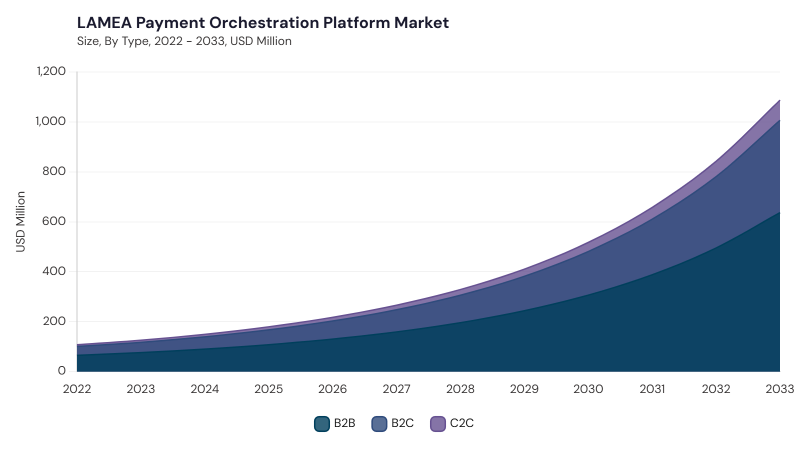
Based on Type, the market is segmented into B2B, B2C, and C2C. The B2B market dominated the LAMEA Payment Orchestration Platform Market by Type in 2025, and would continue to be a dominant market till 2033; thereby, achieving a market value of USD 243.6 million by 2029, growing at a CAGR of 25.4 % during the forecast period. The B2C market is expected to witness a CAGR of 26.3% during (2026 - 2033). The C2C market is expected to witness a CAGR of 27.4% during (2026 - 2033).
B2B remains central as enterprises use orchestration platforms to consolidate banking connections, automate supplier settlements, manage multi-currency transactions, simplify reconciliation, and connect regional and global payment providers. B2C maintains a substantial position as online retail, app-based services, mobile payments, digital subscriptions, wallets, local payment methods, and omnichannel commerce expand across consumer markets. C2C holds a smaller but promising role through peer-to-peer transfers, social commerce, remittance-linked platforms, mobile wallets, gig-economy applications, refunds, payouts, and cross-border transaction connectivity.
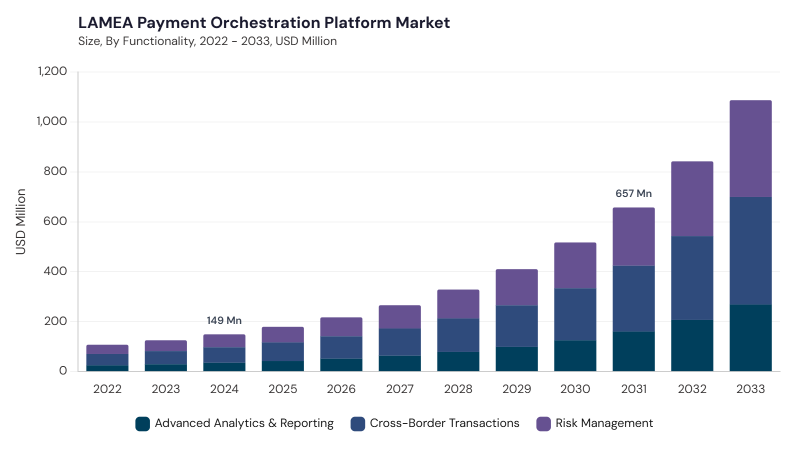
Based on Functionality, the market is segmented into Cross-Border Transactions, Risk Management, and Advanced Analytics & Reporting. Cross-Border Transactions remain important as merchants use orchestration platforms to manage currency conversion, local acquirers, international processors, alternative payment methods, settlement complexity, and compliance across different jurisdictions.
Risk Management maintains a substantial role through fraud detection, identity verification, transaction monitoring, chargeback management, authentication, AI-driven risk scoring, and regulatory compliance. Advanced Analytics & Reporting holds a smaller but growing position as enterprises use dashboards, transaction intelligence, processor performance analysis, failed-transaction tracking, predictive analytics, and reporting tools to improve routing and operational efficiency.
Based on End-use, the market is segmented into BFSI, E-commerce, Travel & Hospitality, Healthcare, and Other End-use. BFSI relies on orchestration platforms for secure payment processing, digital banking, mobile wallets, cross-border transfers, regulatory compliance, fraud controls, interbank settlement, and multi-channel transaction management. E-commerce holds a substantial position as online marketplaces, social commerce, digital wallets, mobile commerce, local payment schemes, and scalable checkout systems become more important.
Travel & Hospitality maintains a considerable presence due to tourism, international bookings, multicurrency payments, refunds, loyalty-linked payments, and multi-party settlements. Healthcare adoption is supported by digital billing, patient co-payments, insurance reimbursements, online appointment payments, and secure payment reconciliation. Other End-use includes telecommunications, education, utilities, entertainment, mobility, professional services, and public-sector collections requiring digital payment modernization.
Free Valuable Insights: Payment Orchestration Platform Market Size Worth USD 14.9 Billion billion by 2033
Based on Country, the market is segmented into Brazil, Argentina, UAE, Saudi Arabia, South Africa, Nigeria, and Rest of LAMEA. The Brazil market dominated the LAMEA Payment Orchestration Platform Market by Country in 2025, and would continue to be a dominant market till 2033; thereby, achieving a market value of USD 104.7 million by 2029, growing at a CAGR of 24.3 % during the forecast period. The Argentina market is expected to witness a CAGR of 27.2% during (2026 - 2033). Additionally, The UAE market is expected to witness a CAGR of 24.7% during (2026 - 2033).
Brazil is supported by PIX, credit card installments, digital wallets, boleto bancário, AI routing, and localized payment integration, while Argentina is shaped by omnichannel payments, local wallets, installment financing, embedded finance, and compliance-led orchestration. The UAE reflects omnichannel payment solutions, KYC and AML compliance, data encryption, AI-driven risk management, and localized payment preferences, whereas Saudi Arabia is driven by SAMA-led regulation, cashless payment initiatives, omnichannel acceptance, open banking-like APIs, and Arabic-localized payment solutions. South Africa is advancing through mobile wallets, instant EFT, regulatory security, AI routing, and omnichannel payments; Nigeria is supported by unified payment operations, mobile money, pan-African payment networks, API-based orchestration, and cross-border capabilities; and Rest of LAMEA is shaped by localized payment methods, cloud-native orchestration, AI fraud detection, compliance frameworks, and regional payment ecosystem integration.
By Country
Set to reach $410.3 Million by 2029, growing at 25.9% CAGR during 2026-2033.
Brazil leads with $104.7 million by 2029, growing at a CAGR of 24.3% during 2026-2033.
Rising demand in B2B transactions, reaching $243.6 million by 2029 at 25.4% CAGR during 2026-2033.
The B2C segment is expected to grow at a CAGR of 26.3% during 2026-2033.
The UAE market is expected to witness a CAGR of 24.7% during 2026-2033.
The C2C segment is expected to grow at a CAGR of 27.4% during 2026-2033.
Our team of dedicated experts can provide you with attractive expansion opportunities for your business.



 Unique Offerings
