
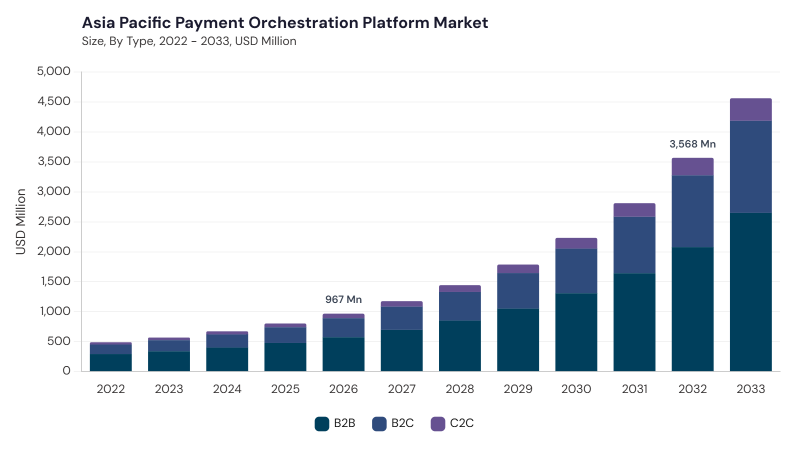
The Asia Pacific Payment Orchestration Platform Market is expected to reach USD 2231.9 million by 2030, growing at a CAGR of 24.8% during (2026 - 2033).
The Asia Pacific Payment Orchestration Platform Market originated from the increasing complexity of digital payments, rapid e-commerce expansion, and the growing use of multiple payment methods and providers across the region. Early adoption focused on simplifying payment gateway integrations and streamlining transaction flows for online merchants, while later advancements in cloud computing, API-driven architectures, AI analytics, real-time routing, fraud detection, and compliance features expanded platform capabilities. The market has since evolved from fragmented payment integration into a unified orchestration layer that improves payment transparency, merchant control, transaction success, and secure multi-channel payment handling.
Current market growth is shaped by cross-border payments, multi-currency processing, AI-based fraud prevention, regulatory compliance, real-time payment systems, and omnichannel payment experiences. Businesses are increasingly using orchestration platforms to manage local payment methods, digital wallets, QR-based payments, real-time payment rails, settlement complexity, and regulatory diversity across China, India, Japan, Southeast Asia, and other regional markets. Demand is also rising for scalable, cloud-native, API-driven platforms that support localized checkout, secure authentication, intelligent routing, and advanced analytics across highly diverse payment ecosystems.
Based on Type, the market is segmented into B2B, B2C, and C2C. The B2B market dominated the Asia Pacific Payment Orchestration Platform Market by Type in 2025, and would continue to be a dominant market till 2033; thereby, achieving a market value of USD 1308.2 million by 2030, growing at a CAGR of 24.4 % during the forecast period. The B2C market is expected to witness a CAGR of 25.2% during (2026 - 2033). The C2C market is expected to witness a CAGR of 25.9% during (2026 - 2033).
B2B remains central as enterprises use orchestration platforms to manage multiple currencies, banks, payment systems, payment-provider relationships, routing, reconciliation, and transaction visibility across regional and cross-border commercial flows. B2C maintains a substantial position due to mobile commerce, digital marketplaces, super-app ecosystems, wallets, QR-based transactions, real-time payments, and the need to localize checkout experiences across different countries. C2C holds a smaller but growing role across online marketplaces, social commerce, gig platforms, peer-to-peer payments, mobile wallets, refunds, seller settlements, and app-based commerce.
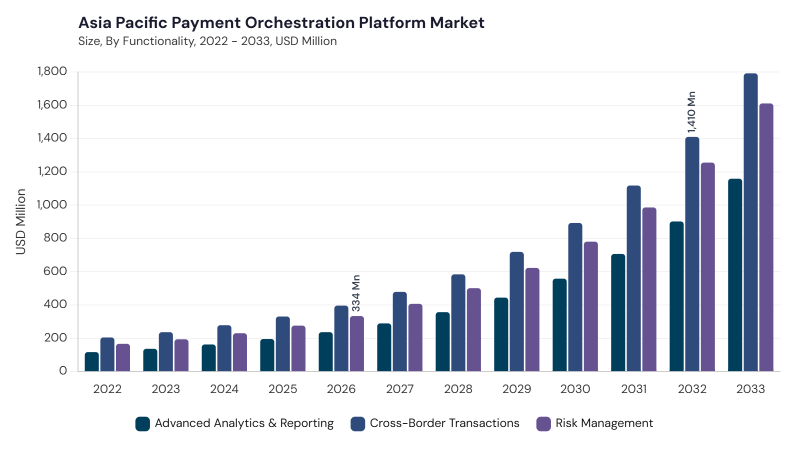
Based on Functionality, the market is segmented into Cross-Border Transactions, Risk Management, and Advanced Analytics & Reporting. Cross-Border Transactions remain important as merchants use orchestration platforms to manage currencies, local payment methods, settlement complexity, foreign exchange, compliance, routing, and international checkout preferences across fragmented markets.
Risk Management maintains a substantial role through fraud detection, AML compliance, chargeback management, transaction monitoring, AI-driven threat detection, behavioral analytics, and real-time scoring. Advanced Analytics & Reporting holds a smaller but growing position as merchants use dashboards, payment-performance reporting, processor analysis, predictive insights, anomaly detection, refund tracking, and chargeback visibility to optimize payment operations.
Based on End-use, the market is segmented into BFSI, E-commerce, Travel & Hospitality, Healthcare, and Other End-use. BFSI relies on orchestration platforms to integrate payment gateways, settlements, fraud controls, regulatory compliance, real-time payments, open banking APIs, and high-volume digital transaction systems. E-commerce holds a substantial position as online retailers, marketplaces, mobile-commerce platforms, and cross-border merchants require local payment methods, wallets, BNPL, QR payments, dynamic routing, and higher checkout success.
Travel & Hospitality maintains a considerable presence due to international bookings, refunds, chargebacks, multiple currencies, tax rules, and cross-border settlement needs. Healthcare adoption is supported by hospital billing, patient co-payments, insurance claims, digital health platforms, secure routing, and payment integration with healthcare systems. Other End-use includes education, utilities, gaming, telecommunications, digital content, mobility, government, and digital entertainment sectors requiring multi-channel payments, recurring billing, automated invoicing, and customer-friendly payment options.
Free Valuable Insights: Payment Orchestration Platform Market is Predicted to reach USD 14.9 Billion billion by 2033, at a CAGR of 24.2%
Based on Country, the market is segmented into China, Japan, India, South Korea, Singapore, Malaysia, and Rest of Asia Pacific. The China market dominated the Asia Pacific Payment Orchestration Platform Market by Country in 2025, and would continue to be a dominant market till 2033; thereby, achieving a market value of USD 623.7 million by 2030, growing at a CAGR of 22.6 % during the forecast period. The Japan market is expected to witness a CAGR of 23.8% during (2026 - 2033). Additionally, The India market is expected to witness a CAGR of 25.6% during (2026 - 2033).
China is shaped by Alipay and WeChat Pay integration, AI routing, fraud detection, compliance, and cross-border payment orchestration, while Japan reflects omnichannel acceptance, mobile wallets, cross-border optimization, tokenization, and konbini or carrier billing support. India is driven by UPI, open banking, mobile commerce, digital wallets, AI-based security, and real-time payment flows. South Korea is supported by mobile payments, contactless transactions, QR payments, compliance automation, and cross-border commerce, whereas Singapore is influenced by AI-led orchestration, multi-currency payments, local and regional payment methods, cloud-native infrastructure, and strong compliance features. Malaysia is progressing through DuitNow, real-time payments, AI fraud prevention, omnichannel orchestration, and localized bank partnerships, while Rest of Asia Pacific is shaped by QR payments, e-wallets, localized alternative payment methods, cross-border e-commerce, compliance tools, and adaptive API-based orchestration.
By Country
Set to reach $2231.9 Million by 2030, growing at 24.8% CAGR during 2026-2033.
China leads with a market value of USD 623.7 million by 2030, growing at a 22.6% CAGR during the forecast period.
Rising enterprise cloud adoption and AI-driven workloads are the main catalysts.
B2B segment reaches USD 1308.2 million by 2030, growing at a 24.4% CAGR during the forecast period.
India market is expected to witness a CAGR of 25.6% during 2026-2033.
B2C segment is expected to witness a CAGR of 25.2% during 2026-2033.
Our team of dedicated experts can provide you with attractive expansion opportunities for your business.



 Unique Offerings
