The sample copy of this report is available for access.
The North America Maternity Innerwear Market is expected to reach USD 3.4 billion by 2032, growing at a CAGR of 5.6% during (2026 - 2033).
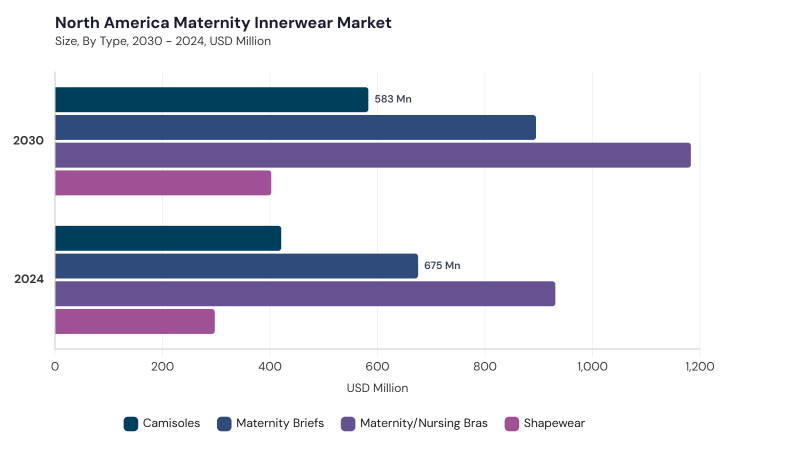
The North America Maternity Innerwear Market evolved from basic pregnancy undergarments focused primarily on loose fits and cotton-based comfort into specialized products addressing support, body adaptability, hygiene, and aesthetics. Advances in stretchable textiles, seamless knitting, moisture-wicking materials, adjustable constructions, and ergonomic designs improved garment performance across pregnancy and postpartum stages. Growing awareness of maternal wellness, body positivity, and specialized apparel needs further expanded consumer acceptance. Current development increasingly emphasizes hypoallergenic fabrics, sustainable materials, multifunctional designs, inclusive sizing, digital fitting technologies, and intelligent textiles capable of enhancing comfort and supporting maternal health-oriented applications.
Sustainable fabrics, adaptive designs, smart textiles, personalization, and maternal wellness are shaping current market development. Manufacturers are increasingly incorporating organic cotton, bamboo fibers, moisture-management materials, antimicrobial treatments, seamless construction, temperature-regulating fabrics, and adjustable support features to improve comfort and usability. Digital shopping tools, virtual fitting, AI-supported sizing, and personalized recommendations are strengthening the purchasing experience, while smart textile integration is opening opportunities for non-invasive health monitoring. At the same time, high production costs, sizing complexity, regulatory and safety requirements, supply chain challenges, affordability concerns, and limited awareness of specialized maternity innerwear continue to influence broader market adoption.
Based on Distribution Channel, the market is segmented into Offline and Online. The Offline market dominated the North America Maternity Innerwear Market by Distribution Channel in 2025, and would continue to be a dominant market till 2033; thereby, achieving a market value of USD 2.0 billion by 2032, growing at a CAGR of 5.2 % during the forecast period. The Online market is expected to witness a CAGR of 6.2% during (2026 - 2033).
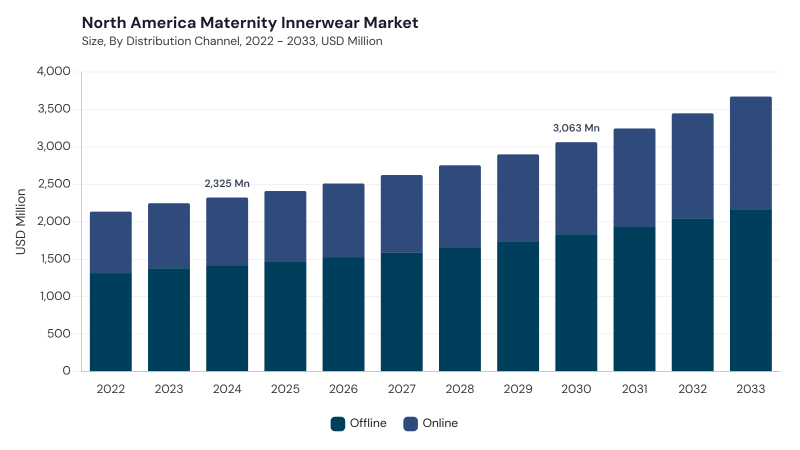
Offline distribution includes department stores, maternity boutiques, lingerie stores, and large retail chains where expectant mothers can physically assess garments, receive fitting assistance, and access maternity-specific product ranges. Personalized service and immediate product availability remain important advantages, particularly for consumers experiencing rapid body changes during pregnancy. Online channels are gaining importance through broader product assortments, discreet purchasing, home delivery, virtual fitting tools, customer reviews, AI-driven recommendations, and mobile commerce. Digital platforms also enable specialized brands to reach consumers beyond conventional retail locations while supporting personalized engagement and easier access to inclusive sizing.
Based on Type, the market is segmented into Maternity/Nursing Bras, Maternity Briefs, Camisoles, and Shapewear. Maternity/Nursing Bras incorporate adjustable straps, flexible support, breathable fabrics, nursing access, and changing-size accommodation to address pregnancy and breastfeeding requirements. Maternity Briefs emphasize stretchable waistbands, abdominal comfort, breathable materials, gentle support, and extended use into postpartum recovery.
Camisoles offer multifunctional use as undergarments, layering pieces, nursing tops, and comfortable everyday apparel, supported by stretchable and moisture-managing fabrics. Shapewear provides targeted abdominal, lower-back, and postpartum support through gentle compression and adaptive construction, while advances in seamless textiles, ergonomic design, and breathable materials are improving comfort across all product categories.
Free Valuable Insights: The Global Maternity Innerwear Market will hit USD 12.8 Billion billion by 2033, at a CAGR of 6.2%
Based on Country, the market is segmented into US, Canada, Mexico, and Rest of North America. The US market dominated the North America Maternity Innerwear Market by Country in 2025, and would continue to be a dominant market till 2033; thereby, achieving a market value of USD 2.5 billion by 2032, growing at a CAGR of 4.9 % during the forecast period. The Canada market is expected to witness a CAGR of 8% during (2026 - 2033). Additionally, The Mexico market is expected to witness a CAGR of 6.9% during (2026 - 2033).
Across North America, maternity innerwear adoption is being shaped by sustainable materials, adaptive sizing, digital retail, smart textiles, and growing emphasis on maternal comfort and wellness. The US focuses on seamless and adaptive construction, sustainable and hypoallergenic fabrics, health-monitoring textiles, advanced moisture management, and multifunctional maternity products, while Canada emphasizes eco-friendly materials, AI-driven fitting, smart textile applications, ergonomic support, and localized product assortments. Mexico is advancing sustainable fabrics, temperature-regulating and supportive textiles, social commerce, culturally aligned designs, and broader digital distribution, whereas Rest of North America increasingly emphasizes hypoallergenic materials, smart fabrics, convertible maternity-to-postpartum designs, sustainable sourcing, and digitally enabled consumer engagement.

By Distribution Channel
By Type
By Country
Set to reach $3.4 Billion by 2032, growing at 5.6% CAGR during 2026-2033.
The US leads with $2.5 billion by 2032, growing at a 4.9% CAGR during the forecast period.
Offline distribution dominates, reaching $2.0 billion by 2032 with a 5.2% CAGR during 2026-2033.
The online market is expected to witness a 6.2% CAGR during 2026-2033.
The Canada market is expected to witness an 8% CAGR during 2026-2033.
The Mexico market is expected to witness a 6.9% CAGR during 2026-2033.
Our team of dedicated experts can provide you with attractive expansion opportunities for your business.




 Unique Offerings