The sample copy of this report is available for access.
The Asia Pacific Maternity Innerwear Market is expected to reach USD 4.1 billion by 2030, growing at a CAGR of 6.6% during (2026 - 2033).
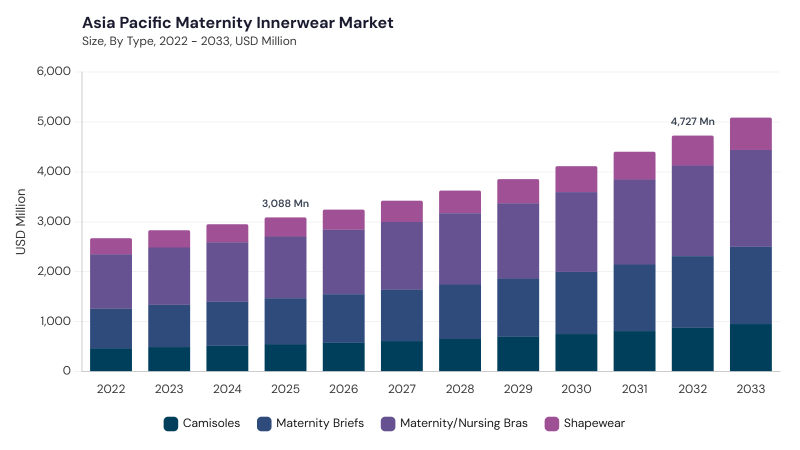
The Asia Pacific Maternity Innerwear Market evolved from basic cotton-based garments designed primarily for comfort and accommodation during pregnancy into specialized apparel addressing support, hygiene, fit, and postpartum functionality. Advances in stretchable, breathable, moisture-wicking, and skin-friendly textiles improved product performance, while ergonomic construction and adjustable features enabled garments to adapt across different stages of pregnancy and nursing. Rising urbanization, disposable incomes, and maternal health awareness further expanded category acceptance. Current development increasingly emphasizes sustainable materials, multifunctional designs, inclusive sizing, digital personalization, advanced textile technologies, and culturally adapted products suited to diverse climates and consumer preferences across the region.
Sustainable fabrics, digital commerce, inclusive sizing, smart textiles, and maternal wellness are shaping current market development. Manufacturers are increasingly using organic cotton, bamboo blends, recycled fibers, seamless knitting, antimicrobial treatments, moisture-management materials, and adaptive support technologies to improve comfort and usability. E-commerce, social commerce, AI-driven recommendations, virtual fitting tools, and direct-to-consumer platforms are strengthening accessibility across metropolitan and emerging urban markets. Localization of sizing, climate-specific fabrics, and culturally relevant designs is also gaining importance. At the same time, high production costs, fragmented regulatory requirements, price sensitivity, limited awareness, and cultural barriers continue to influence adoption across several Asia Pacific economies.
Based on Distribution Channel, the market is segmented into Offline and Online. The Offline market dominated the Asia Pacific Maternity Innerwear Market by Distribution Channel in 2025, and would continue to be a dominant market till 2033; thereby, achieving a market value of USD 2.4 billion by 2030, growing at a CAGR of 6.2 % during the forecast period. The Online market is expected to witness a CAGR of 7.3% during (2026 - 2033).
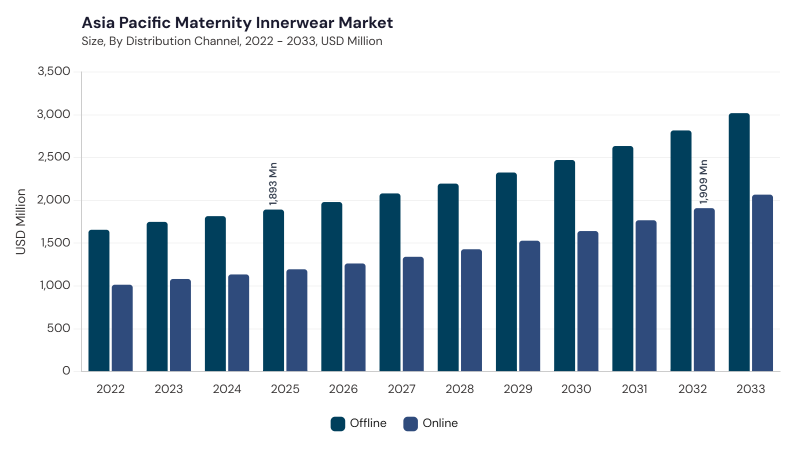
Offline channels include maternity boutiques, department stores, supermarkets, pharmacies, and large retail chains that provide fitting assistance, immediate product access, and direct assessment of fabric quality and garment construction. These outlets remain particularly relevant where online purchasing confidence or digital penetration is comparatively lower. Online channels are expanding rapidly through e-commerce platforms, branded websites, social commerce, and mobile applications, offering broader product assortments, discreet purchasing, home delivery, reviews, and personalized recommendations. Virtual fitting, flexible returns, digital promotions, and improved logistics are further strengthening online adoption among younger and urban maternity consumers.
Based on Type, the market is segmented into Maternity/Nursing Bras, Maternity Briefs, Camisoles, and Shapewear. Maternity/Nursing Bras provide adaptable support, adjustable straps, nursing access, soft fabrics, breathable construction, and sizing flexibility across pregnancy and breastfeeding stages. Maternity Briefs emphasize stretchable waistbands, breathable materials, lower-abdominal comfort, hygiene, and non-restrictive construction for daily use.
Camisoles offer multifunctional applications across pregnancy, nursing, sleepwear, and loungewear through stretchable fabrics, built-in support, and layering flexibility. Shapewear serves a more specialized role in postpartum support, abdominal stabilization, and gentle body contouring, while advances in seamless, hypoallergenic, and breathable materials are improving comfort and acceptance across all product categories.
Free Valuable Insights: Maternity Innerwear Market is Predicted to reach USD 12.8 Billion billion by 2033, at a CAGR of 6.2%
Based on Country, the market is segmented into China, Japan, India, South Korea, Singapore, Malaysia, and Rest of Asia Pacific. The China market dominated the Asia Pacific Maternity Innerwear Market by Country in 2025, and would continue to be a dominant market till 2033; thereby, achieving a market value of USD 1.1 billion by 2030, growing at a CAGR of 4.7 % during the forecast period. The Japan market is expected to witness a CAGR of 5.8% during (2026 - 2033). Additionally, The India market is expected to witness a CAGR of 7.2% during (2026 - 2033).
Across Asia Pacific, maternity innerwear adoption is being shaped by sustainability, ergonomic comfort, digital retail, inclusive sizing, and culturally adapted product development. China emphasizes sustainable textiles, e-commerce, ergonomic design, multifunctionality, and localized sizing, while Japan focuses on seamless construction, smart textiles, maternal wellness, eco-friendly materials, and high-quality ergonomic products. India is advancing organic fabrics, direct-to-consumer models, multifunctional designs, nursing convenience, and localized distribution, whereas South Korea emphasizes body positivity, sustainable textiles, digital fitting, adaptive sizing, and advanced fabric technologies. Singapore focuses on sustainable materials, inclusive sizing, virtual fitting, tropical-climate designs, and maternity-specific functional innovation, while Malaysia emphasizes natural fabrics, digital personalization, adaptive support, localization, and maternal wellness positioning. Rest of Asia Pacific continues to develop sustainable materials, smart textile functionality, personalized sizing, culturally aligned designs, and advanced manufacturing technologies suited to varied regional preferences.

By Distribution Channel
By Type
By Country
Set to reach $4.1 Billion by 2030, growing at 6.6% CAGR during 2026-2033.
China leads with a market value of $1.1 billion by 2030, growing at a 4.7% CAGR during the forecast period.
The Offline distribution channel dominates, reaching $2.4 billion by 2030, with a 6.2% CAGR during 2026-2033.
The Online segment is expected to witness a 7.3% CAGR during 2026-2033.
Japan is expected to witness a CAGR of 5.8% during 2026-2033.
India is expected to witness a CAGR of 7.2% during 2026-2033.
Our team of dedicated experts can provide you with attractive expansion opportunities for your business.




 Unique Offerings