The sample copy of this report is available for access.
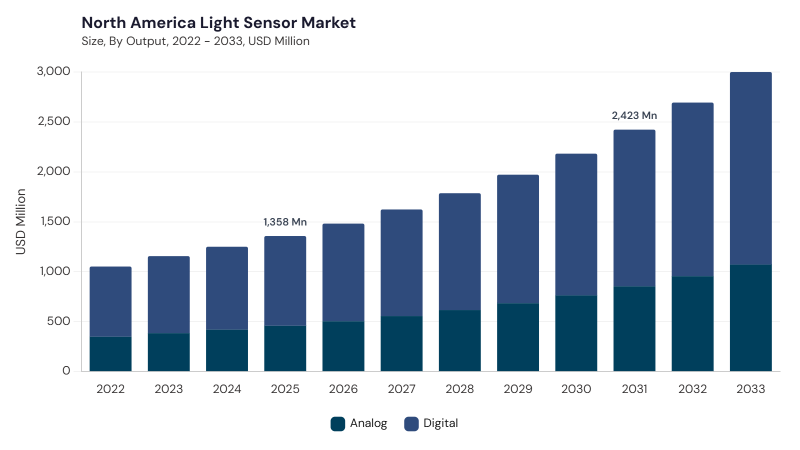
The North America Light Sensor Market is expected to reach USD 2693.9 million by 2032, growing at a CAGR of 10.6% during (2026 - 2033).
The North America Light Sensor Market evolved from basic photodiodes and phototransistors used for ambient light detection into highly integrated sensing solutions supporting intelligent electronic systems. Advances in semiconductor fabrication, MEMS, CMOS technologies, miniaturization, and digital processing progressively improved sensitivity, response time, energy efficiency, and integration capabilities. Expansion of smartphones, automotive electronics, industrial automation, smart homes, and IoT infrastructure further broadened adoption across multiple applications. Current development increasingly combines advanced materials, sensor fusion, embedded intelligence, SoC integration, AI-enabled processing, and application-specific designs suited to autonomous mobility, smart infrastructure, precision agriculture, and connected devices.
IoT expansion, autonomous mobility, smart building automation, precision agriculture, and energy-efficient consumer electronics are shaping current market development. Manufacturers are increasingly focusing on ultra-low-power architectures, miniaturized sensor designs, intelligent calibration, photonic integration, advanced optical materials, and AI-supported analytics to improve sensing accuracy and contextual awareness. Demand is also rising for sensors capable of maintaining reliable performance across variable lighting, harsh weather, temperature extremes, and industrial environments. At the same time, high manufacturing costs, specialized material requirements, integration complexity, interoperability limitations, regulatory compliance, environmental interference, and demanding reliability standards continue to influence product development and adoption across North America.
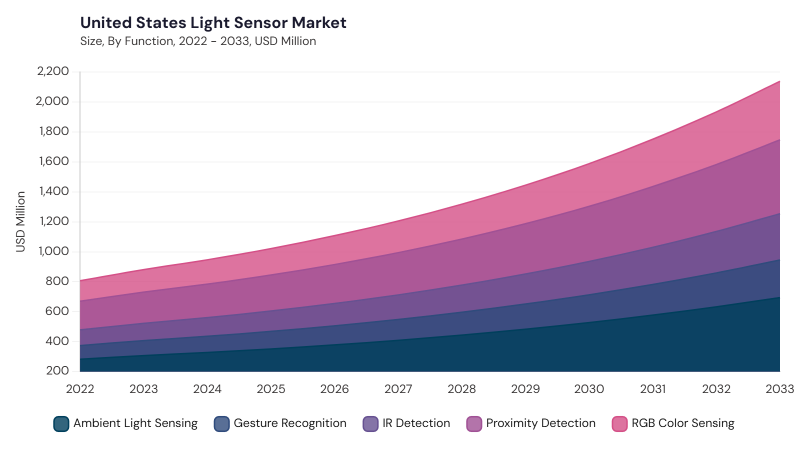
Based on Function, the market is segmented into Ambient Light Sensing, Proximity Detection, RGB Color Sensing, IR Detection, and Gesture Recognition. The Ambient Light Sensing market dominated the North America Light Sensor Market by Function in 2025, and would continue to be a dominant market till 2033; thereby, achieving a market value of USD 882.8 million by 2032, growing at a CAGR of 9.8 % during the forecast period. The Proximity Detection market is expected to witness a CAGR of 10.3% during (2026 - 2033). The Gesture Recognition market is expected to witness a CAGR of 10.9% during (2026 - 2033).
Ambient Light Sensing enables automatic adjustment of displays and lighting systems based on surrounding illumination, improving user comfort and energy efficiency. Proximity Detection supports touchless interfaces, object presence sensing, automotive safety, and industrial automation, while RGB Color Sensing facilitates display calibration, imaging, color detection, and quality-control applications. IR Detection remains important for security, automation, night vision, occupancy monitoring, and environmental sensing. Gesture Recognition represents a more specialized function, enabling contactless human-machine interaction across smart devices, automotive infotainment, AR/VR systems, and connected interfaces.
Based on Output, the market is segmented into Digital and Analog. The Digital market dominated the North America Light Sensor Market by Output in 2025, and would continue to be a dominant market till 2033; thereby, achieving a market value of USD 1738.3 million by 2032, growing at a CAGR of 10.2 % during the forecast period. The Analog market is expected to witness a CAGR of 11.4% during (2026 - 2033).
Digital light sensors provide encoded outputs compatible with modern electronic interfaces, supporting higher noise immunity, advanced processing, IoT connectivity, automation, and intelligent applications across automotive, industrial, consumer, and optical systems. Analog sensors generate continuous signals proportional to detected light intensity and remain relevant where simplicity, lower cost, continuous measurement, and compatibility with established control architectures are prioritized. Although digital solutions are gaining stronger adoption through Industry 4.0, photonic integration, and edge computing, analog output continues to serve conventional industrial, environmental, smart-lighting, and cost-sensitive applications.
Based on Application, the market is segmented into Consumer Electronics, Automotive, Industrial, Healthcare, and Other Application. Consumer Electronics applications emphasize miniaturization, low power consumption, adaptive displays, proximity sensing, and multifunctional integration within compact devices. Automotive applications use light sensors in automatic lighting, infotainment, cabin monitoring, ADAS, LiDAR, and autonomous driving systems requiring high reliability across varying environmental conditions.
Industrial applications support automation, machine vision, safety systems, process monitoring, and smart manufacturing, while Healthcare applications include pulse oximetry, phototherapy, diagnostics, patient monitoring, and wearable medical devices. Other Application includes smart buildings, agriculture, environmental monitoring, security systems, and specialized connected infrastructure requiring adaptable light-sensing capabilities.
Free Valuable Insights: The Global Light Sensor Market will hit USD 10.9 Billion billion by 2033, at a CAGR of 11.3%
Based on Country, the market is segmented into US, Canada, Mexico, and Rest of North America. The US market dominated the North America Light Sensor Market by Country in 2025, and would continue to be a dominant market till 2033; thereby, achieving a market value of USD 1933.5 million by 2032, growing at a CAGR of 9.9 % during the forecast period. The Canada market is expected to witness a CAGR of 12.9% during (2026 - 2033). Additionally, The Mexico market is expected to witness a CAGR of 11.7% during (2026 - 2033).
Across North America, light sensor adoption is being shaped by IoT integration, automotive innovation, industrial automation, energy efficiency, and intelligent sensing technologies. The US emphasizes AI-enabled sensors, ultra-low-power designs, miniaturization, smart infrastructure, autonomous mobility, and advanced environmental monitoring, while Canada focuses on IoT-enabled sensing networks, energy-efficient devices, AI-supported analytics, smart buildings, precision agriculture, and advanced photonic technologies. Mexico is advancing automotive LiDAR, ADAS-related sensing, localized manufacturing, industrial IoT, smart lighting, and energy-efficient infrastructure, supported by its growing electronics and automotive production base. Rest of North America increasingly emphasizes multispectral sensing, AI-enhanced lighting systems, LiDAR, SWIR technologies, data-center monitoring, smart infrastructure, and integrated optical systems adapted to diverse industrial and commercial requirements.

By Function
By Output
By Application
By Country
Set to reach $2693.9 Million by 2032, growing at 10.6% CAGR during 2026-2033.
The US leads with $1933.5 million by 2032, growing at a CAGR of 9.9% during 2026-2033.
Rising adoption of Ambient Light Sensing, reaching $882.8 million by 2032 at 9.8% CAGR during 2026-2033.
Digital segment to reach $1738.3 million by 2032, growing at a CAGR of 10.2% during 2026-2033.
The Canada market is expected to witness a CAGR of 12.9% during 2026-2033.
Gesture Recognition is expected to witness a CAGR of 10.9% during 2026-2033.
Our team of dedicated experts can provide you with attractive expansion opportunities for your business.




 Unique Offerings