The sample copy of this report is available for access.
The LAMEA Light Sensor Market is expected to reach USD 592.9 million by 2029, growing at a CAGR of 13.1% during (2026 - 2033).
The LAMEA Light Sensor Market evolved from basic photoresistor-based light detection toward sophisticated, digitally integrated sensing technologies supporting connected applications. Advances in photodiodes, phototransistors, CMOS, CCD technologies, semiconductor manufacturing, and miniaturization progressively improved sensitivity, response time, precision, and durability. Expansion of consumer electronics, automotive safety systems, industrial automation, smart buildings, and IoT infrastructure further widened adoption across the region. Current development increasingly emphasizes multifunctional sensing, intelligent interfaces, energy-efficient operation, advanced materials, localized designs, and robust technologies capable of performing under diverse climatic and infrastructure conditions.
Smart infrastructure, energy conservation, automotive modernization, IoT connectivity, and localized product development are shaping current market growth. Manufacturers are increasingly focusing on low-power sensors, AI-enabled analytics, wireless connectivity, advanced photonic materials, sensor fusion, adaptive lighting, and enhanced environmental robustness. Demand is expanding across smartphones, smart buildings, automated lighting, ADAS, industrial monitoring, healthcare devices, security systems, agriculture, and environmental applications. However, high implementation costs, fragmented regulations, limited standardization, infrastructure gaps, integration complexity, and performance challenges under extreme heat, humidity, dust, and strong sunlight continue to influence broader market adoption across LAMEA.
Based on Function, the market is segmented into Ambient Light Sensing, Proximity Detection, RGB Color Sensing, IR Detection, and Gesture Recognition. The Ambient Light Sensing market dominated the LAMEA Light Sensor Market by Function in 2025, and would continue to be a dominant market till 2033; thereby, achieving a market value of USD 201.5 million by 2029, growing at a CAGR of 12.3 % during the forecast period. The Proximity Detection market is expected to witness a CAGR of 12.9% during (2026 - 2033). The Gesture Recognition market is expected to witness a CAGR of 13.6% during (2026 - 2033).
Ambient Light Sensing enables automatic brightness control, smart lighting optimization, camera exposure adjustment, and improved energy efficiency across connected devices and buildings. Proximity Detection supports touchless interfaces, mobile electronics, access systems, automotive applications, and industrial safety, while RGB Color Sensing enables accurate color reproduction, imaging, display adjustment, quality control, and selected agricultural applications. IR Detection serves surveillance, security, industrial monitoring, automotive night vision, and healthcare diagnostics. Gesture Recognition remains an emerging function supporting contactless interaction across smart appliances, automotive interfaces, public systems, gaming, and AR/VR environments.
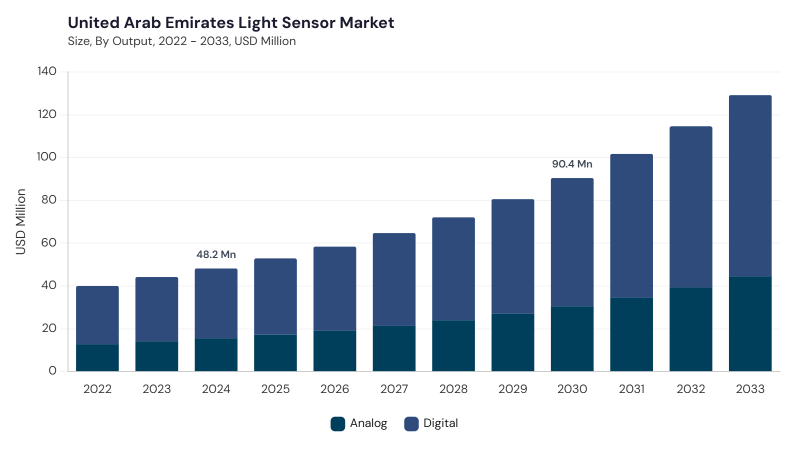
Based on Output, the market is segmented into Digital and Analog. The Digital market dominated the LAMEA Light Sensor Market by Output in 2025, and would continue to be a dominant market till 2033; thereby, achieving a market value of USD 392.5 million by 2029, growing at a CAGR of 12.7 % during the forecast period. The Analog market is expected to witness a CAGR of 14% during (2026 - 2033).
Digital light sensors provide processed outputs suitable for microcontrollers, smart systems, IoT platforms, and applications requiring higher accuracy, programmability, and noise resistance. Their compatibility with protocols such as I2C and SPI strengthens adoption across smart cities, industrial automation, advanced consumer electronics, and environmental monitoring. Analog sensors generate continuous electrical outputs proportional to illumination intensity and remain relevant where cost efficiency, simple circuitry, and legacy compatibility are prioritized. Their affordability and straightforward implementation continue to support use across agriculture, basic automation, infrastructure, and other cost-sensitive environments.
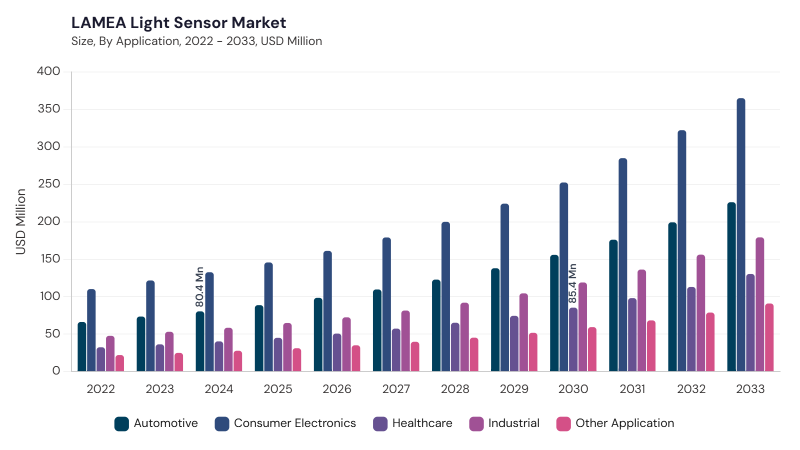
Based on Application, the market is segmented into Consumer Electronics, Automotive, Industrial, Healthcare, and Other Application. Consumer Electronics applications use light sensors for adaptive brightness, proximity sensing, camera optimization, gesture control, and energy-efficient operation. Automotive applications include automatic headlights, cabin lighting, ADAS, collision avoidance, infotainment displays, and connected vehicle systems requiring reliable sensing under variable road conditions.
Industrial applications support automation, machine monitoring, building controls, energy management, safety systems, and smart manufacturing, while Healthcare applications include pulse oximetry, phototherapy, diagnostics, wearable monitoring, and connected-care devices. Other Application covers smart cities, security systems, agriculture, environmental monitoring, and public infrastructure requiring adaptable sensing technologies.
Free Valuable Insights: Light Sensor Market Size Worth USD 10.9 Billion billion by 2033
Based on Country, the market is segmented into Brazil, Argentina, UAE, Saudi Arabia, South Africa, Nigeria, and Rest of LAMEA. The Brazil market dominated the LAMEA Light Sensor Market by Country in 2025, and would continue to be a dominant market till 2033; thereby, achieving a market value of USD 128.2 million by 2029, growing at a CAGR of 11.5 % during the forecast period. The Argentina market is expected to witness a CAGR of 14.5% during (2026 - 2033). Additionally, The UAE market is expected to witness a CAGR of 12% during (2026 - 2033).
Across LAMEA, light sensor adoption is being shaped by IoT integration, smart infrastructure, energy efficiency, automotive modernization, localization, and environmental adaptability. Brazil emphasizes IoT-enabled sensing networks, renewable-energy monitoring, AI-supported analytics, sustainable sensor technologies, and designs adapted to humidity and temperature variability, while Argentina focuses on Industry 4.0, smart buildings, precision agriculture, energy management, and locally customized connected sensors. The UAE is advancing IoT-enabled smart lighting, occupancy sensing, green buildings, smart-city infrastructure, and technologies designed for harsh climatic conditions, whereas Saudi Arabia emphasizes Vision 2030-linked smart cities, IoT sensing, sustainable infrastructure, precision agriculture, and localized technology development. South Africa focuses on AI-powered lighting, IoT sensor networks, edge computing, solar-powered and energy-harvesting solutions, while Nigeria emphasizes smart buildings, connected sensor networks, localized assembly, energy efficiency, and designs adapted to dust and infrastructure constraints. Rest of LAMEA continues to develop IoT-connected sensing, low-power technologies, smart cities, precision agriculture, environmental monitoring, localized sensor designs, and ruggedized solutions tailored to diverse operating environments.

By Function
By Output
By Application
By Country
Set to reach $592.9 Million by 2029, growing at 13.1% CAGR during 2026-2033.
Brazil leads with a market value of USD 128.2 million by 2029, at 11.5% CAGR during the forecast period.
Ambient Light Sensing segment dominates, reaching USD 201.5 million by 2029, growing at 12.3% CAGR during the forecast period.
Digital segment achieves USD 392.5 million by 2029, growing at 12.7% CAGR during the forecast period.
The UAE market is expected to witness a CAGR of 12% during 2026-2033.
Gesture Recognition segment is expected to witness a CAGR of 13.6% during 2026-2033.
Our team of dedicated experts can provide you with attractive expansion opportunities for your business.




 Unique Offerings