The sample copy of this report is available for access.
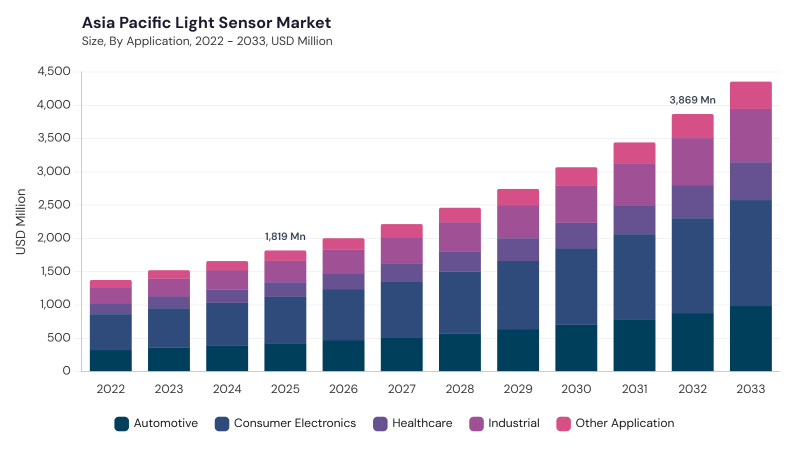
The Asia Pacific Light Sensor Market is expected to reach USD 3.0 billion by 2030, growing at a CAGR of 11.7% during (2026 - 2033).
The Asia Pacific Light Sensor Market evolved from basic photosensitive components used for ambient light detection into advanced, highly integrated sensing technologies supporting complex electronic ecosystems. Progress in semiconductor materials, photodiodes, CMOS technologies, MEMS, and miniaturized fabrication significantly improved sensor sensitivity, precision, power efficiency, and integration capabilities. Expansion of consumer electronics manufacturing, automotive electronics, industrial automation, smart lighting, and IoT infrastructure further accelerated adoption. Current development increasingly emphasizes intelligent sensing, multifunctionality, advanced photonics, AI-enabled processing, connectivity, energy efficiency, and application-specific designs suited to smart cities, autonomous systems, precision agriculture, and connected industrial environments.
Rapid IoT adoption, expanding electronics production, automotive transformation, urbanization, and sustainability requirements are shaping current market development. Manufacturers are increasingly focusing on low-power architectures, miniaturized sensor modules, advanced optical technologies, embedded intelligence, AI-supported calibration, wireless connectivity, and improved environmental resilience. Demand is strengthening across smartphones, smart-home systems, industrial automation, intelligent transportation, EVs, ADAS, healthcare devices, and precision agriculture. However, high capital requirements, cost sensitivity, diverse regulatory standards, integration complexity, infrastructure limitations, and difficulties maintaining sensor accuracy under extreme temperature, humidity, pollution, and dust continue to influence adoption across Asia Pacific.
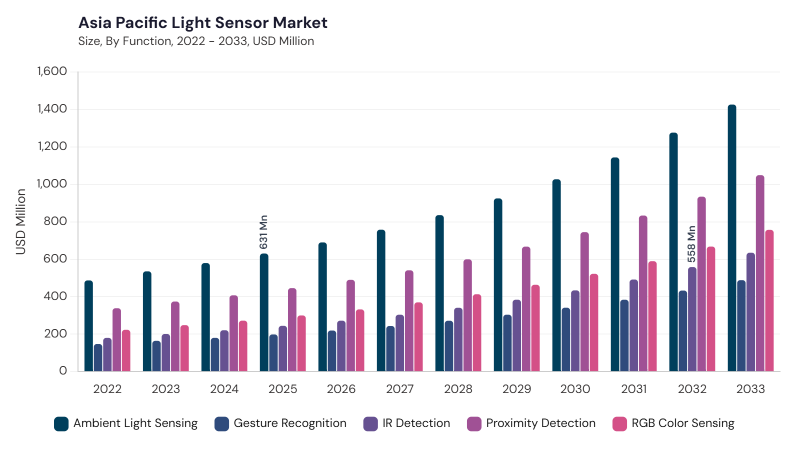
Based on Function, the market is segmented into Ambient Light Sensing, Proximity Detection, RGB Color Sensing, IR Detection, and Gesture Recognition. The Ambient Light Sensing market dominated the Asia Pacific Light Sensor Market by Function in 2025, and would continue to be a dominant market till 2033; thereby, achieving a market value of USD 1.0 billion by 2030, growing at a CAGR of 10.9 % during the forecast period. The Proximity Detection market is expected to witness a CAGR of 11.5% during (2026 - 2033). The Gesture Recognition market is expected to witness a CAGR of 12.1% during (2026 - 2033).
Ambient Light Sensing supports adaptive display brightness, smart lighting, and energy management by measuring surrounding illumination levels. Proximity Detection enables contactless interfaces, device presence sensing, occupant detection, and automated controls across electronics and automotive systems, while RGB Color Sensing supports display calibration, imaging, manufacturing quality control, and precise color measurement. IR Detection remains important in surveillance, automotive monitoring, industrial automation, security, and healthcare applications. Gesture Recognition represents a developing function supporting touch-free control, gaming, automotive infotainment, AR/VR, appliances, and next-generation human-machine interfaces.
Based on Output, the market is segmented into Digital and Analog. The Digital market dominated the Asia Pacific Light Sensor Market by Output in 2025, and would continue to be a dominant market till 2033; thereby, achieving a market value of USD 2.0 billion by 2030, growing at a CAGR of 11.3 % during the forecast period. The Analog market is expected to witness a CAGR of 12.5% during (2026 - 2033).
Digital sensors provide readily processable outputs compatible with microcontrollers, I2C, SPI, automated systems, IoT platforms, and advanced data-processing environments. Their noise resistance, integrated intelligence, and simplified digital connectivity support consumer electronics, industrial automation, automotive systems, and smart infrastructure. Analog sensors generate continuous electrical signals proportional to detected light intensity and remain relevant where simplicity, cost efficiency, rapid response, and compatibility with established circuitry are required. Continued use across basic automation, agriculture, lighting controls, and price-sensitive electronic products preserves the commercial relevance of analog solutions.
Based on Application, the market is segmented into Consumer Electronics, Automotive, Industrial, Healthcare, and Other Application. Consumer Electronics applications emphasize compact design, low power consumption, adaptive displays, proximity sensing, and multifunctional integration. Automotive applications use light sensors for automatic headlights, adaptive lighting, cabin sensing, ADAS, LiDAR, vehicle safety, and connected mobility, with increasing importance from EV and autonomous vehicle development.
Industrial applications support robotics, machine vision, process control, factory automation, and safety monitoring, while Healthcare applications include pulse oximetry, diagnostic equipment, wearable health devices, patient monitoring, and optical sensing. Other Application includes precision agriculture, environmental monitoring, smart lighting, security systems, and smart-city infrastructure requiring durable and adaptable light-sensing technologies.
Free Valuable Insights: Light Sensor Market is Predicted to reach USD 10.9 Billion billion by 2033, at a CAGR of 11.3%
Based on Country, the market is segmented into China, Japan, India, South Korea, Singapore, Malaysia, and Rest of Asia Pacific. The China market dominated the Asia Pacific Light Sensor Market by Country in 2025, and would continue to be a dominant market till 2033; thereby, achieving a market value of USD 1.0 billion by 2030, growing at a CAGR of 10.2 % during the forecast period. The Japan market is expected to witness a CAGR of 10.9% during (2026 - 2033). Additionally, The India market is expected to witness a CAGR of 12.9% during (2026 - 2033).
Across Asia Pacific, light sensor adoption is being shaped by electronics manufacturing, IoT integration, smart infrastructure, automotive digitization, sustainability, AI, and localization. China emphasizes domestic semiconductor development, AI-enabled sensors, smart cities, energy-efficient sensing, localized supply chains, and advanced automotive applications, while Japan focuses on CMOS and VCSEL technologies, compact multifunctional sensors, IoT-enabled smart systems, automotive sensing, and energy-efficient designs. India is advancing IoT- and AI-based sensing, smart cities, precision agriculture, adaptive lighting, localized manufacturing, and cost-efficient sensor integration, whereas South Korea emphasizes smart infrastructure, AI-enabled optical sensing, wearable healthcare devices, automotive safety, and advanced semiconductor capabilities. Singapore focuses on Smart Nation infrastructure, IoT-connected light sensors, energy management, environmental monitoring, wearable applications, and tropical-environment reliability, while Malaysia emphasizes smart cities, adaptive lighting, AI integration, localized manufacturing, industrial automation, and technologies designed for regional climatic conditions. Rest of Asia Pacific continues to develop compact IoT sensors, AI-enabled sensing, precision agriculture, environmental monitoring, smart lighting, and application-specific technologies suited to diverse regional requirements.

By Function
By Output
By Application
By Country
Set to reach $3.0 Billion by 2030, growing at 11.7% CAGR during 2026-2033.
China leads, reaching $1.0 billion by 2030, with a 10.2% CAGR during 2026-2033.
Ambient Light Sensing is a key driver, reaching $1.0 billion by 2030 at a 10.9% CAGR during 2026-2033.
Digital output segment hits $2.0 billion by 2030, growing at 11.3% CAGR during 2026-2033.
India is expected to grow at a 12.9% CAGR during 2026-2033.
Gesture Recognition is expected to grow at a 12.1% CAGR during 2026-2033.
Our team of dedicated experts can provide you with attractive expansion opportunities for your business.




 Unique Offerings